Downfall of a King: Juan Carlos of Spain,
by Paul Preston
(William Collins, £30.00 / €35.50)
Paul Preston is one of the foremost historians of modern Spain. He has written sixteen books about the history of Spain since the late 19th century, most of them describing different aspects of the Civil War. Preston, an Englishman, is a strong defender of Republican Spain, but he has studied both the dictatorship and the monarchy that play central roles in the story.
In 2004, Preston, who has a Catholic background, published Juan Carlos: a People’s King. It was an admiring biography of the man who restored and saved Spanish democracy in the post-Franco era. Ten years later, the king abdicated in disgrace. The book under review tries to discover what went wrong and how a much-esteemed man destroyed his own reputation.
Abolition
Born in Rome in 1938, seven years after the abolition of the Spanish monarchy, Juan Carlos had the peripatetic life of exiled royalty until 1947, when he was sent to Spain for an education under the guidance of Francisco Franco. His father Juan, third son of King Alfonso XIII, had become heir to a throne that was abolished in 1931.
In an atmosphere of tension and insecurity, increased by the savagery of ETA, the Basque terrorist group, Juan Carlos became King of Spain in November 1975”
Life was lonely; there was tragedy in the accidental shooting of his younger brother Alfonso; there were pressures from his father, Juan, who was determined to become king himself and from the Francoist circle, on whom the young prince’s future depended. Spain was officially a monarchy, without an actual monarch.
Life was no easier after Juan Carlos married Sophia of Greece in 1962, because they were spied upon constantly and were surrounded by intrigue, not least on the part of the Franco family, who would have preferred if the Crown went to a cousin who had married the dictator’s granddaughter.
In an atmosphere of tension and insecurity, increased by the savagery of ETA, the Basque terrorist group, Juan Carlos became King of Spain in November 1975. Briefly the only absolute monarch in Europe, the king began to encourage the growth of democracy, whilst reaching out to many opposition political parties, including communists and separatists.
Travelled
The king and queen travelled all over Spain, even when they might not be entirely safe, engaged with vast numbers of people and made the monarchy very accessible.
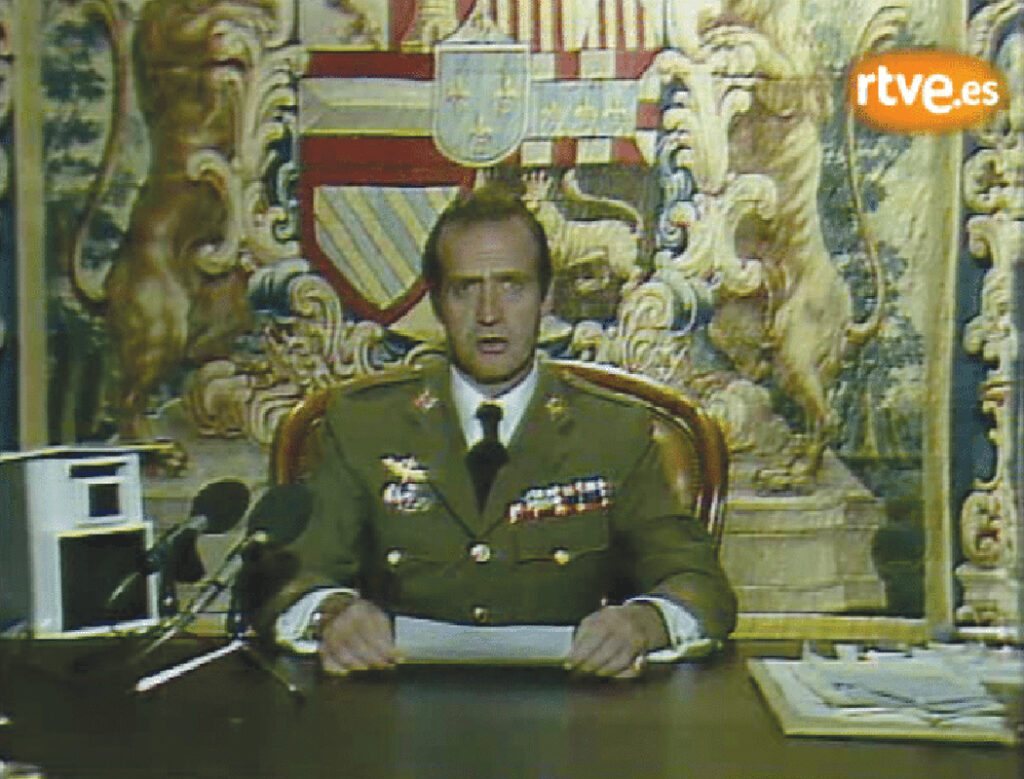
The king’s finest moment came in February 1981, when his broadcast, in the middle of the night, halted a military coup
Preston offers us almost forensic detail in his account of the acceptance of democracy and the gradual reduction in royal power. The king’s finest moment came in February 1981, when his broadcast, in the middle of the night, halted a military coup and ensured the future of Spanish democracy.
It was often rumoured that Juan Carlos was somehow behind the coup, but Preston makes it clear that he suspected only something was afoot and was ready to oppose it.
There was another kind of test in 1982, when the socialists won a general election and began eighteen years in power. Juan Carlos had no difficulty in his collaboration with a party that was fundamentally republican, proving that a constitutional monarchy really was above politics.
Queen Sophia had been a loyal partner and a tireless consort during all the years of tension and insecurity. In 1990, however, she discovered the extent of her husband’s infidelities, and the royal couple began to live separate lives. Juan Carlos became a womaniser on an almost industrial scale, emulating some of his crowned French ancestors. The Spanish press remembered all his constitutional achievements and kept silent.
Money
It was money rather than women that proved to be the undoing of Juan Carlos. Rather than trying to improve his rather distant relationship with his three children, he devoted himself to building up a vast fortune, not least through his contacts with Arab princes.
When womanising and greed combined, the results were disastrous. Not only did the king begin to treat his wife badly, even in public, but he installed one mistress in a hunting lodge near the small palace he shared with the queen. That mistress was delighted, understandably, when the king gave her 64.8 million euro.
She was with Juan Carlos in 2012, when he was severely injured during an elephant-hunting trip to Botswana. The contrast between the royal lifestyle and the struggles of most Spaniards during a recession was so startling that criticism of the king and examination of his finances became unstoppable.
As king, he affirmed his religious faith. His beliefs do not seem to have influenced his private life in any way whatsoever”
Reluctantly, Juan Carlos abdicated in favour of his son Felipe in April 2014. Since then, his life has been one of comfortable, if lonely, exile, whilst Queen Sofia continues to be an active member of the royal family.
When Juan Carlos was a cadet, he rose early for Mass on weekdays. Later, as king, he affirmed his religious faith. His beliefs do not seem to have influenced his private life in any way whatsoever. That aspect of his life is not examined by Paul Preston, who, in common, with many other non-Spanish historians, underestimates the role of the Spanish Church in the transition to democracy.
Will Spain revert to being a Republic? Felipe VI is popular and has distanced himself from his father, even renouncing any future inheritance. His two daughters are being trained as “working royals.”
The Spanish monarchy may survive, because it would be too troublesome to replace it, and there is widespread apathy about the role of the Head of State. It is tragic that Juan Carlos, having been so successful in restoring a Spanish constitutional monarchy, should, by greed and hubris, have harmed it so much.