The final four standing in the race for the Liam McCarthy Cup will lock horns this weekend as the championship reaches its penultimate stage. In truth, hurling desperately needs two high-quality semi-finals to inject some life into what has, for long periods, been a surprisingly underwhelming summer.
For years the Munster Championship has been regarded as the greatest sporting spectacle in Ireland, while the All-Ireland series has traditionally provided the drama to match. Yet this year the hurling championship has struggled to capture the imagination in the way many expected, particularly when compared to a revitalised football championship which has stolen much of the spotlight.
The quarter-finals only reinforced some of the concerns surrounding the current structure of the competition. Cork’s demolition of Offaly by 26 points was every bit as one-sided as the scoreline suggested, while Clare comfortably accounted for Leinster runners-up Dublin. Neither result was particularly surprising, but both highlighted the widening gulf between the strongest counties of Munster and the chasing pack.
Help
Hurling needs help now more than ever, or at least that is the growing fear among many of those who care most deeply about the game.
After a summer that has failed to live up to expectations, combined with the visible struggles of some of the sport’s traditional powerhouses, there is a genuine concern that the game risks slipping further into football’s shadow. The level of skill at present on display is extraordinary, but the wider championship is increasingly struggling to command the same attention or generate the same excitement as its Gaelic football counterpart.
That concern was evident during Cork’s All-Ireland quarter-final victory over Offaly in Thurles. Remarkably, the opening ten minutes of the match were not shown live on RTÉ, with coverage instead remaining on post-match reaction and interviews following Dublin’s dramatic football victory over Donegal.
Coverage
Nobody could argue that the football did not deserve the level of coverage. It was a thrilling contest and one of the games of the summer. However, when it comes to live action, surely an All-Ireland hurling quarter-final should take precedence over post-match analysis, regardless of how compelling the preceding game may have been.
For many hurling supporters, it felt like a symbolic moment. The sport is routinely described as the greatest game on earth, yet for years there has been endless discussion about giving it more space to breathe, more room to grow and more opportunities to attract new audiences. At some point those conversations must be matched by action.
If the opening stages of an All-Ireland quarter-final cannot be guaranteed full national coverage on the country’s public broadcaster, then questions inevitably arise about how serious the commitment really is to promoting the game.
If the game is to thrive beyond its traditional strongholds, those charged with promoting it must do more than simply tell people how great it is”
Hurling does not need sympathy. It does not need token gestures or annual debates about its future. It needs visibility. It needs consistent promotion. It needs to be treated as a premier sporting product rather than an afterthought whenever schedules become congested.
The irony is that hurling remains capable of producing some of the finest sporting spectacles anywhere. Yet if the game is to thrive beyond its traditional strongholds, those charged with promoting it must do more than simply tell people how great it is. They must create the conditions for people to actually see it. Because if hurling is genuinely to be given the space to grow, then missing the first ten minutes of an All-Ireland quarter-final feels like a strange way of showing it.
It has reignited debate around the long-term health of the game. At elite level, hurling is realistically played in a relatively small number of counties, and there are growing fears that number could shrink further if the gap between the established powers and emerging counties continues to widen.
Kilkenny
Perhaps the biggest shock of the summer came in Kilkenny. The Cats have long been regarded as the gold standard for player development and remain the most successful county in hurling history with 36 All-Ireland titles and 77 Leinster crowns. Yet the Cats failed to emerge from Leinster for the first time since 1996, a statistic that would have seemed almost unimaginable not so long ago.
In Waterford, frustration continues to grow. Many observers felt the Déise were arguably the third-best side in Munster this year. They pushed both Cork and Limerick close and played their part in a thrilling encounter against Clare in Ennis, yet once again found themselves on the outside looking in, meaning that they have failed to emerge from the round-robin championship every year since 2018, with the exception of the COVID straight-knockout championships. For a county with such a proud hurling tradition, repeated early exits are becoming increasingly damaging both for supporter engagement and the visibility of the game.
Tipperary, meanwhile, endured a disappointing defence of their All-Ireland crown. However, there remains little concern that the Premier County will stay down for long. Their conveyor belt of talent remains among the strongest in the country, and there is every expectation that they will quickly re-establish themselves among the leading contenders once their emerging golden generation reaches maturity.
Offaly will undoubtedly learn from the experience. There were moments where they showed flashes of quality and evidence of the exciting future many believe awaits them”
Still, there is no denying that an All-Ireland championship without either Kilkenny or Tipperary feels unusual. Offaly have been one of the great success stories of modern hurling. Their remarkable resurgence over the past number of years has shown exactly what can be achieved through patient planning, investment in underage structures and a clear long-term vision.
Yet their heavy defeat to Cork also served as a reminder of the challenge that remains. Ben O’Connor’s side would likely have beaten anyone on that particular afternoon as they sought to respond to the heartbreak of their Munster final defeat to Limerick. However, a 26-point margin helps nobody. It offers little spectacle for neutral supporters and does little to enhance the overall championship.
Offaly will undoubtedly learn from the experience. There were moments where they showed flashes of quality and evidence of the exciting future many believe awaits them. But bridging the gap to the very top level remains a significant task, one that will require continued development both on and off the field.
For Cork, however, the victory only strengthened the growing belief that they are genuine All-Ireland contenders. There is a steel and maturity about this group that perhaps has not always been present in previous years. The disappointment of losing the Munster final appears to have sharpened rather than damaged them as they return to Jones Road, where they will look to right the harrowing wrongs of last year’s second-half final collapse.
Renaissance
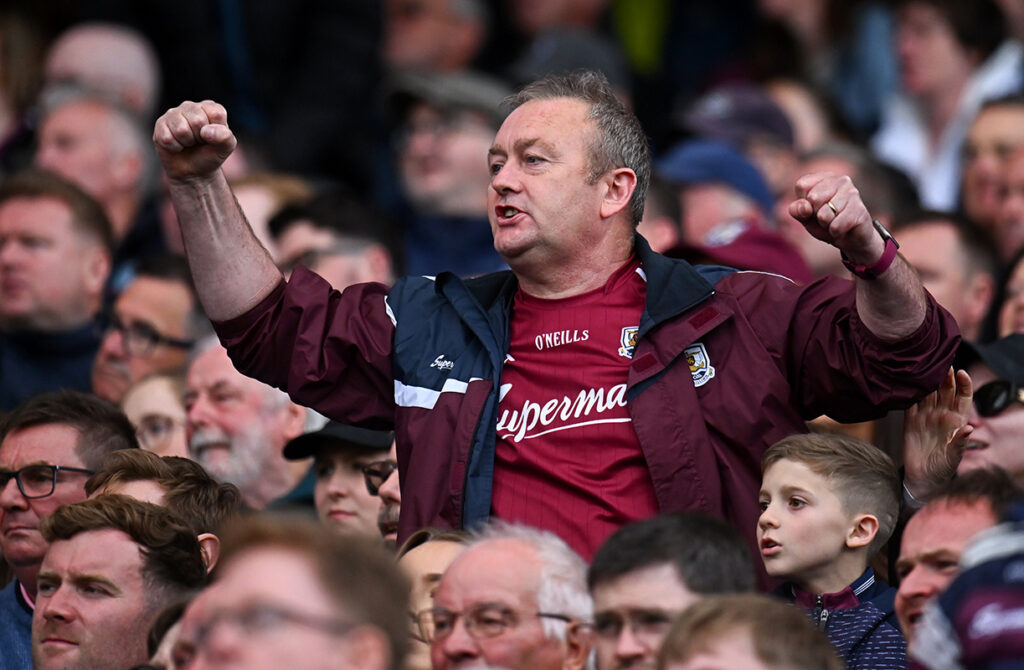
Standing in their path this weekend is a Galway side enjoying something of a renaissance under Micheál Donoghue. In his second spell in charge, Donoghue has successfully blended emerging talent with proven experience to breathe fresh life into the Tribesmen. The likes of Jason Rabbitte, Aaron Niland and Cillian Trayers have brought youthful energy and enthusiasm to the squad while simultaneously easing the burden on established stars such as Daithí Burke, Conor Whelan and Pádraic Mannion.
That balance has been one of Galway’s greatest strengths this season. The experienced players look revitalised, liberated from carrying the entire weight of expectation, while the younger generation has embraced the opportunity to make its mark on the biggest stage. The result has been a Galway team that appears far more balanced and dangerous than many predicted at the start of the campaign.
Whether that will be enough to stop Cork remains to be seen. But after a championship that has struggled at times to truly ignite, the hope is that a packed Croke Park, driven by Cork’s almost cult-like following and a rejuvenated Galway side, can produce a genuine blockbuster and finally provide the memorable occasion needed to sink its hook into the wider sporting public.
On paper, that long-awaited thriller should be all but guaranteed on Sunday when the great old rivals from either side of the Shannon finally renew acquaintances in Croke Park for the first time since 2013. On that occasion, Clare stunned reigning Munster champions Limerick with a 1-22 to 0-18 victory en route to claiming their fourth Liam McCarthy Cup. Needless to say, much has changed in the intervening twelve years.
Since the core of that group graduated into the senior panel, they have shown a level of consistency at the very top of the game that few teams ever have managed to sustain”
Remarkably, the core of this current Limerick team were actually involved in the curtain-raiser that day. The Shannonsiders’ minor side suffered a controversial extra-time defeat to Galway, with a Barry Nash point in normal time infamously ruled out following a Hawk-Eye malfunction. Cian Lynch, Sean Finn, Mike Casey, Darragh O’Donovan and Tom Morrissey all lined out for Limerick that afternoon and will almost certainly be central figures again as John Kiely’s men bid to reach another All-Ireland final.
Since the core of that group graduated into the senior panel, they have shown a level of consistency at the very top of the game that few teams ever have managed to sustain, and even fewer have consistently tested them. Yet Clare have.
These two counties have produced some of the defining contests of the modern era. Were it not for the extraordinary standards set by this Limerick team, the Banner would likely have added considerably to both their Munster and All-Ireland tallies. At the height of Limerick’s dominance, Clare were the one side that never seemed intimidated by the green machine.

Classics
Three successive Munster final classics immediately spring to mind, in particular the breathtaking 2022 provincial decider on a rain-soaked afternoon in Thurles. There is also no shortage of needle between the counties, and while the Cork-Limerick rivalry has understandably taken centre stage in recent years, the animosity between Clare and Limerick should never be underestimated. These are neighbours, friends and even family members who, when it comes to hurling, simply do not like each other, and that only adds to the intrigue whenever they collide.
There are also striking similarities between this Clare side and Liam Cahill’s Tipperary team of last season. Brian Lohan’s men have arrived here somewhat under the radar. They were well beaten by both Cork and Limerick in the Munster round-robin and, while they did enough to finish third and progress, few would have labelled them genuine All-Ireland contenders just a number of weeks ago.
That perhaps suits them perfectly. By avoiding the physical and emotional drain of a Munster final, Clare have quietly built momentum. Their performances have improved with every outing, and there is now a sense that they are peaking at precisely the right moment.
There were legitimate concerns surrounding Clare earlier in the year. Defensively they looked vulnerable, particularly against Waterford and Limerick, where they were repeatedly exposed”
Even the make-up of the panel carries echoes of Tipperary’s All-Ireland-winning side from last year. For the class of 2013 – players such as John Conlon, David McInerney, Shane O’Donnell and Tony Kelly, this could realistically represent one final assault on the Liam McCarthy Cup. All four are now well into their thirties and have given extraordinary service to the Banner jersey.
There were legitimate concerns surrounding Clare earlier in the year. Defensively they looked vulnerable, particularly against Waterford and Limerick, where they were repeatedly exposed. However, to their immense credit, they have addressed many of those issues and found solutions from within.
The emergence of Sean Rynne and Diarmuid Stritch has injected fresh energy into the team. Their youthful exuberance, fearlessness and energy have brought a different dimension to Clare’s attack and crucially have eased some of the burden on the old guard. Suddenly, the likes of Kelly and O’Donnell are no longer carrying the entire weight of expectation on their shoulders.
Balance
Instead, Clare looks like a side that has rediscovered balance. And that is what makes Sunday’s contest so compelling. Limerick possess the pedigree, experience and winning habit of serial champions even as a new generation emerges beneath that 2013 minor brigade. Clare arrive with momentum, freshness and a group of seasoned warriors who know opportunities like this do not come around forever.
For all the criticism aimed at this year’s championship, this semi-final has all the ingredients of something special. History, rivalry, jeopardy and two exceptional teams separated by little more than the width of the Shannon. If hurling has been waiting for its summer to finally catch fire, this weekend should surely provide the moment.