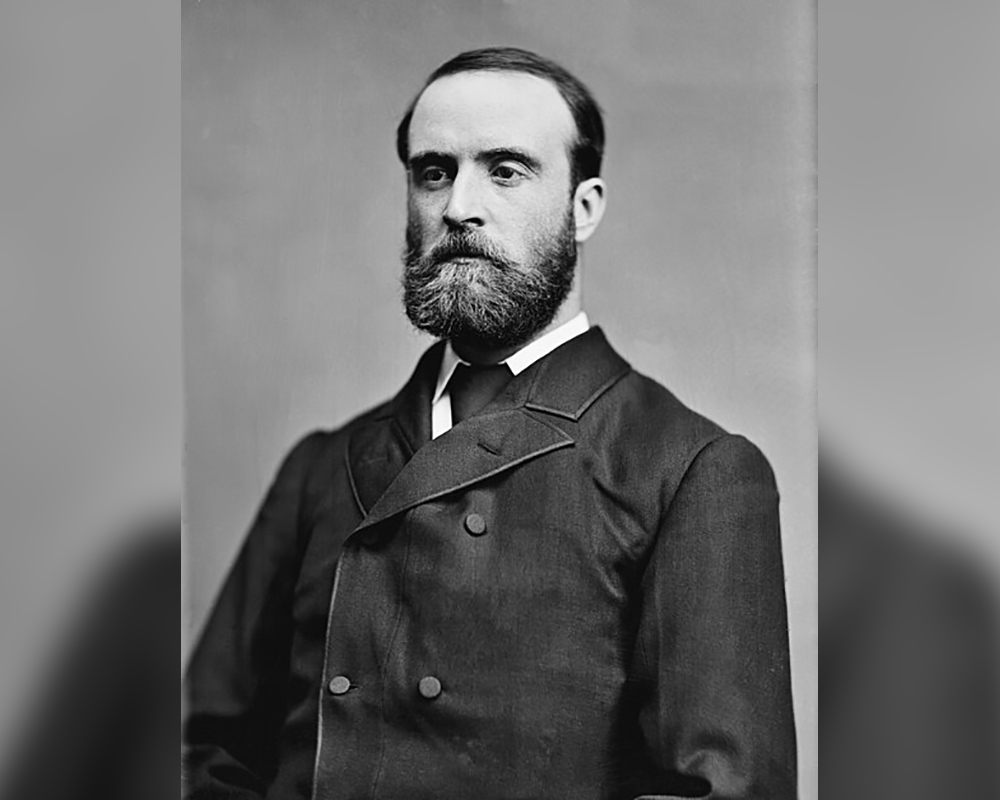
Parnell’s Other Island: Charles Stewart Parnell’s life and times in late Victorian Britain,
by Alan F. Parkinson
(Eastwood Books, €25.00 / £21.50)
The title of this book echoes that of George Bernard Shaw’s 1904 play John Bull’s Other Island, but with the conceit inverted. Whereas Shaw was referring to Ireland, Parnell’s other island was Great Britain. That was where he spent much of his short life, where he found happiness with an Englishwoman and where he died in 1891. The author’s focus is on the society, and in particular, its public life, that Parnell found there, and how he interacted with it.
He was rusticated, or temporarily sent down, from Magdalene after becoming involved in a drunken street brawl”
Parnell’s engagement with Britain began early. His formal education included spells at schools in various parts of England, as well as nearly four years at Magdalene College, Cambridge. Famously, he was rusticated, or temporarily sent down, from Magdalene after becoming involved in a drunken street brawl. He regarded his punishment as disproportionate and felt he had been treated harshly because of his nationality.
In a fit of pique, he decided not to return to complete his degree course. Some biographers have identified this incident as the source of the strong antipathy to the English that marked his public life.
Career
His parliamentary career spanning the last sixteen years of his life was spent largely in London. Indeed, after he became romantically involved with Katherine O’Shea, his visits to Ireland became increasingly infrequent. Mrs O’Shea’s home at Eltham, now a leafy London suburb, but then a rural Kent village, was Parnell’s permanent residence from 1884 until Katherine sold the property in 1889. They then moved to Brighton and later to Hove, where Parnell died. Given the nature of their cohabitation, they lived a secluded life, and played no part of the London social scene.
Parnell was, in any event, despised by London high society. His first years at Westminster had alienated him irrevocably from the British establishment. The policy of parliamentary obstructionism followed by a small group of dissident Irish MPs which Parnell would join soon after his election in 1875 disrupted the work of the House of Commons and was deeply resented on all sides of the House.
His profile, both at home in Ireland and in parliament, was such, however, that by 1880 he was the undisputed leader of the Home Rule movement. British leaders – especially, after 1880, with Gladstone and Lord Salisbury.
The parliamentary arithmetic after the General Election of 1885 made it imperative for Gladstone to grasp the nettle of Home Rule if he were to regain the premiership”
The most interesting parts of this book are about Parnell’s dealings with Parnell contrived to hold the balance of power between the Conservatives and the Liberals in the period 1885-6, and this was a factor in Gladstone’s conversion to the principle of Home Rule – though it is apparent that Gladstone had concluded some time earlier that Home Rule would have to be conceded, but hoped it would be enacted by Lord Salisbury’s government.
The parliamentary arithmetic after the General Election of 1885 made it imperative for Gladstone to grasp the nettle of Home Rule if he were to regain the premiership.
Parnell’s relationship with Gladstone is described in this book as “personally distant”, with “little intimate contact”. Even during their alliance after Gladstone’s conversion to Home Rule, there were only a handful of meetings between the pair. The only occasion when they are known to have been together for a prolonged period was during a visit Parnell made to Hawarden, Gladstone’s country estate in Flintshire, in Wales, in December 1889. Their communications were generally through intermediaries – one of whom was, curiously, Katherine O’Shea.
Gladstone’s response to the O’Shea divorce case in December 1890 was a critical factor – though not the only one – in the so-called Parnell Split. Gladstone’s view, expressed in a letter to Parnell, was that Parnell’s “continuance as leader would render my retention of the leadership of the Liberal Party, based as it has been mainly on the prosecution of the Irish cause, almost a nullity”.
Alliance
Parnell’s response was to ditch his alliance with the Liberals, but the majority of his Irish party colleagues knew that they had to stick with them – and ditch Parnell. The option of playing the two great British political parties off against one another was no longer open to them once Gladstone had embraced Home Rule.
Parnell’s desperate fight to salvage his political career in the last year of his life strained his already fragile health and this led to his premature death, aged 45.
In his introduction, the author writes that “Britain has a serious claim to shaping the life and also, sadly, the death of Charles [Stewart] Parnell, and it is not a theme which has been central to other works on Parnell’s life”.
This book fills that lacuna. So, while largely based on secondary sources, it is nevertheless an important contribution to Parnell scholarship. It is worth noting that it has what many history books would benefit from, namely a detailed chronology of the relevant events.