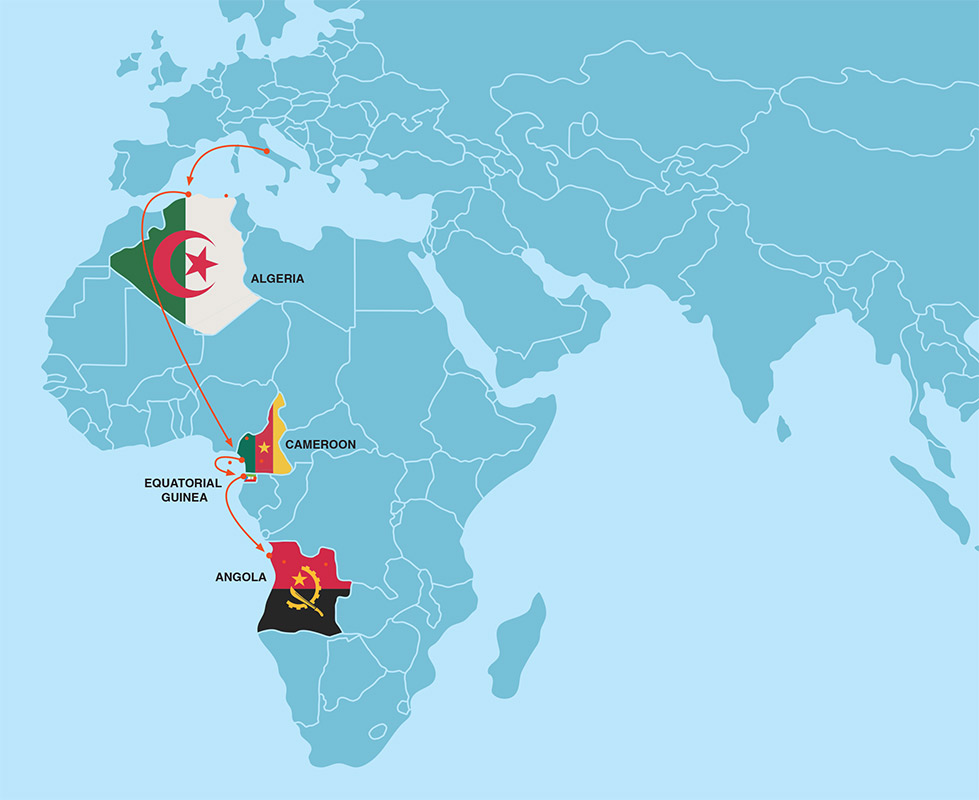
As Pope Leo XIV prepares for his first visit to the Church in Africa, I examine the key issues he is likely to encounter when he meets Catholic leaders in Algeria, Cameroon, Angola and Equatorial Guinea from April 13 to 23. The pontiff has accepted the invitation from the government authorities and Church leaders of the four countries involved.
Meetings with Catholic communities, dialogue with other faiths and cultures, commemorations of the nations’ struggle to free themselves from colonial oppression, symbolic gestures and geopolitical activities. Leo XIV’s first apostolic journey to Africa took on the character of a highly ambitious mission aimed at re-establishing the Church’s key role on the continent.
Algeria
The first stop on the mission will be Algeria, where the Pope will stay from April 13 to 15, visiting the capital Algiers and the city of Annaba. This great North African country holds a unique significance for the history of the Church, both past and recent, and stands at the crossroads of worlds that are often in conflict yet, at the same time, in desperate need of dialogue and peace.
Algeria was the birthplace of St Augustine, one of the most important saints in Christianity and a central figure, particularly for the religious order to which Pope Leo belongs. It is no coincidence that the then Robert Prevost had already visited here when he was Superior General of the Order of St Augustine and here, in addition to Algiers, he will visit the city where St Augustine was bishop, Hippo, now called Annaba.
The country, which is overwhelmingly Muslim, is divided into four Catholic dioceses. In this land, ravaged by war and violence, wonderful examples of Christian witness have flourished. The devotion to and memory of the 19 martyrs of Algeria – Catholic men and women religious (including the seven monks of Tibhirine and Bishop Pierre Claverie) – who were killed between 1994 and 1996 during the civil war, remain very strong.
All of them, each in their own way deeply rooted in Algerian society and leading lives of sharing and coexistence of great social and spiritual value, chose to remain alongside the local Muslim population despite the threats of terrorism, bearing witness to a dialogue of life, friendship and peace. They were beatified on December 8, 2018, in Oran.
Algeria is characterised by an apparent stability, underpinned by military power, and by a renewed strategic role”
It is interesting to note that Cardinal Prevost was elected on the very day the Church was celebrating the liturgical feast of the martyrs of Algeria, among whom were two Augustinian nuns. And in the description of the ‘unarmed and disarming’ peace of the Risen One proclaimed by the new pontiff in his first Urbi et Orbi blessing, the echo of the prayer left in writing by Christian de Chergé, the prior of Tibhirine, resounded.
Shaken by numerous street protests and the dissatisfaction of a significant section of the population, Algeria is characterised by an apparent stability, underpinned by military power, and by a renewed strategic role on the international stage as a key energy supplier, particularly to Italy. The issue of relations with neighbouring Morocco is a highly sensitive one, with the two countries in a state of constant tension and the borders between the two countries closed since 1994, largely due to the support and hospitality provided by Algeria to the Sahrawi cause and refugees, fighting Rabat for independence.
The visit represents a significant event for Europe and the Western world, as the Pope’s presence consolidates the role of Algeria as meeting point between the West and the Arab-Muslim world.

Leo will be in Equatorial Guinea from April 21 to 23. Photo: OSV News / Luc Gnago, Reuters
Cameroon
The second step of Pope Leo’s journey will be Cameroon from April 15 to 18, with stops planned in Yaoundé, Bamenda and Douala.
The Cameroon that the Pope is set to visit is a country facing many problems. In October, presidential elections were held and, for the umpteenth time, 93-year-old Paul Biya was elected, thus beginning his seventh term in an uninterrupted presidency that has now lasted for 42 years.
There were numerous objections, directed not so much at his election as at his very candidacy. Among these were those of the Catholic Church, which, through various bishops and representatives, strongly criticised the candidacy and called for a renewal of the ruling class. As in previous rounds, the opposition parties have reported serious irregularities in the voting and have also claimed victory. The protests have often led to clashes with the police and have heightened tensions across the country.
The Catholic Church is at the forefront of fostering constructive dialogue between the parties”
The second stop on the Pope’s visit to Cameroon will be Bamenda, the capital of the English-speaking regions. This stop will be highly symbolic. Since 2017, when separatists declared independence and proclaimed the Republic of Ambazonia, Cameroon’s English-speaking regions have plunged into utter chaos.
Kidnappings, killings, massacres carried out by the regular army and separatist militias, and hundreds of thousands of refugees are now a daily occurrence. The Catholic Church is at the forefront of fostering constructive dialogue between the parties and has, over the years, often taken the lead in peace initiatives, particularly those spearheaded by Archbishop Andrew Fuanya Nkéa, Bishop of Bamenda and President of the Episcopal Conference of Cameroon.

Cameroon from April 15 to 18. Photo: OSV News / Desire Danga Essigue, Reuters
In an interview with The Irish Catholic during a session of the Synod on Synodality, Msgr Nkéa spoke as follows regarding the serious issue of the English-speaking regions “Synodality implies dialogue, discussion, moving together. If we look at the conflict that has been engulfing the Anglophone regions of Cameroon for seven years now, we understand that at the root of it is a lack of mutual understanding.
“…To foster peace in Cameroon, we are working together with other religious denominations and faiths, such as Muslims, Protestants, Pentecostals, and none of us would dream of approaching them with a sense of superiority or inferiority. On the contrary, we approach others recognising them as brothers and sisters. This is what the Synod and synodality does. To sit down and dialogue in the search for peace is the basis of all endeavours”.
Another serious problem facing Cameroon is terrorist attacks led by extreme Islamists in the far north “We have high hopes for this visit,” stated Msgr Nkéa in an interview with the Vatican media. “Pray that the Holy Father may come and conclude his visit in peace and tranquillity and view the Holy Father’s visit in a positive light, seeing it as an act of God on behalf of the Cameroonian people”.
Angola
The journey will continue in Angola from April 18 to 21, where visits to Luanda, Muxima and Saurimo are scheduled.
In a historic audience on July 1, 1970, Pope Paul VI received the leaders of the liberation movements from the Portuguese colonies (Angola, Mozambique and Guinea-Bissau). This meeting marked a significant moral endorsement by the Catholic Church of the calls for independence in the Portuguese-speaking world, despite the diplomatic tensions with Portugal at the time.
Pope Leo will find a country grappling with serious structural challenges, including high levels of poverty”
The delegation included prominent figures such as Agostinho Neto (MPLA – Angola), Marcelino dos Santos (FRELIMO – Mozambique) and Amílcar Cabral (PAIGC – Guinea-Bissau and Cape Verde). Speaking of this historic event, the leaders said: “This is the first day of our nation’s creation.” The Catholic Church’s relationship with Angola has always been special, not least because of this pivotal episode in its history.
In this southern African country, where the majority of the population is Christian (around 90%), Catholics form a clear majority (nearly 60%). This is not the first time a pope has visited this country. Before Leo, John Paul II visited Angola from June 7 to 10, 1992, and Pope Benedict XVI from March 17 to 23, 2009.
Pope Leo will find a country grappling with serious structural challenges, including high levels of poverty affecting around 30% of the population, deep-rooted social inequality and an economy heavily dependent on oil. The year 2025 was marked by numerous tensions, which reached a peak last summer and led to serious clashes that resulted in the deaths of dozens of people.
Guinea
The mission will conclude in Equatorial Guinea from April 21 to 23, with stops in Malabo, Mongomo and Bata. The groundwork for Pope Leo’s visit to Equatorial Guinea was most likely laid during the visit of its President, Teodoro Obiang Nguema Mbasogo, which took place on Saturday, June 28, 2025, at the Vatican. After the audience, the President met with Archbishop Paul Richard Gallagher, Secretary for Relations with States and International Organisations.
The Catholic Church is the dominant religious denomination in Equatorial Guinea, with over 90% of the population baptised”
Equatorial Guinea is an economic paradox: although it is one of the richest countries in sub-Saharan Africa in terms of GDP per capita, thanks to oil, over 50–70% of the population lives in poverty. President Teodoro Obiang Nguema Mbasogo – aged 83, in power without interruption since 1979, is a controversial figure. He is widely regarded as a dictator, known for his repression of the opposition, elections often deemed fraudulent with landslide results, and his authoritarian control over the country. His Equatorial Guinea ranks 172nd out of 180 countries in the Corruption Perceptions Index published annually by Transparency International.
The situation in Equatorial Guinea, as reported in the Comboni Missionaries’ magazine Nigrizia, is characterised by stark inequalities.
The Catholic Church is the dominant religious denomination in Equatorial Guinea, with over 90% of the population baptised. “The Pope is a messenger of peace. He comes to foster greater communion within the Church and in society. These aspects are therefore important for our people today,” Monsignor Juan Domingo Beka Esono Ayang, Bishop of Mongomo and President of the Episcopal Conference of Equatorial Guinea, said in an interview with the Vatican media.