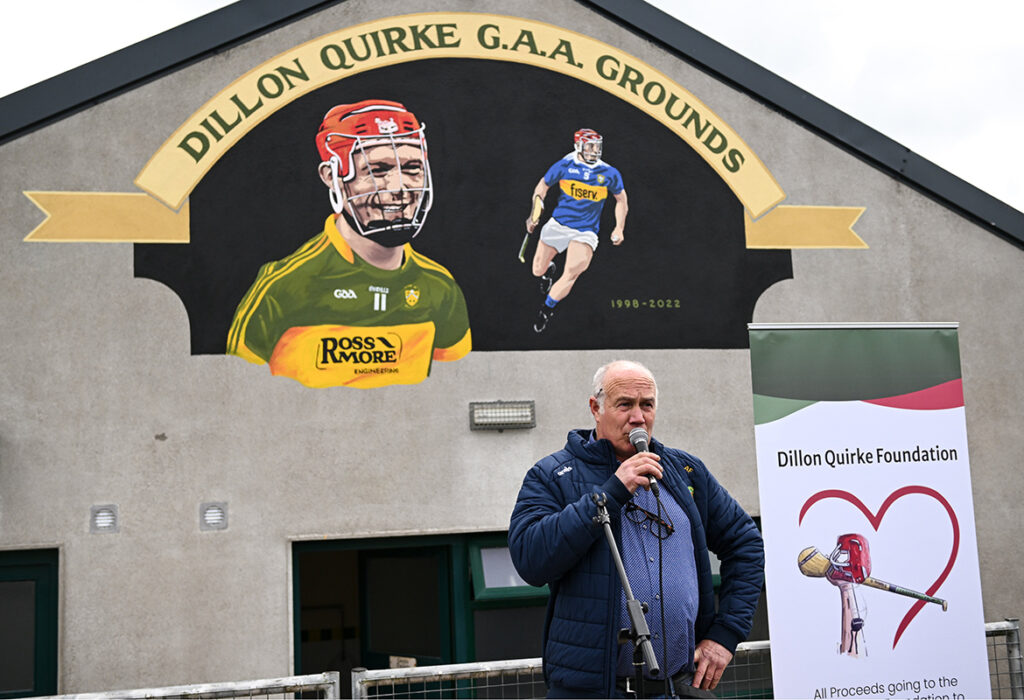
In August 5 2022, Dillon Quirke lost his life playing the sport he loved in a Tipperary Senior Hurling Championship match between his club, Clonoulty-Rossmore, and Kilruane MacDonaghs on the hallowed turf of Semple Stadium. The prodigious 22-year-old was one of the rising stars of the Premier County before his life was so tragically cut short.
No doubt a future Tipperary captain, Quirke remained at the heart of his county’s thoughts when the Blue and Gold steamrolled past Cork in the 2025 All-Ireland final. Captain Ronan Maher ensured that their former teammate remained part of the celebrations, with an emotional tribute to the young man whose spirit no doubt helped carry his teammates across the line.
SADS
The cause of his untimely death was Sudden Adult Death Syndrome (SADS). Like so many families, the Quirke’s had never even heard of the condition until it tragically arrived on their doorstep.
In their grief, they established the Dillon Quirke Foundation to raise awareness of SADS and other underlying cardiac conditions while helping to protect other young people and their families from experiencing the same devastation.
One such person was Loughgiel Shamrocks and Antrim star Paul Boyle. At just 23 years of age, Boyle had made his breakthrough into the Saffron senior setup under the stewardship of former Tipperary All-Star goalkeeper Darren Gleeson. Entering his second year with the county, he was keen to kick on and cement his place within the group.
I got a phone call to say that my ECG had been flagged with an anomaly. They didn’t know what my diagnosis was, but there was a strange rhythm with my heartbeat”
Given Gleeson’s connection to Tipperary, he arranged cardiac screening for the Antrim team. For Boyle, the findings would make clear just how vital that decision had been.
“Darren was keen for us to get it done. He would’ve known Dillon Quirke, being from Tipperary. It was an ECG; I’d never had one done before. The Tuesday after, I got a phone call to say that my ECG had been flagged with an anomaly. They didn’t know what my diagnosis was, but there was a strange rhythm with my heartbeat. I had to stop everything and was referred to a consultant.”
“I was very taken aback because I thought if there was something wrong with me, I’d be well aware of it. I was in a state of panic and rang Darren, and he managed to calm me down. All I could do was wait to see the consultant.”
Shock
“After the initial shock, I was thinking that I’d just get back hurling. It wasn’t until I met the consultant that I realised how lucky I’d been. I was diagnosed with Wolff-Parkinson-White syndrome, which is essentially an extra electrical pathway in your heart that can cause your rhythm to spike at a moment’s notice.”
“I could be sitting there with a resting heart rate, and suddenly it might rise to 170 or 180. If that happened to me during a game, it could’ve been a very bad situation.”
Approximately one in 300 teenagers screened are found to have a serious, previously undiagnosed cardiac condition”
Boyle is one of the lucky ones, with his diagnoses of Wolff-Parkinson-White syndrome caught before anything worse could happen. Following two surgeries on his heart to burn away the excess tissue that was causing the atrial fibrillations, he was eventually cleared to return to hurling, just four months after his diagnosis.
The speed of the process was largely down to the support afforded to him by the GPA and the GAA itself, something the Saffron man is eternally grateful for.
To date, the Dillon Quirke Foundation has tested over 23,000 young athletes and children across Ireland. According to the Foundation’s data, approximately one in 300 teenagers screened are found to have a serious, previously undiagnosed cardiac condition.
In many ways, that is the legacy of the Clonoulty-Rossmore man who was taken from this earth far too soon. In his untimely death, he has perhaps saved the lives of countless young people across the country who could have suffered a similar fate.
Professionalism
With the levels of professionalism in the GAA now, the organisation is effectively amateur in name only. Inter-county athletes are elite sportsmen and women, and to have something like this should be the standard, believes Boyle.
“You can’t understate how important these screenings are. The number of people who had underlying issues who have been caught is unbelievable. It has just become the norm. The GPA and the backing that they’ve given players means that if something does come back, players will know that they are being supported. Every squad should be getting screened because the level of training that inter-county is at nowadays, everything else is covered, so why wouldn’t your health be as well?”
“The Dillon Quirke Foundation and the work that they have done is unbelievable. The cardiac screening for young people all over Ireland has caught so many issues. Even for us, Dillon Quirke is the reason that Darren pushed us to do it, and if you can prevent one fatality, sure, isn’t it a job well done?”
Three years on, the Loughgiel man is back to his best and is hoping that 2027 can deliver a better year for all involved in hurling in the Glens. A tumultuous past season saw the Saffrons just about secure their status in Division 1B of the Allianz Hurling League, as well as their place in next year’s Joe McDonagh Cup, where they will be joined by Ulster rivals Derry and Down.
I’m just so grateful for my health now. The minute I got diagnosed, my only thought was, ‘When can I get back hurling?’”
However, the experience has changed Boyle’s outlook on life in more ways than one. Whereas before hurling would have been the be-all and end-all, a very different priority has now taken centre stage.
“I’d definitely try to drink less coffee,” he joked. “I’d be more aware of getting regular ECGs and checking up with my GP a lot more. It would make you more switched on and appreciative of your general health.”
“I’m just so grateful for my health now. The minute I got diagnosed, my only thought was, ‘When can I get back hurling?’ Whereas now I realise that I just needed to take a minute and sort this out. If you don’t have health, you don’t have anything.”
“You’re a hurler, and that’s what your whole personality and identity is. For me, it was a bit of a shock at first, but there’s also so much more to life. We’re so busy nowadays; everyone is running around, going to games and doing other things. Sometimes, you just need to take a second to look after yourself.”