Pathway to the Cosmos: The alignment of megalithic tombs in Ireland, Britain and Atlantic Europe,
by Peigín Doyle
(Wordwell in Association with the National Monuments Service, €10.00 / £8.99)
The recent total eclipse of the sun, visible across a large swathe of Europe caused great excitement. It was certainly a rare lifetime event, but even so there were some who were disappointed: these days it takes a very great effort on the part of the natural world to impress the imaginations of our digital age, who feel that it would all look better on an IMAX screen.
But the event emphasised just how moving and emotional people still find such celestial events, as moving indeed as anthropologists and scholars of antiquity have suggested they affected traditional and ancient cultures.
So this little book will, I think, be of great interest to all those whose imaginations were aroused by the eclipse to read further into what is thought about ancient peoples and how they read the sky.
It is based on the research of some of those hard-working people who care for our national monuments as an attempt to explain about the astronomical ideas of our ancestors.
The text is written by Peigín Doyle who provides a popular account of the academic papers presented at a conference organised by Archaeology Ireland and the Office of Public Works in Dublin Castle back in September 2018.
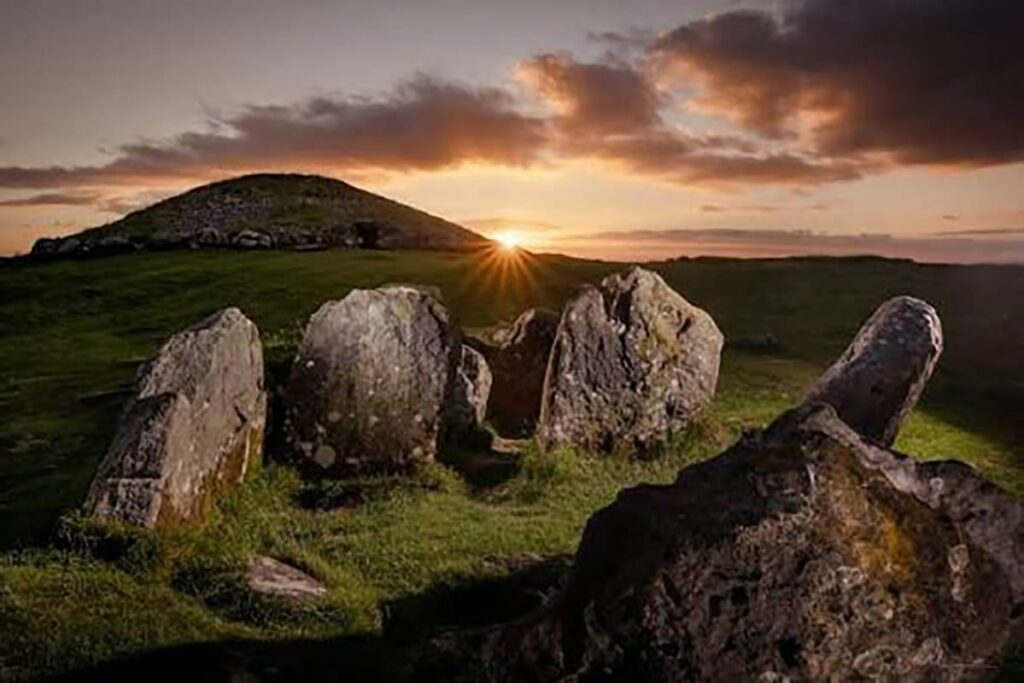
The text is divided into eight chapters, dealing with the whole idea of the astronomical orientation of megalithic sites and what can be surmised about such an outlook in sites from Iberia to the Orkney Islands, by way more familiar places in the Irish landscape.
All of this is very up to date, dealing as it does with what are now accepted ideas. But I can well remember the international controversy aroused back in 1963 by the publication of Stonehenge Decoded by astronomer Gerald S. Hawkins, based on a paper he wrote in 1963 which had been converted into a documentary for American television by CBS News, followed in 1965 by the book.
This created, largely through the television programme, a sensation. But as Hawkins had pointed out at the time there had been efforts in the past by such people as Norman Lockyer, the founder of Nature, and by our own Admiral Boyle Somerville (the brother of the novelist).
At the end of the 19th and the beginning of the 20th century their ideas had been rejected; and were still disputed by Atkinson writing on Stonehenge in the 1950s. It was perhaps only after 2000 that the idea became widely accepted by the relevant scientists and archaeologists.
But, as is usual in science, when a once resisted idea becomes commonplace scientists write as if it had been accepted as obvious all along.
Cosmos
But is the term “cosmos” the right one to use here about what was being recorded by our megalithic ancestors, the first farmers?
There are some “spiritually minded” people who have claimed these sites for a pagan continuity; they mingle surmises about the Neolithic with the few late classical records of the druids. But they cannot help but see the cosmos with the eyes of modern astronomy, which is a distortion of what can really be known about the prehistoric past.
What little we can know about the druids – much of which comes from Julius Caesar in some pages of his Gallic Wars – was long ago summarised by T. D. Kendrick and Stuart Piggott on a well referenced basis.
Everything else that you read about druids and megaliths – or see in tourist posters – is imaginative nonsense, any discussion of which professional archaeologists are rightly wary of these days.
But the ancient Irish had no idea of the universe as we think of it. They seem to have seen the world of man to lie below a dome across which moved the planets and the stars. The passage of these signs in the heavens was noted, and due to the phenomenal memories noted by anthropologists among non-literate cultures, were remembered and recalled, so that patterns could be realised, patterns by which it was possible to manage the passage of time, the turn of seasons, the times for planting and harvesting, for hunting or not hunting animals.
This is an excellent little book summarising what we know or thinks we know today about the underlying alignment of certain site with the passage of the sun, and as some have argued, with perhaps more truth than is widely accepted, the phases of the moon, which may well have been more important on a monthly basis than the sun.
However, we should keep in mind that this cultural matter of the planets affecting events on earth continues. We have only to recall the long controversy between Celtic and European Christianity in the early middle ages as to how the date of Easter was to be set, to realise how the movements of the planets and stars are still of the very greatest importance to humanity down to this day.