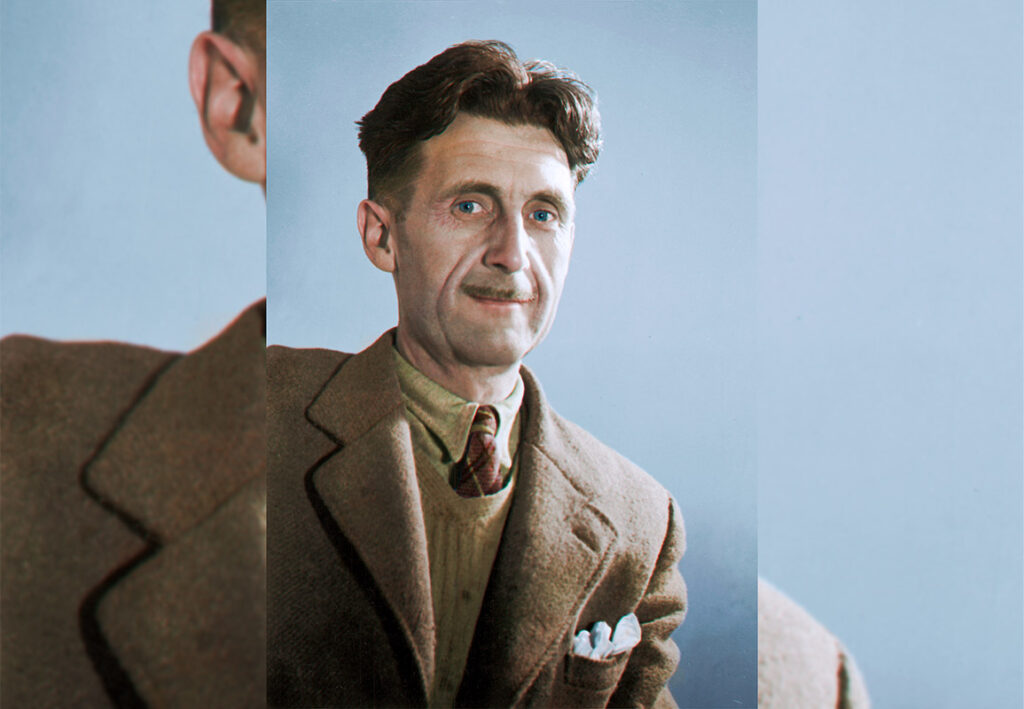
Some books are remembered as much for their epigrams as themselves. One thinks of L.P. Hartley’s The Past Is Another Country; Tolstoy’s Happy families are all alike.
I’d wager that what most people will remember from Andy Serkis’ Animal Farm (PG), as they probably did from the George Orwell book on which it’s based, is the phrase: “All animals are equal, but some are more equal than others.”
I first read it when I was in secondary school. A forward-thinking priest who taught us English bought a copy for our class and we spread it around. It wasn’t on the curriculum.
None of my classmates knew then that it was a satire of Stalinist Russia. Today’s young people are more sophisticated. They’ll probably ‘get’ the symbolic import right off.
Serkis’ iteration is a brilliant blitzkrieg of special effects and ingenuity, doubling not only as a critique of both communism and capitalism but ultimately of all political systems in favour of the most straightforward panacea of all, Christianity.
Orwell’s landmark tome is more of a skeletal template than a full-blown narrative resource for Serkis. His quasi-dystopian film begins with the Trotskyite Snowball, a pig voiced by Laverne Cox, advocating a takeover of the eponymous farm so the animals can have some autonomy.
This comes after a panicky realisation that the so-called Laughter House they’re being carted off to is really a slaughter one. (For which read Nazi Holocaust?)
As a banker threatens to repossess the farm, Snowball is unseated by a more self-aggrandising pig, Napoleon – no prizes for guessing why he’s called that.
Napoleon unpicks Snowball’s diktats to suit himself, preaching self-indulgence rather than deferred gratification. He manages to hoodwink the animals into thinking they can wear clothes, stand on two feet – the most hilarious scene in the film – and enjoy the blandish-ments of an acquisitive consumerist culture without any ill-effects. Good luck with that.
The notion of political systems becoming inherently self-destructive because of human – here animal! – frailty is telegraphed through a sequence of allegorical set-pieces where Serkis plays with concepts like money (“magic paper”) and alcohol (“naughty juice”) to great effect.
Trumpian greed is epitomised by the space-agey character of Frieda (“I love to dominate”) Pilkington. There are rib-splitting send-ups of everything from credit cards to remote controls to electricity as the formerly horizontal and now vertical inmates take over the agrarian asylum only to realise the cure is worse than the disease.
We get so many motifs it’s hard to keep up with them: a drone called Moses, a “Blue Danube” sequence recalling Stanley Kubrick’s hallucinogenic Space Odyssey, a Titanic sub-theme – I even heard a line from Midnight Cowboy.
Will Pilkington plc. be Napoleon’s Waterloo? Maybe it’s best to just enjoy the mayhem and let the ideological chips fall where they may. My favourite moment had the self-sacrificing horse of the piece scratching Einstein’s E=MC2 on the ground with his hoof and going, “I wish I wasn’t so dumb.”
Classic.