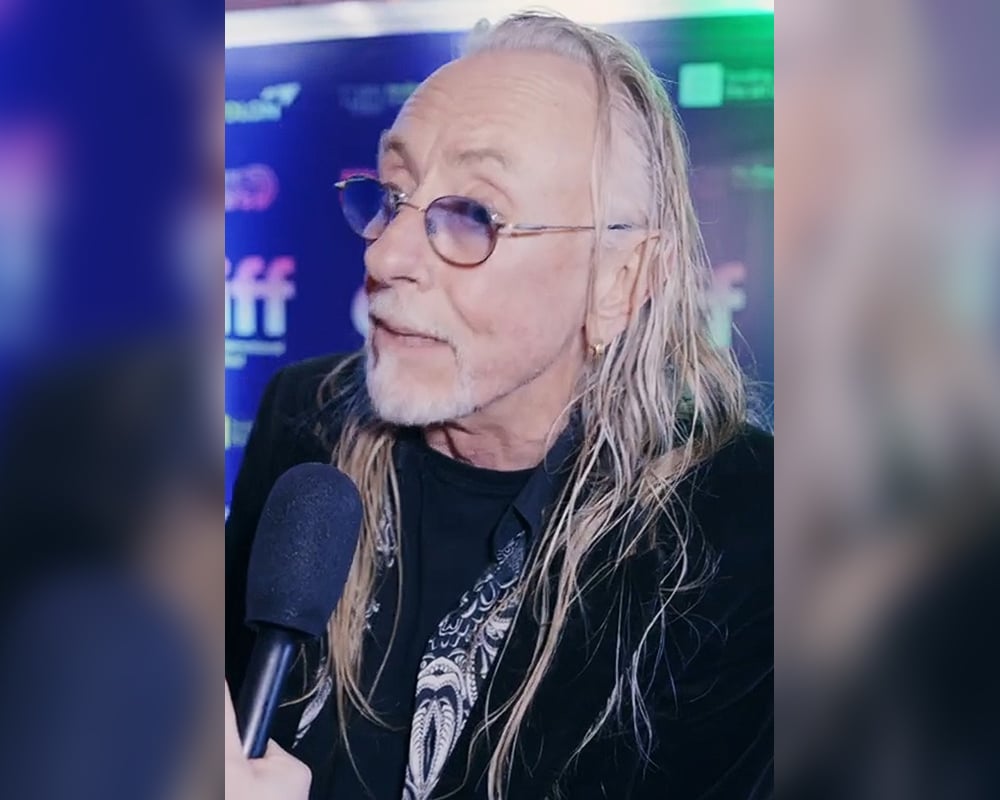
“I’m not one for analysing my work,” says artist Paul Rowen in Guggi, a documentary on the artist-cum-sculptor with that moniker currently showing at the Irish Film Institute.
When I heard his words I thought: You could have fooled me. He seemed to be engaging in little other than such analysis for the past hour.
A fair whack also comes from commentators on it – people like Bono, Gavin Friday, Mannix Flynn, Jim Sheridan, Sean Scully and others.
Before I saw the film, I was aware of him mainly from his association with Bono. Any notion I had that his fame was vicarious on that account was rapidly dispelled by scenes showing the great success of his exhibitions both in Ireland and overseas.
The film starts with his youth in Cedarwood Road on the fringes of Ballymun and Finglas. Horses roam the streets. Bono and Gavin Friday live within spitting distance of him.
“He was painting before he could talk,” says Bono. With Gavin he joined a musical group called The Virgin Prunes in the 1970s. Here both of them gave vent to their androgynous side. The punk revolution was in full swing with its ‘Anything goes’ agenda.
After the Prunes broke up he returned to his first love. His wildness behind the microphone was replaced by the almost contradictory calmness he showed with his paintbrush.
I could have done without some of the over-intellectualisation of his sculptures by the aforementioned commentators. Was its spiritual underpinning a result of his fundamentalist upbringing?
This kind of exegesis sounds like pretentious rubbish. Guggi seems to have started sculpture for no better reason than a suggestion by John Rocha that he do so.
It’s easier for an artist to become a sculptor, he suggests, than vice versa. This may be true but it sounds disrespectful to sculptors.
But Guggi is an interesting film, not only for an account of his life but also the cultural and religious history of Ireland. He bridled against an authoritarian father, having more empathy with his mother, as artists often do – though he found himself using his father’s penchant for hoarding in some of his later work.
Covid derailed his career. Then came a much bigger crisis. He suffered a brain haemorrhage. The original prognosis was poor but he pulled through.
He speaks articulately about his life in the film but his wife (the mother of four of his five children) is airbrushed out of it in favour of a partner from his more recent past. This is a major omission.
When Bono and ‘Gav’ chat with him in his studio towards the end, the three of them reiterate a childhood vow never to grow up.
“Can Guggi come out to play?” Bono used to ask at his door when he was a child. At 66, he repeats the request.
It’s a touching moment, reminiscent of the old Jesuitical precept: “Give me the boy and I’ll give you the man.”