As I’ve suggested in earlier reflections in this series, one of the ways in which we can protect ourselves from excessive anxiety is to be clear regarding what we might call a sensible ‘moral architecture.’ Our moral responsibility is limited; it does not extend to the whole world. Developing a wise and balanced sense of the limits of our responsibility is, itself, part of the exercise of moral responsibility.
When we allow ourselves to be morally ‘dumped on,’ made to feel responsible for more than we can address, then we become less, not more, able to act well. Ultimately, we can become paralysed with anxiety and sadness. To suggest that the world’s problems are so grave that we ought to be paralysed by fear would obviously be irresponsible. To amplify crisis to the extent that people lose hope would be entirely counter-productive, since without hope there can be no remedial action of any kind. The suggestion that there is no hope for humanity is not just faithless; from a purely secular point of view it is destructive, and it is every bit as big a lie as the opposite notion that humanity is progressing inevitably towards a utopia.
We live in the midst of crisis. This much is clear. Less clear is how we are called to live in the midst of crisis, yet our Christian faith provides us with a degree of clarity and with inestimable resources. In anxious times, it is essential that we retain a sanctuary, an inner space to which we can retreat, not in order to escape definitively from the world and its woes, but in order to be re-equipped for our share – our limited, prudentially-discerned, share – of the struggle. As the young Jewish woman, Etty Hillesum, wrote, while the Nazi noose was tightening around her people: “Ultimately what matters most is to bear the pain, to cope with it, and to keep a small corner of one’s soul unsullied, come what may.”
To retreat regularly to that place of sanctuary does not mean living under a stone, or sticking our head in the sand. It is simple obedience to our Lord’s counsel: “When you pray, go into your room and shut the door and pray to your Father who is in secret; and your Father who sees in secret will reward you.” (Mt 6:6) That room, that inner sanctuary, is not a merely psychological reality; it is inhabited by Christ, whom we encounter there, and who strengthens us.
Sanctuary
When we risk being suffocated by state of things, the sanctuary of faith and prayer gives us breathing space. This image of breathing space was used to great effect by Pope Benedict XVI, who noted that the perspectives of faith give breathing-space and direction to our commitments, and that, on the other hand, “without the perspective of eternal life, human progress in this world is denied breathing-space.”
This is a very fine statement of the fact that a periodic ‘retreat’ into the perspective of faith, a regular stepping off the hamster-wheel of anxiety, is not so much denial of reality as restoration for reality, a restoration of the spiritual energy and focus we need if we are to make an authentic difference. What faith offers is not some kind of un-anxious lethargy, but a solid foundation for all that we do.
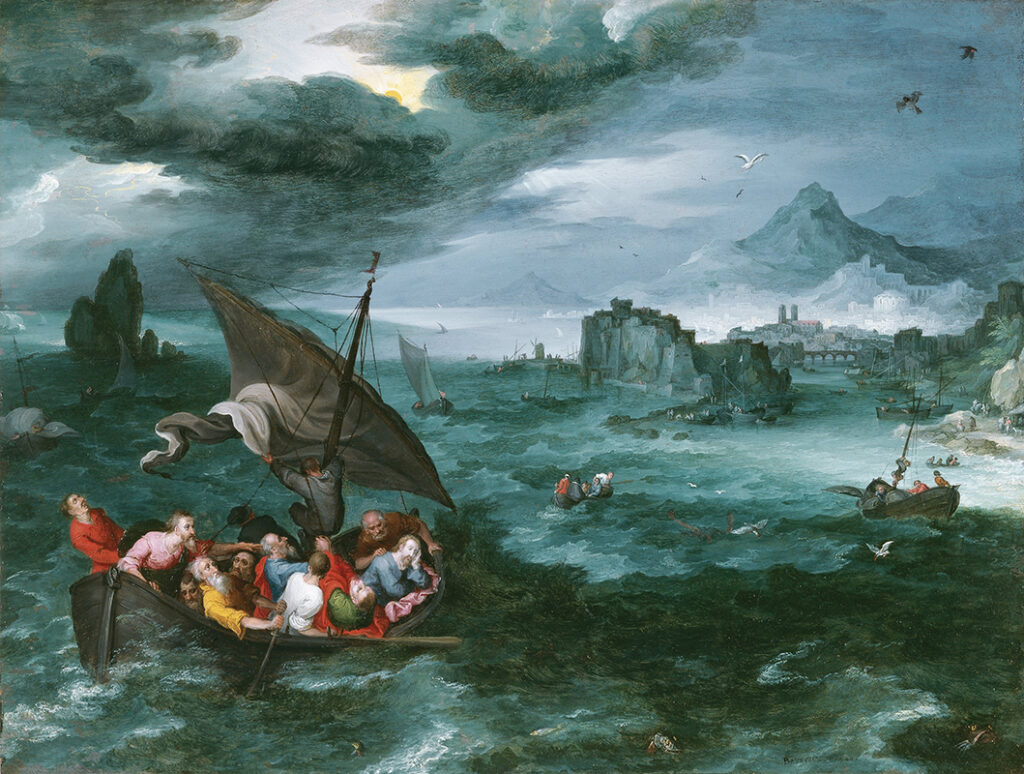
I cannot think of a more suitable place to conclude these reflections on faith in a time of anxiety than at the Sea of Galilee! Let us recall that it was there that Peter once asked Jesus to bid him step out onto the waters and come to Jesus. As long as he was looking towards Jesus, Peter was fine. But at a certain point, we’re told that instead of seeing Jesus, Peter ‘saw the wind’ and began to sink and panic. To ‘see the wind’ is an odd expression, given that the wind is invisible, yet it makes the point that once he took his attention away from Jesus, Peter suffered from an excessive sensitivity to threat, from that anxious hyper-arousal that afflicts people suffering from trauma stress, and that can become chronic in the case of post-traumatic stress disorder.
Saviour
When we find ourselves ‘seeing the wind,’ becoming painfully, anxiously sensitive to threats and forebodings, let us instead ‘see’ Christ our Saviour. How do we see him? In prayer. In that ‘inner room’ which he himself urges us to enter. It is in that place of retreat and restoration that we can regain our peace, that we can prophetically resist excessive anxiety, and that we can discern, with serene prudence, how best to serve our needy world.
This is the seventh and final instalment in Fr Chris Hayden’s series, ‘Faith in a time of anxiety’.