Am I not allowed to do what I choose with what belongs to me?
Matt 19:30 But many who are first will be last, and the last will be first.
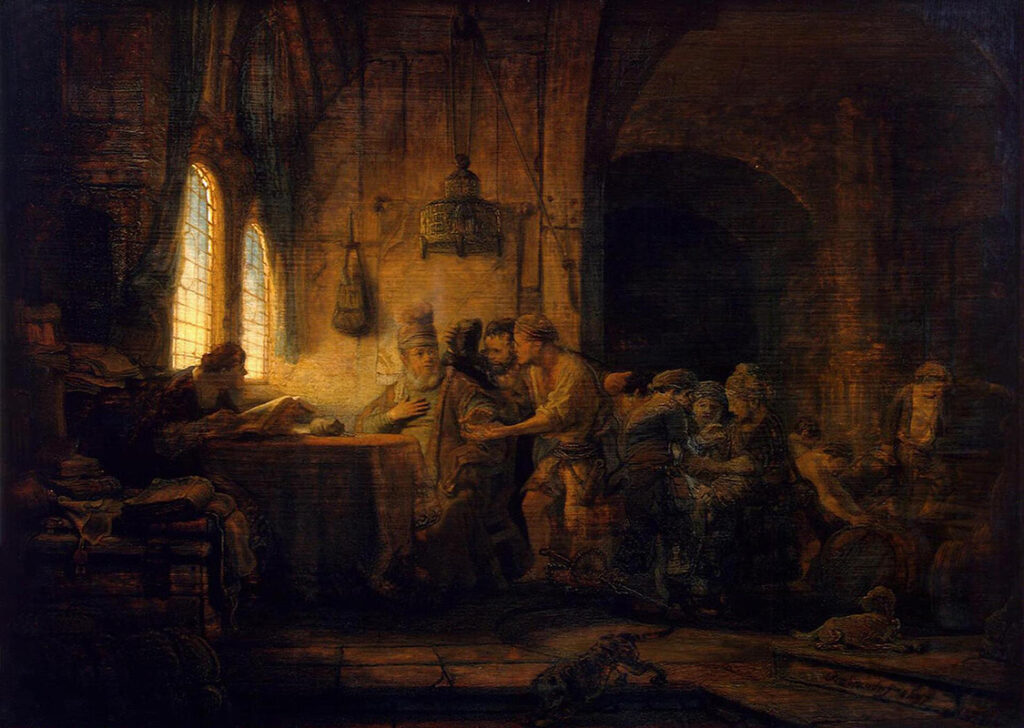
Matt 20:1 “For the kingdom of heaven is like a landowner who went out early in the morning to hire labourers for his vineyard.
Matt 20:2 After agreeing with the labourers for the usual daily wage, he sent them into his vineyard.
Matt 20:3 When he went out about nine o’clock, he saw others standing idle in the marketplace;
Matt 20:4 and he said to them, ‘You also go into the vineyard, and I will pay you whatever is right.’ So they went.
Matt 20:5 When he went out again about noon and about three o’clock, he did the same.
Matt 20:6 And about five o’clock he went out and found others standing around; and he said to them, ‘Why are you standing here idle all day?’
Matt 20:7 They said to him, ‘Because no one has hired us.’ He said to them, ‘You also go into the vineyard.’
Matt 20:8 When evening came, the owner of the vineyard said to his manager, ‘Call the labourers and give them their pay, beginning with the last and then going to the first.’
Matt 20:9 When those hired about five o’clock came, each of them received the usual daily wage.
Matt 20:10 Now when the first came, they thought they would receive more; but each of them also received the usual daily wage.
Matt 20:11 And when they received it, they grumbled against the landowner,
Matt 20:12 saying, ‘These last worked only one hour, and you have made them equal to us who have borne the burden of the day and the scorching heat.’
Matt 20:13 But he replied to one of them, ‘Friend, I am doing you no wrong; did you not agree with me for the usual daily wage?
Matt 20:14 Take what belongs to you and go; I choose to give to this last the same as I give to you.
Matt 20:15 Am I not allowed to do what I choose with what belongs to me? Or are you envious because I am generous?’
Matt 20:16 So the last will be first, and the first will be last.”
Initial observations
This parable is found only in Matthew’s gospel, giving a window into the social and religious world at the time of the writing of this Gospel. It is meant to shock and surprise because it seems to undermine much that is in the Bible, especially in the Old Testament. Indeed, it seems to go against much that is in Matthew’s own Gospel, where we read: “For with the judgment you make you will be judged, and the measure you give will be the measure you get.” (Matt 7:2). The context within the Gospel is Matthew 19, which closes with the words which end this reading. Perhaps 19:30 and 20:16 are the real frames of this story here, on account of the theme of reversal.
It is probable that the parable is dealing again with a situation in Matthew’s community. The question behind the parable seems to be this: new-comers to the covenant, that is, the Gentiles, should be received on exactly the same basis as those who have been faithful to the covenant for centuries, that is, the people of Israel. The time aspect of the parable is the key: no matter how long or how short your living of the covenant has been, the very same welcome and grace are given to all. As St Paul puts it, there is no distinction between Jew and Gentile.
Kind of writing
This is a parable, which takes an ordinary situation, that of day labourers, and goes against natural justice to make the point that while humans must regulate wages for justice, there is no limit to God’s overflowing grace and generosity.
Old Testament background
(i) There is a broad background in the Old Testament, where God is the owner of the land promised to the Israelites and the people are his tenants and “employees.” “The land shall not be sold in perpetuity, for the land is mine; with me you are but aliens and tenants.” (Lev 25:23) With that picture of God as the real owner went a sense of utter gratuity for God’s election of Israel.
(ii) There is a terrific OT background in the book of Jonah. Jonah preaches and is successful and still he resents God’s extension of forgiveness to outsiders. The prophet rebukes God in these words larded with irony:
But this was very displeasing to Jonah, and he became angry. He prayed to the Lord and said, “O Lord! Is not this what I said while I was still in my own country? That is why I fled to Tarshish at the beginning; for I knew that you are a gracious God and merciful, slow to anger, and abounding in steadfast love, and ready to relent from punishing. (Jonah 4:1-3)
God’s reply, a little further on, is instructive:
“But God said to Jonah, ‘Is it right for you to be angry about the bush?’ And he said, ‘Yes, angry enough to die.’ Then the Lord said, ‘You are concerned about the bush, for which you did not labour and which you did not grow; it came into being in a night and perished in a night. And should I not be concerned about Nineveh, that great city, in which there are more than a hundred and twenty thousand persons who do not know their right hand from their left, and also many animals?’” (Jonah 4:9-11)
(iii) There is an intriguing parallel with a rabbinic parable, which may be worth re-telling. Once a rabbi was asked by his disciples which commandments had the greatest rewards, so they could concentrate on these. He replied, I do not know. The rabbi told them this parable: there was once a king who owned a orchard with many different kinds of trees in it. He employed different workers to work on the different species – one to look after figs, another to take care of the apples, and another to tend the vines. In the evening, at the time of payment, the king gave them all different wages – one denarius to the one who looked after the figs, three denarii to the apple man and five denarii to the man who tended the vines.
The workers who received less objected, “Had we known that different wages were attached to different trees, we would all have worked on the vines”. The king replied, “But then how could all my garden be cultivated?” The rabbi concluded: however, I do know the reward for the greatest and the least commandments. The greatest is honour your father and your mother, so that you may live long in the land. The least is this: If you come on a bird’s nest, in any tree or on the ground, with fledglings or eggs, with the mother sitting on the fledglings or on the eggs, you shall not take the mother with the young. Let the mother go, taking only the young for yourself, in order that it may go well with you and you may live long. (Deut 22:6-7).
Thus the rewards for the greatest and least commandments are identical! In this way the rabbi explained to his disciples that all the commandments should be kept, from the greatest to the least. Comparing this parable to that of Matthew is instructive.
New Testament foreground
But I say to you, Love your enemies and pray for those who persecute you, so that you may be children of your Father in heaven; for he makes his sun rise on the evil and on the good, and sends rain on the righteous and on the unrighteous. For if you love those who love you, what reward do you have? Do not even the tax collectors do the same? And if you greet only your brothers and sisters, what more are you doing than others? Do not even the Gentiles do the same? Be perfect, therefore, as your heavenly Father is perfect. (Matt 5:44-48)
St Paul
The very same issue of the inclusion of the Gentiles is discussed in Romans 9:
You will say to me then, “Why then does he still find fault? For who can resist his will?” But who indeed are you, a human being, to argue with God? Will what is moulded say to the one who moulds it, “Why have you made me like this?” Has the potter no right over the clay, to make out of the same lump one object for special use and another for ordinary use? What if God, desiring to show his wrath and to make known his power, has endured with much patience the objects of wrath that are made for destruction; and what if he has done so in order to make known the riches of his glory for the objects of mercy, which he has prepared beforehand for glory— including us whom he has called, not from the Jews only but also from the Gentiles? As indeed he says in Hosea, “Those who were not my people I will call ‘my people,’ and her who was not beloved I will call ‘beloved.’” “And in the very place where it was said to them, ‘You are not my people,’ there they shall be called children of the living God.” (Rom 9:19-26)
Brief commentary
Verses 1-7 The story is quickly told, reflecting social and economic conditions of the day.
Verses 8-10 Starting with the last sets up the expectation that those who worked longer will receive more than the usual daily rate.
Verses 11-12 The logic is impeccable.
Verse 13 The same word for “friend” is used again of Judas in this Gospel.
Verses 14-15 God is free to give graciously to all. Cf. Rom 9:9-16 above.
Verse 16 The reversal of first and last refers to the relative demotion of the Israelites and the promotion of the Gentiles. The theme is an old one in the book of Genesis, where is arises in the form of the “reversal of primogeniture”. This is a feature of stories, in which the Israelites are the younger brother promoted, purely by God’s grace, to a place of eminence in his plan of salvation. The very same reversal has occurred now, quite paradoxically, for the Gentiles.
Pointers for prayer
- “I was there first”. Envy easily comes to the surface when faced with the good fortune of others, especially when compared to what seems less favourable treatment of ourselves. Can you recall that feeling in yourself and what it did to you? Can you also recall times when you were content with your lot, even though it seemed others had greater gifts, better opportunities, etc.
- A parent or teacher who gives a lot of time to a difficult child does not love the others less, but if we are one of those other children we may not see that. Recall a “Jesus person’ in your life who helped you to overcome feelings of envy and helped you appreciate that the apparently more favourable treatment of another did not mean a lessening of love for you.
- Generosity can make us uncomfortable. We feel more comfortable when we see ourselves as having done something to deserve the generosity.
But perhaps you can recall a moment of great need, when you were at the receiving end of someone’s generosity, a time when you recognised you had done nothing to ‘deserve’ that response, a time when all you could do was to say “thanks”?
- This leads us to the core message of this parable, namely, that God’s love is a free gift and not earned. Recall moments when you were particularly conscious of the gift that God’s love is to you.
- “It is too late now” are words sometimes uttered to justify doing nothing about a situation. This parable tells us that where love is involved, it is never too late. Can you recall times when you got a positive response after taking action when you thought it was “too late”?
Prayer
God most high, your ways are not our ways, for your kindness is lavished equally upon all.
Teach us to welcome your mercy towards others, even as we hope to receive mercy ourselves.
We ask this through our Lord Jesus Christ, your Son, who lives and reigns with you in the unity of the Holy Spirit, God for ever and ever. Amen.
Thought for the day
The forty-two parables in the Gospels are designed to take us up short and make us think again. Today’s parable is a good example. The actions of the employer and the treatment of the workers simply would not work today as a labour relations strategy and would also not have worked in the time of Jesus. And what is the point? Really that it doesn’t matter when we come to the Gospel, early, middle or late, by routes direct or circuitous, in full stride or falteringly: all that matters is that we come to the Gospel. Achievement counts for nothing; grace is everything, thanks be to God!
Prayer
The door of faith is always open and you welcome us, O God, whenever our hearts are open. We are grateful for your loving patience and generosity.
For to me, living is Christ and dying is gain
The first reading
Phil 1:20 My confident hope is that I will in no way be ashamed but that with complete boldness, even now as always, Christ will be exalted in my body, whether I live or die.
Phil 1:21 For to me, living is Christ and dying is gain.
Phil 1:22 Now if I am to go on living in the body, this will mean productive work for me, yet I don’t know which I prefer:
Phil 1:23 I feel torn between the two, because I have a desire to depart and be with Christ, which is better by far,
Phil 1:24 but it is more vital for your sake that I remain in the body.
Phil 1:25 Since I am convinced of this, I know that I will remain and continue with all of you for your progress and joy in faith,
Phil 1:26 so that I may share abundantly in your boasting in Christ Jesus when I come to you again.
Phil 1:27 Only conduct yourselves in a manner worthy of the gospel of Christ so that—whether I come and see you or whether I remain absent—I should hear that you are standing firm in one spirit, with one mind, by contending side by side for the faith of the gospel,
Phil 1:28 and by not being intimidated in any way by your opponents. This is a sign of their destruction, but of your salvation—a sign which is from God.
Initial observations
For the next four Sundays, we read from Philippians. Philippi was Paul’s first community in Europe, on the Second Missionary Journey. Traditionally, the letter was written from Rome, just before Paul’s own martyrdom. This would make Philippians his last letter and would document the apostle’s state of mind right up to the end, perhaps c. 64-67 ad. The chief evidence is reference to the praetorium (1:13) and the household of Caesar (4:22). But such details could fit other cities as well, such as Caesarea. However the letter presupposes visits back and forth, which might be difficult with such a distance in mind (2:19-30; 4:16-18). A obvious proposal is Ephesus, about a week’s distance from Philippi, implying a date somewhere in the mid-50s.
Kind of writing
Philippians may be viewed as a letter and as a speech (rhetoric).
Our reading comes from the background section—technically the “statement of facts” in vv. 12-26.
Origin of the reading
The sequence may be constructed as follows. The Philippians learn of Paul’s imprisonment and they send Epaphroditus with a gift to deliver to Paul. Epaphroditus falls seriously ill on his way to Paul and nearly dies. The Philippians learn of Epaphroditus’ illness and become very concerned. However, Epaphroditus recovers, completes his journey to Paul, and delivers the gift. Then, Epaphroditus learns of the Philippians’ anxiety for him and becomes himself distressed. Finally, Paul sends Epaphroditus back to Philippi with this letter in which he commends Epaphroditus, thanks the Philippians for their gift, warns them about false teachers, and informs them about his own circumstances and plans. The letter itself is very warm, affectionate and pastoral.
Related passages
But our citizenship (polituema) is in heaven—and we also await a saviour from there, the Lord Jesus Christ, who will transform these humble bodies of ours into the likeness of his glorious body by means of that power by which he is able to subject all things to himself. (Phil 3:20–21)
Brief commentary
Verse 20 Paul is confident that his imprisonment will come to an end. In this way, his innocence would be obvious and the gospel confirmed. The ashamed/exalted pairing mirrors some psalms of lament (Pss 6:10; 22:5; 25:2, 3; 31:1, 17; 53:5). In other contexts, Paul is not afraid of humiliation and suffering but here he means the shame inflicted by enemies from within. As always, whatever the outcome, the goal is to bear witness to the Good News in Jesus. Living or dying encompasses everything in between as well. The phrases bounce around the next few verses.
Verse 21 Both affirmations trigger a shock, especially the second one. Cf. I have been crucified with Christ, and it is no longer I who live, but Christ lives in me. So the life I now live in the body, I live because of the faithfulness of the Son of God, who loved me and gave himself for me. (Gal 2:20) In a word, life means Christ, for Paul.
Verse 22 Paul is open to this possibility because of the benefit to others. (The phrase itself is very elliptical and translators choose different reconstructions.) Paul says lit. living “in the flesh” but here it means in the body and is positive.
Verse 23 “I am torn” (synechomai) is a very strong expression. Other uses in the NT catch the force of it: Luke 8:45 or 19:43. The only other use in Paul also helps: For the love of Christ controls (synechei) us, since we have concluded this, that Christ died for all; therefore all have died. (2 Cor 5:14) The choices are perfectly balanced, expressing Paul’s dilemma. For “to be with Christ” see 1 Cor 15:35–55 and 1 Thess 4:13–5:10.
Verse 24 Paul feels equally the pull towards further proclamation of the Gospel. Cf. For if I preach the gospel, I have no reason for boasting, because I am compelled to do this. Woe to me if I do not preach the gospel! (1 Cor 9:16)
Verses 25-26 Omitted in the lectionary, these verses make the reading clearer.
Verse 27 A new section, focussed on unity and steadfastness, begins here. This is a warning and an encouragement. Worthy living is developed in 1:12-26. For “to conduct yourself” uses the verb politeuesthai, meaning to live as a citizen. It means to live in partnership and honour your responsibilities.
Pointers for prayer
- Paul has really given over his whole self utterly to Christ, no matter what transpires—inspiring and challenging.
- When faced with significant dilemmas, what have been my considerations?
Prayer
Help me, Lord, to see my life’s choices clearly. By your grace, may I know that “holy indifference” which would place me fully at your service. Through Christ our Lord. Amen.
Seek the Lord while he may be found, call upon him while he is near
Isa 55:6a Seek the Lord while he may be found,
6b call upon him while he is near;
7a let the wicked forsake their way,
7b and the unrighteous their thoughts;
7c let them return to the Lord, that he may have
mercy on them,
7d and to our God, for he will abundantly pardon.
8a For my thoughts are not your thoughts,
8b nor are your ways my ways, says the Lord.
9a For as the heavens are higher than the earth,
9b so are my ways higher than your ways
9c and my thoughts than your thoughts.
The second reading
Initial observations
Where would we be without Isaiah? In Year A alone, the book of Isaiah is read on 27 Sundays and Feasts, effectively 50% of the first readings. All three Isaiahs (Isaiah of Jerusalem, Second Isaiah and Third Isaiah) were spiritual giants and composers of penetrating poetry. Not for nothing is Isaiah known as the fifth evangelist (an accolade he shares—justly—with J. S. Bach).
This portion of a longer poem is a good example. There is no resolution of the near (immanence) and the beyond (transcendence). Both are real: God, greater than our hearts, is nearer to us than we are to ourselves. We don’t stay on this level of exalted mysticism: the call is practical and should lead to conversion heart and life. Why? Because this mysterious God is full of mercy and will always abundantly pardon. Isaiah can say a lot in a few words.
Kind of writing
Isaiah 55 is a single unit, forming a frame with Is 40:1ff. It may be outlined as follows:
1-2: Everyone is called to the feast
3: A new relationship with Darius
4: Darius will have sovereignty
5: Darius will restore Jerusalem
6-7: All are invited to worship YHWH
8-11: The Lord defends using Darius
12-13: Goal? Well-being of Jerusalem.
As always, it is worth paying attention to the poetry. The parallelism is clear and energetic: 6b repeats 6a with the added information that YHWH is near. 7b repeats 7a with the added call to go behind actions to the heart. 7d repeats 7c, adding the encouragement of abundant pardon. 8a is echoed in 9c. 8a and 8b teach the same things, moving from mind to action. 9abc offers a cosmic metaphor of transcendence followed by a double affirmation of the “beyond” of God. Robert Alter, in The Art of Biblical Poetry, speaks of the “uneasy synonymity” of biblical poetry and our few verses are a splendid example.
Origin of the reading
This is the concluding chapter of Second Isaiah. In its present location, it also serves as a bridge passage to Third Isaiah (chapters 56-66). Notice that Is 54, 55 and 56 all share the word “covenant.” The time of writing is after the Exile, while the reconstruction is going on. Rebuilding the Temple makes sense only if accompanied by renewal of life. Notice that the appeal is no longer simply to the leadership, political or religious, but to the whole people.
Related passages
Invitation
Comfort, O comfort my people, says your God. Speak tenderly to Jerusalem, and cry to her that she has served her term, that her penalty is paid, that she has received from the Lord’s hand double for all her sins. (Isaiah 40:1–2)
God experienced a hidden (not near)
Truly, you are a God who hides himself, O God of Israel, the Saviour. (Isaiah 45:15; the Vulgate is evocative here “Deus absconditus”!)
Brief commentary
Verse 6 The invitation is to all, expressed from here on in masculine plural pronouns and verbs. In other times, God withdrew his favour with dreadful consequences such as the exile itself. But now the Temple is open again, now is the acceptable time, the time of grace. No one is excluded. Cf. Is 40:1-9.
Verse 7 One group is addressed—the wicked—but good people need not feel left out! We are reminded of Luke 15: who are the ninety-nine who need no repentance? Their way is how they live; their thoughts (convictions) are the motives behind their behaviour. The unrighteous are those who resist the invitation of YHWH. Cf. Isaiah 53 for a fuller account. In spite of repeated refusal, the offer still stands, open to all.
Verse 8 All religions reflect this concern. It comes up in a personal and practical way in the Gospel: But he turned and said to Peter, “Get behind me, Satan! You are a stumbling block to me; for you are setting your mind not on divine things but on human things.” (Matthew 16:23) It is frequent in the Bible. Cf. O the depth of the riches and wisdom and knowledge of God! How unsearchable are his judgments and how inscrutable his ways! (Romans 11:33) It can work positively as well: For as the heavens are high above the earth, so great is his steadfast love toward those who fear him. (Psalms 103:11)
The big concern of vv. 8-11 is to show that God’s word may be, in fact, must be trusted.
Verse 9 The gap is also experienced in a practical way. YHWH is using a foreigner, Darius, to achieve his plans. This contrast with the hopes of the returned for independence and autonomy.
Pointers for prayer
- The invitation of God is constant and insistent, sometimes loud, other times almost imperceptible. On the spiritual journey, it is part of our task to attune our ears to his voice and to call on him while he is still near.
- Life takes many surprising turns; it is only when we look back that we can see the pattern devised by God, according to which all things work together for good for those who love God, who are called according to his purpose. (Romans 8:28)
- The sheer mystery, the abyss and beyond of God are part of every authentic spiritual experience. But there is a way in! In the words of Rumi, “Love is the astrolabe of God’s mysteries.”
Prayer
You call to us and we hesitate, loving God. Unlock our hearts that we may hear your voice within and, hearing you, may we call out to you who are near and always ready to welcome us with you abundant mercy and unending love.

The Liturgy
Readings 1 and 3
Initially, it might see that the link between Isaiah and Matthew is tenuous. However, there is a solid link: the unfathomable graciousness of God, who is “free” to do what he choses with what is his and he chooses to be compassionate and merciful to all without distinction. Religious people are not always happy with that, as we can see from the end of the book of Jonah cited earlier.
The responsorial Psalm
Psalm 145 (144) takes up v. 7cd on God’s compassion and reflects further on it. The suggested response echoes the first line of the reading from Isaiah: The Lord is close to all who call him.
Sunday introductions
First reading
Isaiah 55:6-9
Our first reading is a great invitation: the door of faith is always open—at least on God’s side!
Second reading
Philippians 1:20-24, 27
St Paul has a robust and entirely believable desire to be “with Christ”—and yet, he is called now to bring Christ to others. It does place him in a dilemma. Probably our desire to be with Christ after death is not so strong…and yet, why not?
Gospel
Matthew 20:1-16
It must be said that this reading would not work now or even in the past as a labour relations strategy. As theology, it works really well…as long as we recall that we, the Gentiles, are the latest arrival and still we get the same!
Weekday introductions
Monday 21 September
St Matthew, apostle and evangelist
Ephesians 4:1-7,11-13
The readings are special for the feast. The first one from Ephesians reminds us of the variety of gifts needed in the community of faith, including the gift of teaching and writing.
Matthew 9:9-13
It is historically unlikely that the Matthew of this story was the author of the Gospel. Nevertheless, the story does go to the heart of the proclamation of Jesus, a proclamation of compassion, just as challenging today as in Jesus’ day.
Tuesday 22 September
Proverbs 21:1-6,10-13
Today, we hear a series of proverbs offering wisdom coming from reflection upon experience. Any one proverb would merit reflection and perhaps there is one that speaks to you today.
Luke 8:19-21
It is interesting that Luke, who has the fullest portrait of Mary, should include this intriguing passage.
Wednesday 23 September
St Padre Pio
Proverbs 30:5-9
The prayer included in this reading is a surprise, but the reasons given are good. It comes down to moderation or, as a friend puts it, an “elegant sufficiency”!!
Luke 9:1-6
The Twelve are empowered to do exactly what Jesus did. Just like him, they are to depend on the providence of God and the kindness of strangers. Shaking off the dust is a prophetic gesture of judgement and rejection (cf. Luke 10:11; Acts 13:51; 18:6).
Thursday 24 September
Ecclesiastes 1:2-11
For the next three days, we hear from the book of Ecclesiastes. When read as a whole, it is a surprise to find this book in our Bible, because it is so pessimistic. Our reading today captures that in a reflection upon vanity of vanities. Remember, however, that vanity here does not mean self-regard (cf. selfies!) but rather futility / emptiness. The opening words could be well translated as “futility of futilities” or “the most futile.”
Luke 9:7-9
Herod, who is more curious about than really interested in Jesus, uses the various categories for understanding Jesus.
Friday 25 September
St Finbarr, bishop
Ecclesiastes 3:1-11
This reading is sometimes chosen for funerals and you can see why. The wisdom within is somewhat static: this is just how things are and we must accept it.
Luke 9:18-22
The disciples repeat the common opinion, as we heard yesterday. But Jesus challenges them (and us) directly to go deeper.
Saturday 26 September
Sts Cosmas and Damian, martyrs
Ecclesiastes 11:9-12:8
Our final reading from Ecclesiastes is a poem…but about what? If you listen carefully, you will see it is about the dilapidation of old age. For instance, the strong men are our legs and the women who grind are our teeth. And so on.
The end of life is captured marvellously “before the silver cord has snapped, or the golden lamp been broken, or the pitcher shattered at the spring, or the pulley cracked at the well.”
Even though Ecclesiastes can be emotionally reserved, there is a pathos for the human condition in this poem.
Luke 9:43-45
Suffering is always bewildering, so the reaction of the disciples in this passage is perfectly understandable.