Ireland’s First Sanitorium: The St. Ann’s Hill Hydro, County Cork, 1843-1953,
by Sinéad McSweeney and Ronan Foley
(Four Courts Press / Maynooth Studies in Local History, €12.95/11.95)
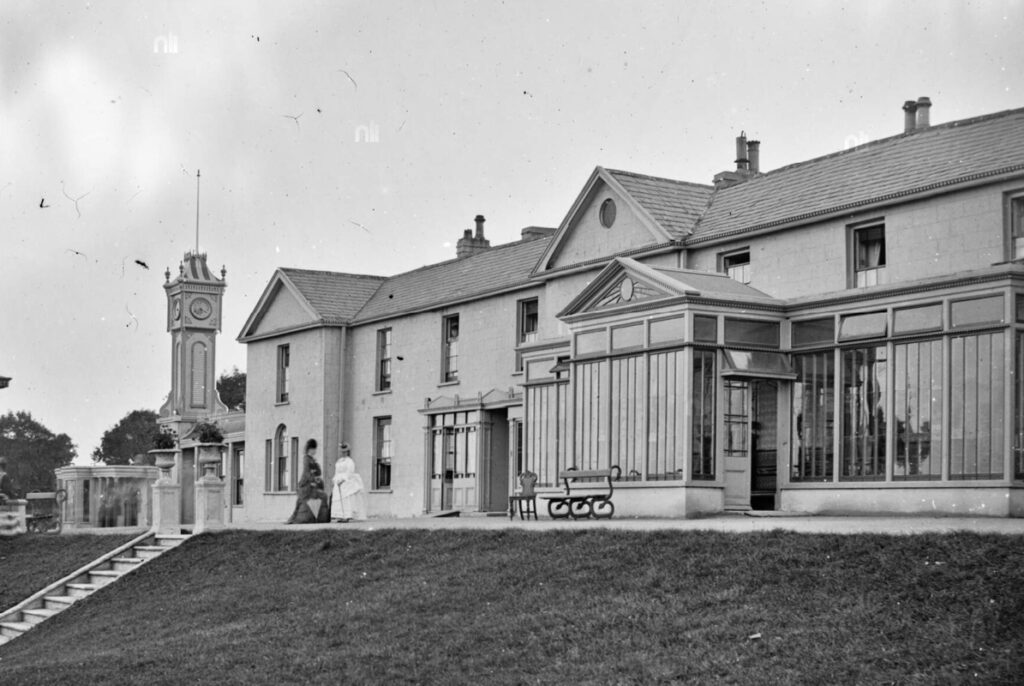
Cork’s famous “Hydro” was one of the most ambitious and successful health spas of its era in Europe. When its doors closed in 1953 it had been in operation for over a century, treating and entertaining the gentry and upper echelons of middle-class society in its luxurious complex of Turkish baths.
By 1859 it housed over 150 overnight guests; and at the grand opening of its third bath in 1870 seven hundred guests gathered to the music of the 63rd Regimental Band and the Rhine Band, with dancing until the late hours.
Perhaps that summer’s night in 1870 was the crowning moment in its owner Dr Richard Barter’s life; Barter, “a private gentleman of modest means”, was a man of extraordinary energy, ingenuity and enterprise. When his daughter Lizzie switched on the gas-lit illuminations across the grand glass copula that day in 1870, the light fell upon dozens of Colthurst, Dunscombe, Beamish, Maguire and Mahony ladies and gentlemen in their glittering finery. The best of Protestant and Catholic society had assembled to pay homage.
Impressive
This present monograph by Sinéad McSweeney and Professor Ronan Foley is yet another publication in the hugely impressive Maynooth Studies in Local History. There is something quite brilliant and Victorian in this careful, unexpected series published by the inimitable Four Courts Press.
The impulse to tell local stories, to make regional history available to a national reading audience, is certainly something Dr Barter would have approved of, as he had approved and insisted upon knowledge, sobriety and temperance as agents of a wider, public health.
While insisting upon health, Dr Barter was a man of enterprise. He and designer David Urquhart became figures of both praise and derision in medical circles, their complex of hydrotherapeutic baths formed the core of what was designed as a looser “health colony” in the manner of the more famous Gräfenberg resort in Germany.
Four generations of Barters kept the Hydro going and it prospered well into the 1930s. There was trouble in the 1920s, hardly surprising in the Co. Cork of that era. In one famous incident, a Hydro meet of the Muskerry Hunt was attacked by IRA volunteers; several IRA men beat the blameless horses with hurling-sticks in a very unpatriotic act while the mounted gentry responded with verve, lashing Ireland’s future Cabinet ministers with their riding crops.
In 1938 the complex became the setting for an Agatha Christie-style murder mystery by ‘Harriet Rutland’
The Hydro was bought from the last generation of Barters by Donegal-man Dr Quigley for £16,000 in 1945, nearly £900,000 in today’s money. Its Victorian sobriety had been cancelled by a liquor license and “he Hydro” while still offering healthy massage and steam was really a combination of luxury hotel and care home.
In 1938 the complex became the setting for an Agatha Christie-style murder mystery by ‘Harriet Rutland,’ the pseudonym of Olive Shimwell, whose microbiologist husband was chief brewer at the local Beamish and Crawford.
By then St Ann’s was a permanent home for retired army officers and their wives and others of modest private means. But the instinct for welcome and service allowed the management to still advertise “the Hydro” as a tourist hotel until the day it closed. And it did have some success in capturing a clientele who broke their annual tourist journeys to Killarney: celebrities like Paul Robeson and Charlie Chaplin were guests.
McSweeney and Foley with their superb end-notes and index have assembled a very important history in just these ninety pages. Their details of the Victorian enterprise and innovative engineering, of the frenetic energy and thoughtfulness of the Barter family, of the subtle religious gradations within the large staff structure, all help the reader to understand the vastness of the enterprise.
Our modern idea of the five-star hotel as a spa destination has its origin in Victorian enterprises like the St Ann’s Hydro. Hotel guests, nowadays, should always say a little prayer for the inventive Dr Richard Barter as they hold their glasses of prosecco aloft in the basement spa of some luxury Irish resort.