Before Fr Luke Macnamara OSB became a monk of Glenstal Abbey, Scripture scholar and Dean of Theology at Maynooth, he trained in medicine. At the bedside, where illness reached into questions of identity, fear and faith, he learned to listen.
He said: “There was a huge emphasis on the doctor-patient relationship and listening to the other, and listening to oneself and listening to the other, and giving people the time and the space. Not rushing from one patient, their issues, into the next consultation, but allowing people the space and the time to be, for their issues to emerge in a calm and reflective way with you.”
Those encounters, he says, brought him closer to God. He was “evangelised” by patients whose faith emerged at the most difficult moments of life. That early formation has become part of how he reads Scripture, teaches theology and accompanies students.
“Illness challenges your very identity and your existence,” he said. “My medical training does give me an insight into people’s humanity… So I think it’s not oppositional, it’s complementary.”
To the classroom
Though the setting has changed, the habit remains. For Fr Macnamara, the classroom has become another place where people are given room to explore. He said: “I go into a classroom and there could be 30 to 60 students, but I’m trying to create that space for them to explore and engage, and that would be a safe place to explore and engage.”
While theology “might seem old-fashioned to outsiders”, he said, “to those who actually engage with theology, it’s actually one of the more vibrant disciplines that is engaging with contemporary questions”.
Students are drawn, he said, to the way theology allows them to reflect on “really big issues today like truth, like justice, like the place of faith in the modern world”.
“There’s never been more questions for people growing up,” he said. “People are less certain and the world is a big mess.”
For Fr Macnamara, theology is not merely about information. Rather, it forms the ability to discern. He said: “We need a new wisdom in this world. We want a civilisation of love and that requires a wisdom. And that wisdom isn’t got from AI, it isn’t got from the internet. It’s got from listening to the Spirit and the Spirit at work in your life here and now in this world, with the resources of Scripture and tradition.”
Holding theology together
At Maynooth, that means resisting a fragmented approach to theology. Scripture, liturgy, canon law, sacramental theology, moral theology and pastoral theology, he said, have to speak to one another.
“I’m a Scripture scholar, I’m not just a Scripture scholar, I’m also a theologian,” Fr Macnamara said. “The moral theologian is not just a moral theologian. We have that shared space, which is really important.”
He saw that recently in an undergraduate course on Genesis 22, the binding of Isaac, which he described as “a very problematic text”. Over the semester, students read the passage through Christian and Jewish interpreters, as well as through art and music. “The students really connected with that,” he said. “Because they got to know the text more and more over time, they began to explore more and more theologically.”
For Fr Macnamara, good teaching is not simply about giving students information. Recalling Paul Valéry’s line that a great poet is one who inspires poetry in others, he said: “That’s what we want for our students.”
Formed within the Church
That concern for formation also shapes the way Fr Macnamara reads Scripture, especially Luke-Acts and the Acts of the Apostles. One idea he is quick to challenge is the image of St Paul as a lone heroic figure, struck by grace and immediately sent out on mission.
He said: “If you look closely at the Acts of the Apostles, he takes an awful long time to get going. He’s called in chapter nine, so he doesn’t go out on mission until 13, and even then he’s got Barnabas to take care of him until 15… Paul is formed within the Church, and I see that as a model for formation. People aren’t formed like lightning bolts from heaven. They’re formed within the Church community.”
For Fr Macnamara, Acts is not simply a record of apostolic activity, but of God working through the Church. He said: “It’s not really the Acts of the Apostles. It’s the acts of God. It’s God at work through certain apostles and communities.”
A vision not yet reached
Acts, for Fr Macnamara, gives the Church a vision without pretending that vision has already been reached. In the early chapters, the Christian community shares everything, breaks bread, prays together, and is united in “one heart and one mind”. It can be dismissed as idealised, he said, but it remains necessary.
The other part of Acts is really important, where it all goes pear-shaped at multiple points, to remind us that we’re not there yet”
“When you get married, if you don’t have a vision, you’re going to go nowhere,” he said. “If you have a shared vision, there’s something that will bear fruit… In the same way, I think we’re given this wonderful vision which is somewhat idealistic, but it’s also pointing to a destination. We’re not there yet, but it’s important to have it in our sights.”
The early Church is given not only a destination, but a way of travelling towards it: prayer, the breaking of bread, unity, and care for those in need.
But Acts is not naïve, as Fr Macnamara makes clear, time and again, the Church struggles, fails, and has to be redirected.
“The other part of Acts is really important, where it all goes pear-shaped at multiple points, to remind us that we’re not there yet,” he said. “And yet God works through the pear-shaped or the misaligned communities all the way through. Through it all, the Holy Spirit is at work.”

Meeting people on the road
There, Acts may speak powerfully to the Church in Ireland. Not as a handbook for restoring lost status, but as a witness to how God acts through uncertainty, weakness and redirection.
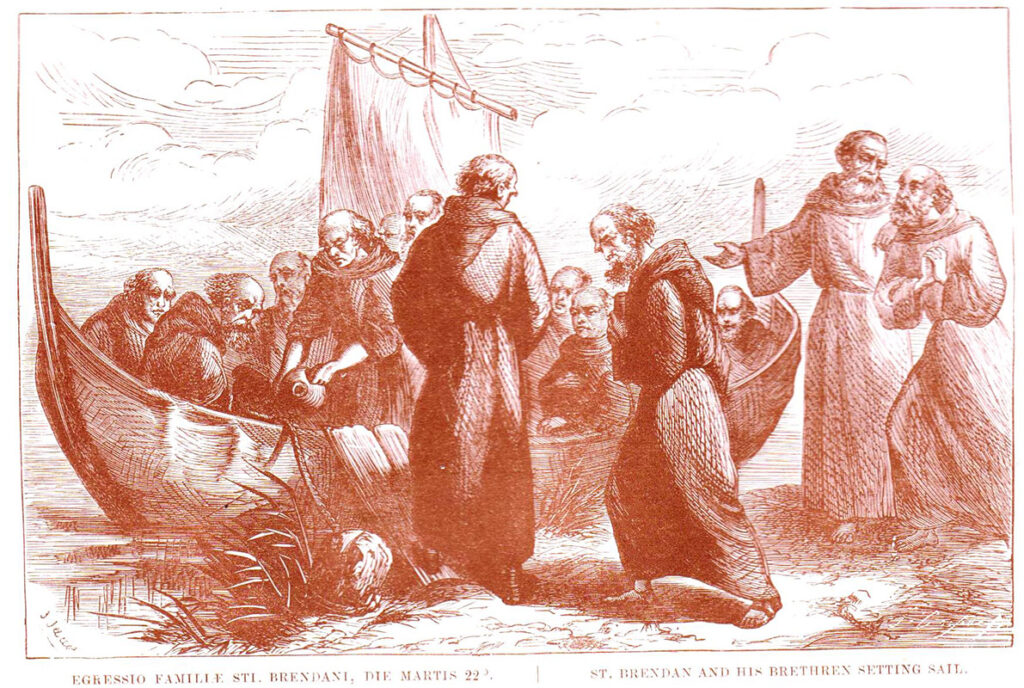
Fr Macnamara drew a connection between Acts 16, where Paul is called in a vision by the Macedonian, and St Patrick’s call to return to Ireland. “We have in Ireland Patrick being called by the vision of the Irishman, ‘come to the Irish’,” he said. “It’s just like the Macedonian in Acts 16. So, in a sense, that low point is almost seen in our patron saint. God working through the low points of the Church.”
The language of the road returned when Fr Macnamara spoke about the disciples on the way to Emmaus. Christ does not overwhelm them, he said. He meets them where they are.
“He meets them on the road where they are, and that’s how God meets us, where we are, where we’re at, with all our works and failings in that space, but talks to us in a way that we’re not overwhelmed, but journeys with us along the road.”
Even the language of “following” Jesus, he suggested, can be heard more richly. The Greek term, he said, carries a sense of the road, and of being with.
“I think that sense of journeying with is really important,” he said. “And I think that’s also what is coming out with synodality. We’re not just journeying together alone, but we’re journeying together with Christ in the Spirit.”
Scripture, for Fr Macnamara, does not speak to the Church from a distance. It meets people on the road, in the questions they actually carry. And that, perhaps, is where theology begins too: with attention to the person before you, and trusting that God is already walking with them.