The Bayeux Tapestry,
by Sue Brunning, Lloyd de Beer, Michael Lewis and Naomi Speakman
(British Museum Publications, £40.00 / €46.50)
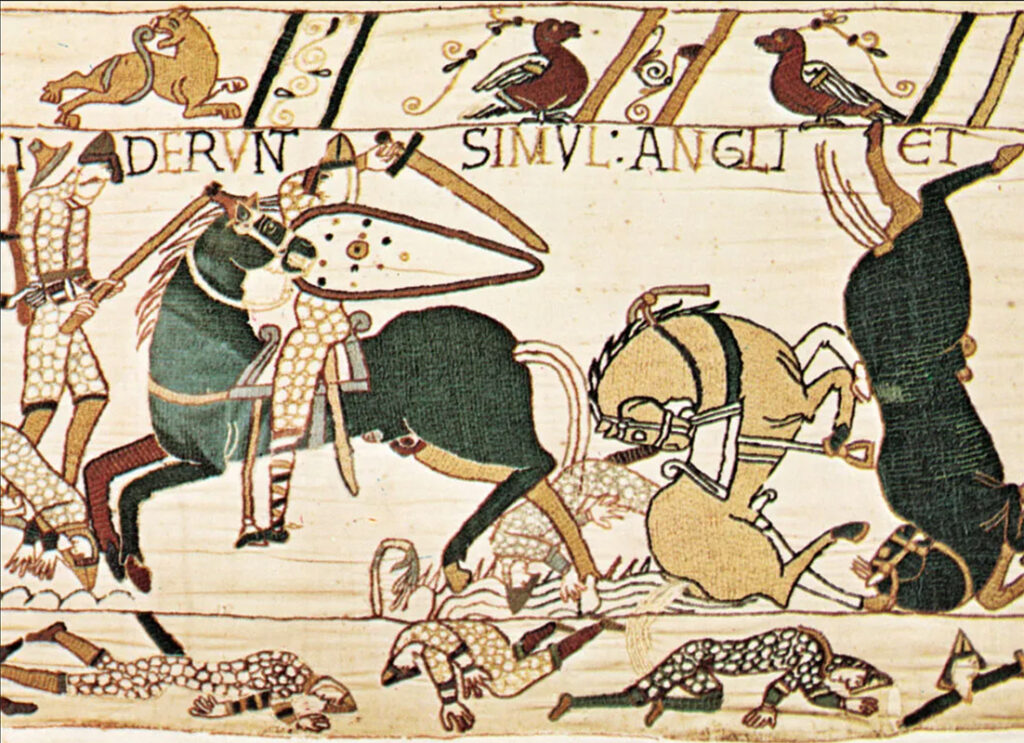
Today there opens in the exhibition galleries of the British Museum in London a much anticipated exhibition of the famous Bayeux Tapestry, a visual record of the Norman invasion of England in 1066 and the defeat of King Harold, last of the Saxon kings. It has been brought to London for reasons, of course, of higher politics rather than culture.
The exhibition runs until July 11, 2027, and ought to be seen. This book gives readers an up to the minute account of what is not known or thought by scholars about the Bayeux Tapestry.
Legacy
The publicity for the exhibition claims that 1066 “was the last time England was successfully invaded, and it is the year from which the modern monarchy dates itself.” But the incursion of William of Orange in September 1688 was that; and it is from that act of settlement that followed the overthrow of the Stuarts that the modern monarchy derives, the throne now being in the power of parliament to grant or withdraw.
But the British, as much as any nation, love their little myths of national destiny. The Bayeux Tapestry is essentially a sort of giant political cartoon justifying the Norman coup d’état.
Over the next year Irish people visiting London should go out of their way to see this great piece of craft skill, which was the creation, not of Norman ladies, but Saxon female needle workers, probably nuns, possibly at Canterbury.
The influence of the Normans affected other parts of Europe. They were a world power; and Ireland and England only a part of their empire building”
It may deal with an invasion of Britain in 1066; but for Irish people it also provides a notion of what the Norman invasion of Ireland in 1169 was like. The armour, the ships, the castle building, the brutal slaughter of war that swept across Ireland from Bannow Bay are all prefigured.
But it should also be recalled that the influence of the Normans affected other parts of Europe. They were a world power; and Ireland and England only a part of their empire building. There are those who would argue that as a world figure Count Roger, King of Sicily and Africa, who welcomed numerous Arab scholars to his court, was a monarch of more universal importance than William I of England.