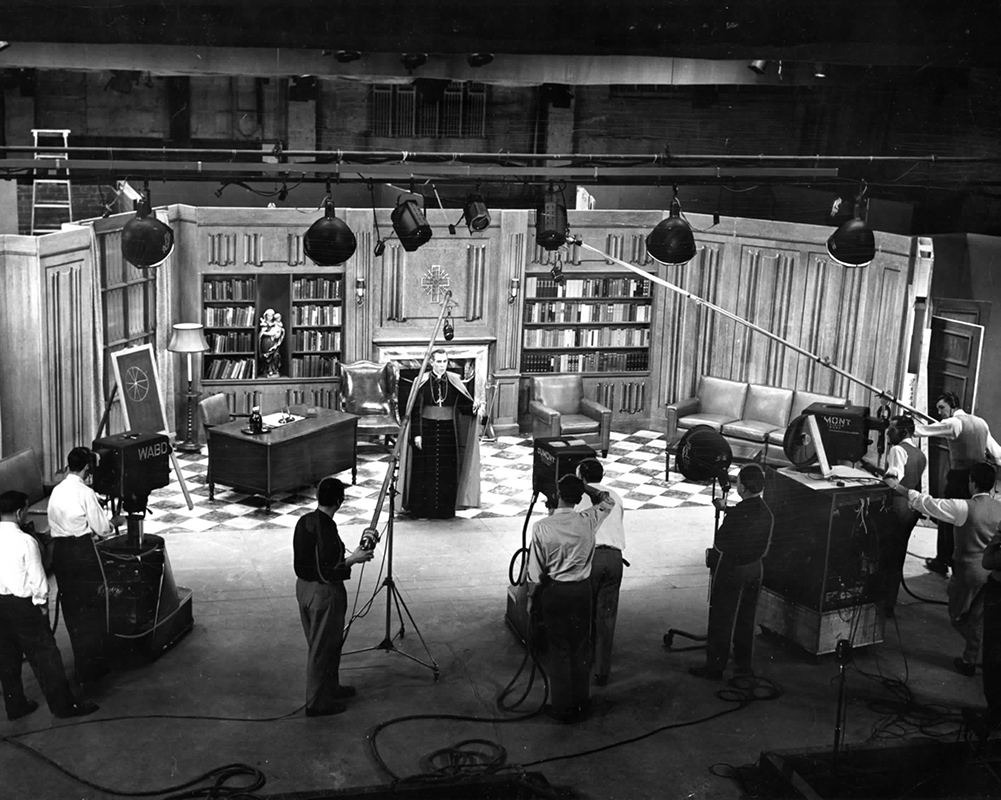
On September 24, the Catholic Church will beatify Venerable Fulton J. Sheen in St Louis. For many Catholics, particularly in the United States, it will be the long-awaited recognition of one of the most recognisable Catholic figures of the twentieth century.
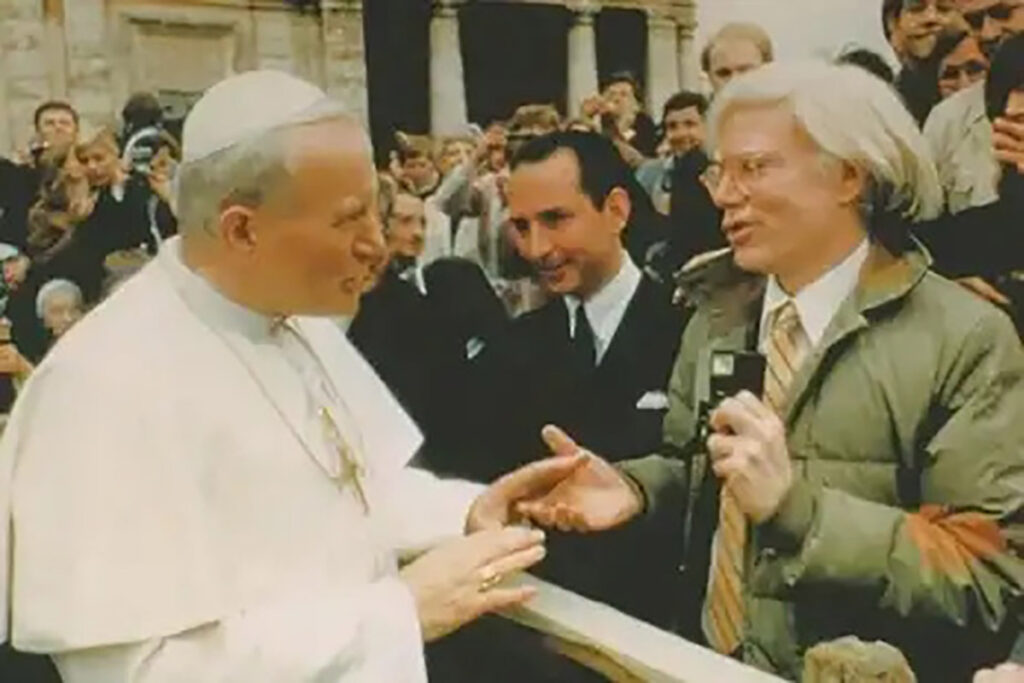
Yet Sheen should not be remembered merely as the famous bishop who appeared on television with a blackboard and a dramatic pause. There was something much larger behind this television personality. Sheen was a real missionary. He happened to discover that the mission field could also be a radio studio, a television station, a newspaper, a lecture hall – and eventually, for millions of people, the living room.
The Gospel enters the modern world
Sheen understood something which the Church has sometimes struggled to understand: modern means of communication are not necessarily enemies of the Gospel. They can be its instruments. The question is not whether Catholics should use them, but what they will use them for. Beginning in 1930, Sheen became the presenter of The Catholic Hour, a weekly radio programme which eventually reached an estimated four million listeners.
In 1940, he participated in what was described as the first broadcast of a Catholic religious service on television. Then, in 1951, came Life is Worth Living. The programme was broadcast opposite the immensely popular entertainment programme of Milton Berle. Sheen nevertheless attracted audiences which eventually reached around 30 million viewers a week and won an Emmy Award in 1952. But the numbers alone do not explain Sheen’s success.
From television to the missions
There is, however, a danger in remembering Sheen principally as “the Bishop of Television”. It can make us forget that, in the middle of his extraordinary media career, he was also deeply involved in the Church’s missionary work.
In 1950, Sheen became National Director of the Society for the Propagation of the Faith in the United States, a position he held until 1966. The task brought him into direct contact with the needs of Catholic missions throughout the world. He travelled, preached, raised funds and tried to awaken Catholics to the fact that the Church was not an American or a European institution, but was the universal Church. This missionary dimension produced one of his most beautiful and enduring contributions: the World Mission Rosary.
Sheen understood that missionary activity begins before the missionary arrives. It begins in prayer”
In 1951 Sheen introduced a Rosary whose five decades were represented by different colours, symbolising the continents of the world. Green represented Africa, red the Americas, white Europe, blue Oceania and yellow Asia. The purpose was simple: when Catholics prayed the Rosary, they should remember that they were praying not merely for themselves, but for the whole world.
The parish Rosary became then a missionary prayer. The elderly woman praying in her home, the child learning the Rosary, the priest praying before Mass – all can participate in the Church’s ad gentes mission. Sheen understood that missionary activity begins before the missionary arrives. It begins in prayer. And perhaps this is why the World Mission Rosary is such a fitting symbol for his beatification. Seventy-five years after Sheen created it, it will again be prayed in preparation for his beatification.
The Little Flower and the great mission
There is another person who helps us understand Sheen: St Thérèse of Lisieux. At first sight, she seems an unlikely companion for America’s great television evangelist. She lived hidden behind the walls of a Carmelite convent. She travelled nowhere. She preached to no crowds. She never appeared on television. Yet she was declared Patroness of the Missions. Why? Because Thérèse discovered that missionary work is ultimately a work of love. And Sheen understood this profoundly.
His missionary vision was not simply about statistics, institutions or money. The purpose of mission was the salvation of souls. This connection between Sheen and the Little Flower becomes particularly interesting for Irish Catholics because it is not merely theoretical.
Sheen had a genuine connection with Ireland and with Dublin’s Carmelite tradition. He was a regular visitor to the Carmelite Church of St Teresa on Whitefriar Street, Dublin, and in 1973 he preached a novena there commemorating the centenary of the birth of St Thérèse of Lisieux. Recordings of those conferences survive.
There is something almost providential about this. The great media evangelist, who had spoken to millions through radio and television, came to a Dublin Carmelite church to speak about a young nun who spent her life in apparent obscurity. But perhaps Sheen knew exactly what he was doing. The media can make a person visible but it is sanctity which makes visible Christ.
An Irish-American bishop
The Irish connection goes deeper still. Fulton Sheen was born in El Paso, Illinois, in 1895, into a Catholic family of Irish descent. His parents’ families traced their roots to Ireland, and Sheen remained conscious of his Irish Catholic heritage. It is perhaps no surprise, therefore, that his voice found a particular resonance among Irish Catholics.
Perhaps that missionary outreach of his is a better summary of Catholicism than any biography could provide”
In 2014, when his cause for canonisation was temporarily suspended, The Irish Catholic reported that the development was a “blow” to Irish devotees. Fr John Hogan described Sheen as one of the great modern evangelists and major catechists for younger generations, noting that many young people in Ireland had encountered him through recordings and video clips.
There is also a rather charming historical irony here. Sheen was born into an Irish-American Catholic culture, travelled the world as a missionary, became one of the first great Catholic television personalities, and eventually came to Dublin to speak about a French Carmelite nun whose spirituality was based upon doing small things with great love. Perhaps that missionary outreach of his is a better summary of Catholicism than any biography could provide.
What will we do with Fulton Sheen?
The beatification of Fulton Sheen should not become an exercise in nostalgia. It would be very easy to look backwards and say: “What a wonderful time it was when millions of people watched a Catholic bishop on television.” But Sheen himself would probably ask a different question. What are we doing with the means of communication we have today?
He lived at the beginning of the television age. We live in the age of podcasts, YouTube and artificial intelligence. Sheen had a blackboard. We have screens in our pockets. He had one weekly television programme.
He was not primarily an entertainer. He was a priest who believed in the power of grace, a bishop who believed in the universality of the Church”
Today, anyone can potentially speak to the whole world. The technological circumstances have changed. The missionary command of Christ has not. Sheen’s historical importance, therefore, is not that he provides us with a template to imitate mechanically. We do not need another Fulton Sheen impersonator. We need Catholics who possess the same missionary confidence: the conviction that the Gospel is worth explaining, worth defending and worth proclaiming – even in places where people have stopped expecting to hear it.
That will be the subject of a second reflection on Sheen: not simply what he accomplished, but what his work, his style and now his beatification might mean for the Church in the world and in Ireland.
For the moment, however, perhaps the most important thing is to remember the man behind the screen. He was not primarily an entertainer. He was a priest who believed in the power of grace, a bishop who believed in the universality of the Church, a missionary who believed in the salvation of souls, and a Catholic who understood that wherever people are gathered – whether in a parish church, a mission territory, a radio audience or a television living room – Christ must be brought there.
And perhaps this is the most provocative question his beatification leaves before us in Ireland: If Fulton Sheen were given our microphones, our cameras and our smartphones today, what would he say – and would we have the courage to listen?