For my fortieth anniversary of priesthood I made a little bucket list of things I hoped to do during the year. Many were decidedly pleasurable, but I wanted a few challenges as well.
One was making the traditional Three Day Pilgrimage to Lough Derg.
Lough Derg — St Patrick’s Purgatory on Station Island in Co. Donegal — was somewhere I had known about since childhood. My mother had gone there several times, as had many friends and colleagues. Nothing I heard about their experiences particularly attracted me. Somehow this rather severe penitential practice didn’t fit comfortably into what I considered my ‘spirituality’.
But pilgrimage often begins with an invitation.
Earlier this year a friend, who had been to Lough Derg many times but not for over twenty years, was planning to return. He asked if I would join him. For reasons I cannot fully explain, the time seemed right to say yes.
Almost everyone I told tried to put me off. There were horror stories about starvation, sleepless nights, sore feet and three days without shoes. There were moments when I considered quietly withdrawing. By the time the day arrived our original group of five had dwindled to two. That didn’t exactly help!
What kept me going was the decision to make the pilgrimage not simply for myself but for others.
Diagnosis
A close family member had recently received a diagnosis of leukaemia. I was conscious too of friends and parishioners struggling with mental health difficulties. And I carried another, more personal intention: to acknowledge and make reparation for people I may have hurt, disappointed or failed during forty years of priesthood.
The pilgrimage began at midnight on Sunday with the fast. I had stayed in a hotel to break the journey and, leaving early on Monday morning, the smell of rashers and sausages drifting from the breakfast room provided the first test of my resolve.
The accommodation on the island transported me back more than fifty years to boarding school: cubicles, bunk beds and very little luxury. But the first real sign of the challenge ahead came when we removed our shoes and socks.
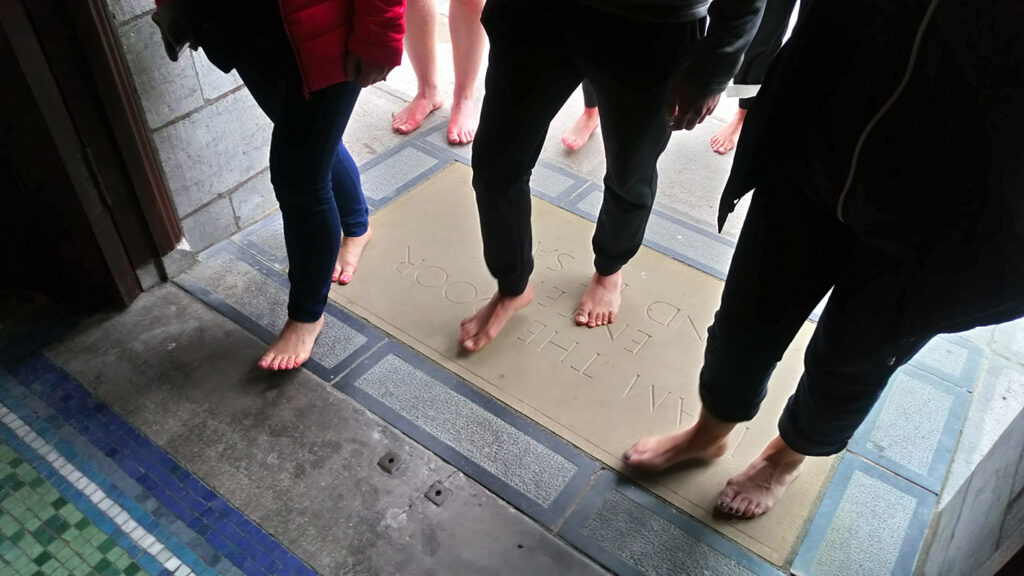
The bare feet proved the most difficult part of Lough Derg for me — and strangely, they have also become one of my most abiding memories.
Take off your shoes, for the place where you stand is holy ground”
There is something vulnerable about taking off your shoes. We spend our lives protecting our feet from the ground beneath us and suddenly there is nothing between you and the earth. You feel every stone and every rough edge. You also become remarkably good at spotting the smoother route!
Somewhere along the way I thought of Moses before the burning bush and God’s words to him: “Take off your shoes, for the place where you stand is holy ground.”
There is something of that in Lough Derg. For centuries pilgrims have walked barefoot across those same stones carrying their prayers, griefs, gratitude and sometimes their desperation. The stones may be hard underfoot, but they are sacred ground, made holy by generations who came there searching for God.
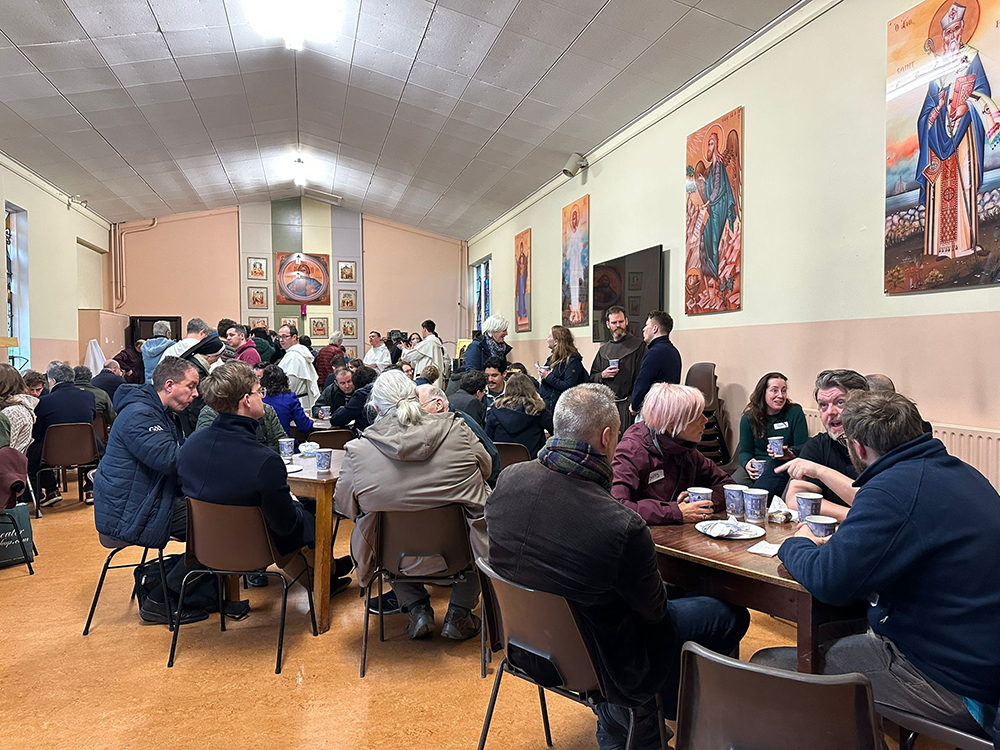
Bare feet are also a great leveller. There were more than 150 pilgrims: young and old, priests and religious, businesspeople and students, even a few faces you might recognise from television. Once the shoes came off, none of that seemed to matter. Nobody’s feet looked particularly important!
Synodality
If synodality means the members of the Church walking together, then Lough Derg must surely be synodality on steroids. There we were, literally walking together — sometimes painfully, occasionally searching for the smoothest stone — but all in our bare feet.
Perhaps that is not a bad image of the Church: pilgrims making their way together over uneven ground, sometimes hurting, sometimes stumbling, but trusting that the ground beneath us is, after all, holy.
At the heart of the pilgrimage are the Nine Stations and the twenty-four-hour Vigil. The Stations involve walking and kneeling around the ancient penitential beds while repeating the Our Father, Hail Mary and Creed.
Again and again.
The island and lake disappear into darkness while inside the long night unfolds through prayer, Scripture, reflection, the Rosary and silence”
Eventually prayer becomes less something happening in your head and more something involving your whole body. Bare feet, tired legs, hunger, kneeling, silence and repeated prayer all become part of the offering.
The Vigil begins around 10 o’clock on the first night and continues until approximately the same time the following night. The penitential beds are walked only during daylight, so the night-time Vigil takes place entirely inside the Basilica.
Outside, the island and lake disappear into darkness while inside the long night unfolds through prayer, Scripture, reflection, the Rosary and silence. As the hours pass, tiredness takes over. Your feet hurt, you are hungry and eventually you haven’t the energy for complicated prayers.
Our Father…
Hail Mary…
I believe in God…
You simply keep going.
And then daylight returns.
That image will remain with me: having literally prayed through the darkness and then watching the light return.
Difficulty
Everything people told me about the difficulty of Lough Derg was true. It will not be for everybody and for sixty years it had no place on my spiritual horizon.
And yet…
My abiding memory is not of deprivation or discomfort but of a profoundly enriching spiritual experience.
There was an emptying — almost a decluttering of the soul — which created a space for God that I don’t often allow in my busy life. I had neither intended nor expected to celebrate the Sacrament of Penance there, but in the midst of that emptying it became the most natural thing in the world to do. I am very glad it happened.
I rediscovered too the power of traditional prayer. The Rosary, Our Father and Hail Mary — prayers so familiar we can sometimes dismiss them too easily — took on a different quality. Their repetition became almost a mantra carrying you somewhere beyond words.
And then there were the people.
So many stories. So many intentions. So many bare feet”
A young journalist hoping to make a career in music; a successful businessman who first came to Lough Derg with his fiancée more than twenty years ago; a mother giving thanks for the recovery of a daughter who had been given little hope; a woman carrying the pain of loving a husband for whom faith means nothing.
So many stories. So many intentions. So many bare feet.
I was struck by the people working on the island. The liturgy and music were beautiful. A young cantor had just completed her Leaving Cert and hoped to study music. A young woman from Chile quietly looked after the sacristy. Fr La Flynn, coming to the end of nine years as Prior, had clearly left his mark on the island.
One young man particularly impressed me. Odhrán from Derry, twenty-five years old, an Oxford graduate now pursuing doctoral studies in engineering, gave the opening reflection for our Vigil. His grasp of scripture, theology and the spirituality of Lough Derg was quite extraordinary.
I am often part of conversations about where we might find the “green shoots” of faith and hope in the Irish Church.
On Station Island I think I saw some of them.
Perhaps there was something wonderfully appropriate about where they were growing — among the ancient stones, surrounded by people carrying burdens and hopes, prayers and questions.
Green shoots growing through the rocky ground.
And a Church, quite literally, walking together in bare feet.