Joe Sheridan’s GAA journey and an infamous afternoon in Croke Park
The 2010 Leinster football final will probably always be remembered for what happened after the final whistle rather than what happened during the 70 minutes that preceded it.
For much of the afternoon, it appeared that Louth’s 53-year wait for a Leinster title was finally about to end. The Wee County had emerged as the surprise package of the championship, defeating Longford, Kildare and Westmeath to reach the provincial decider against their neighbours, Meath. With the clock ticking into injury time, they stood on the brink of completing one of the great provincial fairy tales.
J.P. Rooney’s spectacular goal seven minutes from time had put Louth within touching distance of glory. But with the allotted three minutes of added time already elapsed, Meath found the unlikeliest of escape routes.
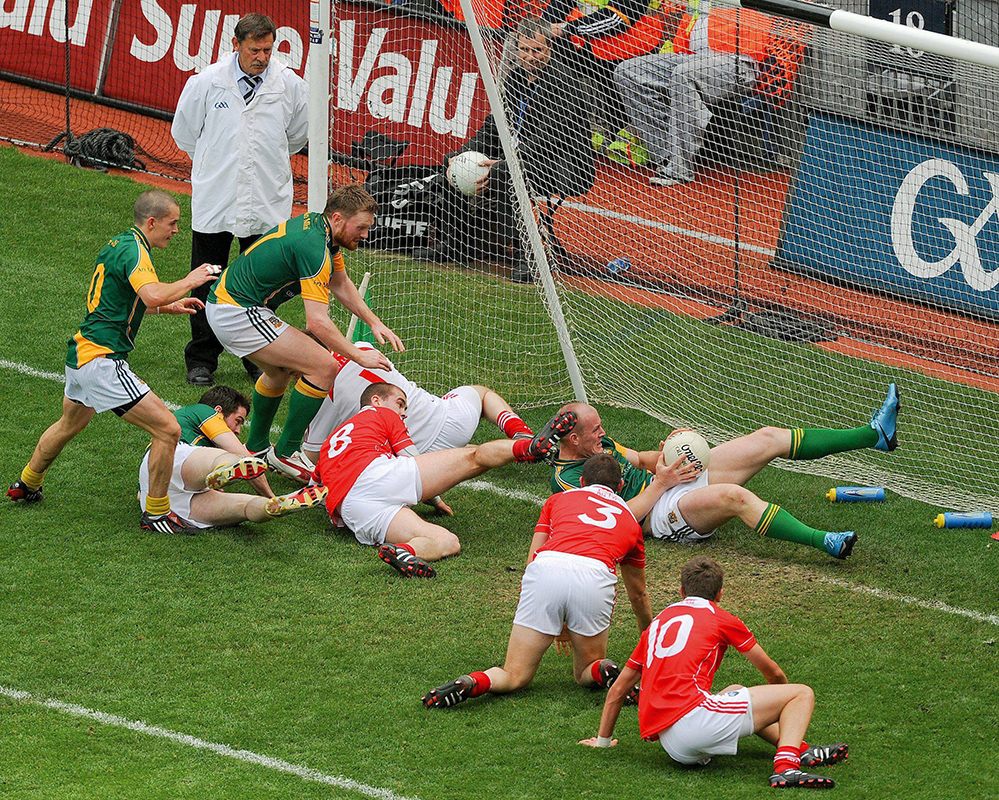
The towering Joe Sheridan latched onto a rebound in the Louth square and was bundled over the line before having the chance to kick the ball in a finish that resembled something more a rugby try than a goal. Referee Martin Sludden awarded the goal before blowing the final whistle immediately after, handing Meath a dramatic victory and denying Louth their first Leinster title since 1957.
Television replays appeared to show that Sheridan had carried the ball over the line, while the Louth players and supporters were incensed by the decision. What followed was an extraordinary and ugly aftermath.
Stormed
Louth supporters stormed the pitch and pursued Sludden from the field, forcing the Tyrone official to be escorted away by Gardaí. Bottles were thrown from the stands, with one striking a steward. The scenes were broadcast live to the nation and sparked widespread condemnation, with senior politicians weighing into the controversy with calls for the game to be replayed.
Yet, no replay ever came. For the Royals, the Leinster title remained theirs, a first since 2001, but the circumstances surrounding it cast a shadow over what should have been a moment of triumph and glory.
The controversy followed Meath into the rest of the championship as players were repeatedly confronted by claims that their provincial title was tainted. Meath’s year came to an end against Kildare three weeks later with the lilywhites storming to a surprising 2-17 to 1-12 victory.
It was obviously very disappointing how things ended, and it left a sour taste in the mouth, but it’s something that I look back on, and I’m still proud to have won a Leinster title”
“To be honest, we probably didn’t get a grasp of what was actually going on until we got in afterwards and saw the reports on the Sunday Game. We sort of rushed off and got in for the trophy presentation and didn’t get much of a gauge for what was actually happening.”
“It was obviously very disappointing how things ended, and it left a sour taste in the mouth, but it’s something that I look back on, and I’m still proud to have won a Leinster title.”
“It’s just unfortunate how it ended, but that’s sport, and you just have to move on from it. There would have been stuff afterwards; you’d have heard in the media that it was a tainted Leinster title, that we didn’t deserve it and that it should have been taken off us and all this sort of stuff. That definitely took a lot of energy out of us between that and the quarter-final against Kildare.”
Fifteen years later, the story finally came full circle. In 2025, the Wee County defeated Meath 3-14 to 1-18 in a thrilling provincial decider, finally claiming the title that had seemed destined to be theirs all those years earlier.
Emergence
For Sheridan, Louth’s emergence as a genuine force in the modern game, alongside Meath’s own resurgence, is something to be welcomed. With Dublin’s once-unchallenged dominance of Leinster increasingly under threat, the province is beginning to rediscover the competitiveness that had been missing for so long.
“Things move on and people move on. Louth have really kicked on in the past couple of years, and you’ve seen this year their performances and how impressive they have been. It’s great to see it, and it’s great to see the competitiveness of Leinster football again. It’s great for Louth football and football in the province because everyone is only going to get stronger from playing each other.”
Yet Sheridan’s own journey to that infamous afternoon in Croke Park had been anything but straightforward. Joe spent much of his formative years across the Irish Sea. Born in 1984, he was just three years old when his parents moved the family to Birmingham, where they would remain for the next decade. It was there that Sheridan first developed his love for Gaelic football.
He joined John Mitchel’s GAA Club in Birmingham, where the family became immersed in the city’s Irish community and the club’s thriving underage setup. Based at Páirc na hÉireann in Solihull, on the outskirts of the city, John Mitchel’s provided Joe and his siblings with their first real grounding in the game.
Far from being isolated from the GAA in Ireland, the young Sheridan was regularly brought back across the Irish Sea for Féile competitions. It was through those experiences that his connection with the sport deepened.
Birmingham
“I was born in ‘84, and when I was three, we moved to Birmingham. We were over there for ten years. I played with a club called John Mitchel’s over there, and there were obviously a lot of Irish people over there at the time. That is where we got the love of the game. We’d come over here for Féiles, going to places like Wexford, Donegal and Waterford, and that’s how we learned the game.”
“Back in ‘96 we moved home to Navan, and then we moved out to Seneschalstown a couple of years later, and that’s where we’ve been ever since. It’s a rural club about eight miles outside Navan. It’s a great community with great people. It wasn’t a linear path for us; it was country to country and club to club.”
“It was definitely a change. I was delighted to move back. We used to come home every summer for holidays, but coming from a big city like Birmingham, it was a different culture and a different way of life. School was obviously very different. Coming back here, it was a lot more slow-paced than life in Birmingham, but the football was the same, and it was great to get straight back into it.”
Gaelic itself has changed immeasurably even since Sheridan’s playing days came to an end in 2017. The sweeping reforms introduced by the Football Review Committee have transformed a game that had become increasingly defined by blanket defences, slow build-up play and the era of so-called ‘puke football’.
It’s absolutely brilliant because the more teams competing at the top level, the better, and long may it continue”
For Sheridan, the changes have brought Gaelic football back towards the version he believes supporters want to see. However, perhaps more significantly, he believes the new rules have not simply made the game stronger. Instead, they have given less fancied teams the freedom to believe they can compete.
“It’s incredible how the game has changed. It’s great to see. Back when I was playing, it wasn’t too bad in terms of the blanket defences and the sweepers, so we were lucky enough, but the new game is great. It’s brought football back to where it should be: free-flowing, free-scoring, high-fielding football, and that’s what we all want to see.”
“It’s absolutely brilliant because the more teams competing at the top level, the better, and long may it continue. You look at the likes of Westmeath winning the Leinster Championship this year, or Mayo. They were probably closer to winning an All-Ireland seven or eight years ago, but with the new rules it takes the pressure off them in a way and allows you to play with freedom and it’s just amazing what can happen.”