For where two or three are gathered in my name, I am there among them
The Gospel
Matt 18:15 [Jesus said:] “If another member of the church sins against you, go and point out the fault when the two of you are alone. If the member listens to you, you have regained that one.
Matt 18:16 But if you are not listened to, take one or two others along with you, so that every word may be confirmed by the evidence of two or three witnesses.
Matt 18:17 If the member refuses to listen to them, tell it to the church; and if the offender refuses to listen even to the church, let such a one be to you as a Gentile and a tax collector.
Matt 18:18 Truly I tell you, whatever you bind on earth will be bound in heaven, and whatever you loose on earth will be loosed in heaven.
Matt 18:19 Again, truly I tell you, if two of you agree on earth about anything you ask, it will be done for you by my Father in heaven.
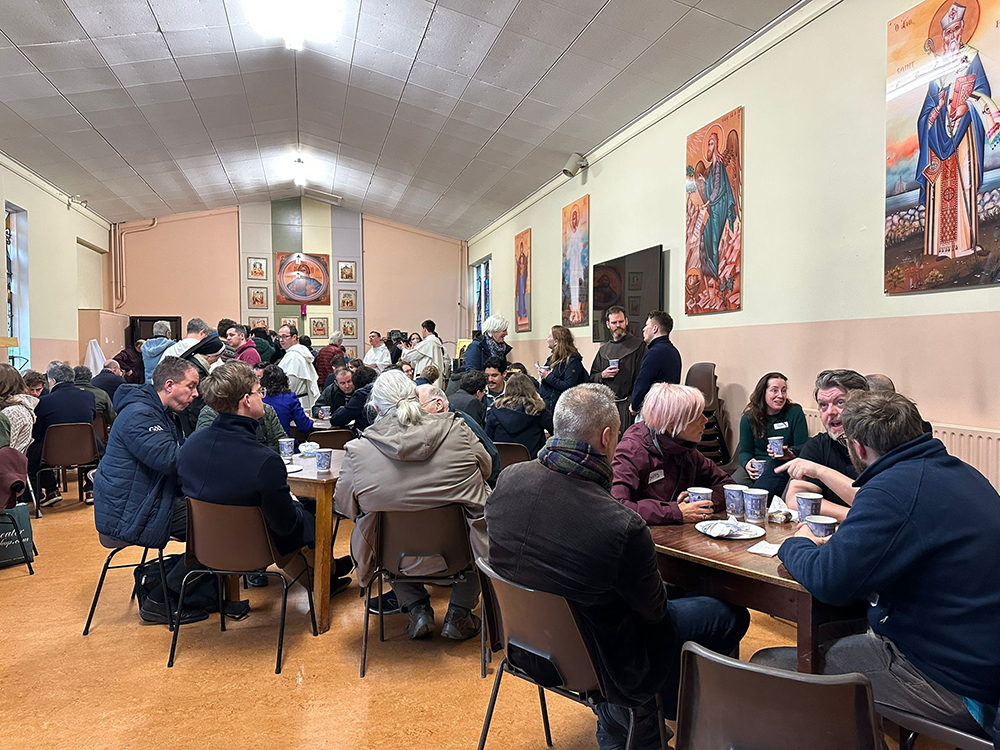
Matt 18:20 For where two or three are gathered in my name, I am there among them.”
‘If your brother does something wrong, go and have it out with him alone, between your two selves. If he listens to you, you have won back your brother. If he does not listen, take one or two others along with you: whatever the misdemeanour, the evidence of two or three witnesses is required to sustain the charge. But if he refuses to listen to these, report it to the community; and if he refuses to listen to the community, treat him like a gentile or a tax collector. ‘In truth I tell you, whatever you bind on earth will be bound in heaven; whatever you loose on earth will be loosed in heaven. ‘In truth I tell you once again, if two of you on earth agree to ask anything at all, it will be granted to you by my Father in heaven. For where two or three meet in my name, I am there among them.’ (New Jerusalem Bible)
Initial observations
(i) A text similar to this, but much shorter and less repelling, may be found in Luke 17:3-4: “Be on your guard! If another disciple sins, you must rebuke the offender, and if there is repentance, you must forgive. And if the same person sins against you seven times a day, and turns back to you seven times and says, ‘I repent,’ you must forgive.”” The elaborate procedural instructions are unique to Matthew and seem to reflect the practice of the community for which he was writing.
(ii) There is a bit of a problem with the NRSV translation at this point. The Greek original does not use language like “member” and “church”, which can make the text reflect a much later institutional development. Instead, the Greek says (as in traditional versions) “brother”, bearing in mind that in Greek “brother” in this context means a disciple, whether male or female.
Likewise, instead of “church” the Greek uses “assembly”, a very ordinary word meaning any kind of official gathering of a group. That is why, for instance, Paul always says “the church of God”, lit. the “assembly of God” to make it clear we are dealing with a gathering of believers and not just any gathering. So, Matthew did not write “member of the church”, simply “brother”. Neither did he write “church”, but simply “assembly”—the NJB gets is right, although it does not succeed in inclusive language. “Member of the family of God” would be correct but perhaps cumbersome.
(iii) It is not historically probable that Jesus instructed the disciples to treat fellow-believers as tax collectors and sinners, with the meaning of excommunication. Jesus’ practice is precisely the opposite, to include tax collectors and sinners. It would seem, therefore, that here we have a local development designed to deal with a new situation—hardened, unrepentant sinners within the community—with appropriate procedures, expressed unfortunately in language which takes us back to attitudes which pre-date the ministry of Jesus. Where there Holy Spirit is in all this is anyone’s guess!!!
(iii) As regards forgiveness and excommunication, there is a similar text in John 20:22-23: “When he had said this, he breathed on them and said to them, “Receive the Holy Spirit. If you forgive the sins of any, they are forgiven them; if you retain the sins of any, they are retained.””
Kind of writing
This is a combination of moral instruction, community procedure and spirituality.
Old Testament background
So you, mortal, I have made a sentinel for the house of Israel; whenever you hear a word from my mouth, you shall give them warning from me. If I say to the wicked, “O wicked ones, you shall surely die,” and you do not speak to warn the wicked to turn from their ways, the wicked shall die in their iniquity, but their blood I will require at your hand. But if you warn the wicked to turn from their ways, and they do not turn from their ways, the wicked shall die in their iniquity, but you will have saved your life. (Ezekiel 33:7–9)
New Testament foreground
(i) The practice of expulsion (excommunication, shunning) may be noticed in all types of voluntary associations which have to deal with non-compliant members. Later on, in the developed penitential practice of the patristic church, sinners were expelled (lit. excommunicated) for a temporary period (often Lent), a penance was imposed and upon successful completion the sinner was re-admitted, usually at the Easter Vigil (originally penance came before absolution). Today’s text shows us the early development of this practice. Behind it lies a theology of community which gives great theological status to the decisions of the community. This equating of the community’s decisions with God’s—always risky—is also reflected in John 20:22-23 and even, when we read it carefully, in the Lord’s Prayer: “And forgive us our sins, for we ourselves forgive everyone indebted to us.” (Luke 11:4)
(ii) Being reconciled before prayer is a teaching of the Sermon on the Mount (Matt 5:21-26), which provides the important counterpart to our passage today.
(iii) The presence of Christ in the community—reflected in the much-loved v.20—is a theme in this Gospel. At the very start, Jesus is identified as Emmanuel, God-with-us (Matt 1:23) and at the end, the Risen Lord promises “to be with you always to the end of time” (Matt 28:20).
(iv) The practice of “mutual confession” is also in James 5:16 “Therefore confess your sins to one another, and pray for one another, so that you may be healed. The prayer of the righteous is powerful and effective.”
St Paul
For by the grace given to me I say to everyone among you not to think of yourself more highly than you ought to think, but to think with sober judgment, each according to the measure of faith that God has assigned. For as in one body we have many members, and not all the members have the same function, so we, who are many, are one body in Christ, and individually we are members one of another. We have gifts that differ according to the grace given to us: prophecy, in proportion to faith; ministry, in ministering; the teacher, in teaching; the exhorter, in exhortation; the giver, in generosity; the leader, in diligence; the compassionate, in cheerfulness.
Let love be genuine; hate what is evil, hold fast to what is good; love one another with mutual affection; outdo one another in showing honour. Do not lag in zeal, be ardent in spirit, serve the Lord. Rejoice in hope, be patient in suffering, persevere in prayer. Contribute to the needs of the saints; extend hospitality to strangers. (Romans 12:3–13)
Brief commentary
Most of what I have to say is found in the remarks above, but the following may help.
Verse 15 A brother/sister i.e. fellow-believer is meant. The sin is against you, i.e. some break-down between the two of you. The first step is discreet “between you and him/her alone”. This is to avoid embarrassment. Naturally, it would take courage.
Verse 16 This follows a well-recognised judicial practice from the Deuteronomy: On the evidence of two or three witnesses the death sentence shall be executed; a person must not be put to death on the evidence of only one witness. The hands of the witnesses shall be the first raised against the person to execute the death penalty, and afterward the hands of all the people. So you shall purge the evil from your midst. (Deuteronomy 17:6–7). The second step is also relatively confined.
Verse 17 It is only at this stage that the whole business becomes public. Three times the brother/sister has been given the opportunity to be reconciled—only then is the drastic action of exclusion considered.
Verse 18 I.e. admitting into or removing people from the community of salvation.
Verse 19 Matthew says nothing about the likelihood of two or three agreeing!
Verse 20 A justly famous verse, giving great comfort and consolation.
Pointers for prayer
- At the time Matthew was writing his gospel local church communities would have numbered no more than fifty people. They would be known to one another. Matthew presents the instructions of Jesus for dealing with people whose behaviour disrupted and harmed the community. Note the steps suggested. Simple directions but many of us do otherwise. We avoid difficult confrontations. We talk about the faults of others to everyone but themselves. We go over the head of someone who displeases us and make complaints. In your experience, which approach is life-giving for you and for others?
- While Jesus is referring to a group situation, the advice can be applied also to personal difficulties and problems with others. What lessons has life taught you about constructive ways of dealing with conflict?
- Jesus also recognises that there are limits to what we can do in resolving conflicts. We may reach out, but if the other person does not respond the matter is out of our control. Let such a one be to you as a Gentile and a tax collector suggests having nothing more to do with that person. But that is not the last word because Gentiles and tax collectors were precisely the kind of people to whom Jesus reached out. So while for the moment we may have nothing more to do with a person who has hurt us, we leave the door open for the future.
- As individuals and communities we have the power to bind and to loose, to exclude people from relationship, or to open up and include others in relationship. When have you found it important to acknowledge this power in your own life?
- There is great assurance in the promise of Jesus in v. 19, but he seems to promise more than we experience. What has been your experience of praying with others for something you wanted God to grant?
- Jesus also promises to be with his followers when they gather together. What does that mean to you? How have you experienced the presence of Jesus in his followers gathered together?
Prayer
Confirm, O God, in unity and truth the Church you gather in Christ.
Encourage the fervent, enlighten the doubtful, and bring back the wayward.
Bind us together in mutual love, that our prayer in Christ’s name may be pleasing to you.
Grant this through our Lord Jesus Christ, your Son, who lives and reigns with you in the unity of the Holy Spirit, God for ever and ever. Amen.
Thought for the day
Our Gospel reading today has some harsh dimensions and most likely it reflects not the teaching of Jesus directly but the practices in the church for which Matthew was writing. People who refuse to acknowledge their failures are to be treated as pagans and tax collectors! But just how are pagans and tax collectors treated by Jesus and in the Gospel of Matthew? They are welcomed and forgiven! Any permanent exclusion is to be resisted on the example and teaching of Jesus himself.
Prayer
We believe your word to us that where two or three are gathered in your name you are in our midst. Help us to recognise you in all our brothers and sisters, whatever their failures or sins. Help us to recognise you in ourselves, whatever our faults.
To love the other person is to fulfil the law
The first reading
Rom 13:8 The only thing you should owe to anyone is love for one another, for to love the other person is to fulfil the law.
Rom 13:9 All these: You shall not commit adultery, You shall not kill, You shall not steal, You shall not covet, and all the other commandments that there are, are summed up in this single phrase: You must love your neighbour as yourself.
Rom 13:10 Love can cause no harm to your neighbour, and so love is the fulfilment of the Law. (New Jerusalem Bible)
Initial observations
We come today to one of the clearest and most directly appealing passages in Romans. As observed below, however, Paul is not writing a general morality but a superficially Christian morality, rooted in the grace of Christ and the gift of the Holy Spirit. (Throughout, “law” means the Law of Moses, the Pentateuch.)
Kind of writing
Our short excerpt is part of the second section of Rom 12:1-15:6.
12:1-2 Christian life as reasonable worship
12:3-13:14 Christian living in the Empire
14:1-15:6 Living inclusively and tolerantly
Within 12:3-13:14, several moment maybe recognised.
12:3-8 Your own gifts in the body of Christ
12:9-16 Gift of love within the community
12:17-21 Love outside the community
13:1-7 Dealing with civil authorities
13:8-10 Being indebted in love
13:11-14 “Knowing the time”
Rom 13:8-10 is part of the closing exhortation and is a distinct unit framed by the fulfilling of the law.
Origin of the reading
Within the letter to the Romans, Paul has already spoken of God’s love (agapē) for us (5:5, 8; 8:35, 37, 39; 9:13, 25) and of our love for God (8:28) but now he takes up the topic of our love for our fellow human beings. Although it sounds somehow generic, Paul’s teaching is rooted in the Christ event and made possible because the love of God has been poured into our hearts through the Holy Spirit (5:5).
Furthermore, our short paragraph is embedded in the context of the letter itself. Paul has just been speaking about our relationship with civil authorities, in terms of taxes, revenues, respect and honour. In a word, what is “owed.” Our section then starts with a link word “owe” and Paul plays with the mutual indebtedness of love. Love, of course, cannot be obliged or owed in any real sense and yet it stands at the heart of who we are as human beings and as believers. (Sartre observed that we are “condemned to be free.” A similar oxymoron applies here: if we are to be fully ourselves, we are “obliged” to love which must always be free to be love in the first place.) Paul, looking back on the previous discussion, widens it here into a general principle about being Christian.
Paul also looks forward to the next section 14:1-5:6, dealing with the practicalities of how to observe the Jewish Law. Before getting into the detail of that discussion, Paul reassures the Roman Christ-believers that already by love they are fulfilling the Law. There are two consequences. Everything else (foods, feasts etc.) comes after that and is subordinate to it. In fact, when Paul spells out his practical rules about tolerance, the key is love. In case of doubt, choose love, choose what builds up the brother and sister in the faith.
All of this is grounded and made possible because of the Christ event. As Paul writer earlier in the letter, For God has done what the law, weakened by the flesh, could not do: by sending his own Son in the likeness of sinful flesh, and to deal with sin, he condemned sin in the flesh, so that the just requirement of the law might be fulfilled in us, who walk not according to the flesh but according to the Spirit. (Rom 8:3–4)
Related passages
Jesus said to him, “What is written in the law? How do you understand it?” The expert answered, “Love the Lord your God with all your heart, with all your soul, with all your strength, and with all your mind, and love your neighbour as yourself.” Jesus said to him, “You have answered correctly; do this, and you will live.” (Luke 10:26–28)
“But I say to you who are listening: Love your enemies, do good to those who hate you, bless those who curse you, pray for those who mistreat you. (Luke 6:27–28)
For the whole law can be summed up in a single commandment, namely, “You must love your neighbour as yourself.” (Gal 5:14)
You must not take vengeance or bear a grudge against the children of your people, but you must love your neighbour as yourself. I am the Lord. (Lev 19:18)
Brief commentary
Verse 8 The NJB is nearer to the Greek at important points. For instance, love for one another might seem unduly limited to the Christian community. But Paul goes on to speak of “the other” (ton herteron) which certainly widens the scope of this love. The judgment (and dismissal) of the other already came up in Rom 2:1. Finally, love as the fulfilment of the Law takes us back to the teaching of Jesus.
Verse 9 Paul is quoting from the Decalogue (Deut 5:17 18, 19 and 21 LXX) as well as from Lev 19:18 LXX. “And all the other commandments” is suddenly very wide, encompassing any legal system. Cf. the marvellous: For Wisdom begins with the sincere desire for instruction, care for instruction means loving her, loving her means keeping her laws, attention to her laws guarantees incorruptibility, and incorruptibility brings us near to God. (Wis 6:17–19)
Verse 10 Paul uses the word plērōma, fulfilment. It is closely linked to an earlier affirmation in Romans: But the Law has found its fulfilment (telos) in Christ so that all who have faith will be justified. (Rom 10:4 NJB) Cf. For in Christ Jesus neither circumcision nor uncircumcision carries any weight—the only thing that matters is faith working through love. (Gal 5:6)
Pointers for prayer
- In my own experience, when did I become aware the the heart of it all is indeed love of the neighbour?
- As the song puts it, “the greatest thing we’ll ever learn is to love and be loved in return.” The gospel pops up in odd places!
- Avoiding doing harm is the minimum: love is much more costly, as we know.
Prayer
God, your name to us is love and you are love within yourself, as Father, Son and Holy Spirit. May the love you show us awaken in our hearts a desire and love for you, in whom we live and move and have our being. Amen.

Yet, O Lord, you are our Father; we are the clay, you the potter
The second reading
Ezek 33:1 The word of the Lord came to me:
Ezek 33:2 O Mortal, speak to your people and say to them, If I bring the sword upon a land, and the people of the land take one of their number as their sentinel;
Ezek 33:3 and if the sentinel sees the sword coming upon the land and blows the trumpet and warns the people;
Ezek 33:4 then if any who hear the sound of the trumpet do not take warning, and the sword comes and takes them away, their blood shall be upon their own heads.
Ezek 33:5 They heard the sound of the trumpet and did not take warning; their blood shall be upon themselves. But if they had taken warning, they would have saved their lives.
Ezek 33:6 But if the sentinel sees the sword coming and does not blow the trumpet, so that the people are not warned, and the sword comes and takes any of them, they are taken away in their iniquity, but their blood I will require at the sentinel’s hand.
Ezek 33:7 So you, mortal, I have made a sentinel for the house of Israel; whenever you hear a word from my mouth, you shall give them warning from me.
Ezek 33:8 If I say to the wicked, “O wicked ones, you shall surely die,” and you do not speak to warn the wicked to turn from their ways, the wicked shall die in their iniquity, but their blood I will require at your hand.
Ezek 33:9 But if you warn the wicked to turn from their ways, and they do not turn from their ways, the wicked shall die in their iniquity, but you will have saved your life.
Initial observations
Responsibility for each other within the community of faith seems to be behind the choice of reading. It is explored using the imagery of a watchman.
Kind of writing
The full chapter 33 is rich and complex.
- 1: Word event formula
- 2-9: The role of watchman
- 10-20: A disputation
- 21-22: Autobiographical notice.
- 23-29: A disputation
- 30-33: The Lord’s judgement
There are two moments in vv. 2-9. The first, vv. 2-6, describes the role of the lookout, included here. Vv. 7-9, the actual reading, applies this image to the role of the prophet. It does fit the role very well. A watchman issues a general alarm, which should elicit a response from each citizen. The prophet issues a general call to repentance and it should elicit a response from every member of the community. This is a kind of commissioning oracle and from now on in Ezekiel, the protagonist is named as a prophet.
Origin of the reading
The great visions seem to be a key to the layout of Ezekiel: 1, 8–11, 40–48. Chapters 8-39 reflect the ministry of Ezekiel among the exiles. The following pattern may be observed:
8-11: The Second Great Vision
12-15: Against the Jerusalem leadership
16-23: Future abominations
24-32 The siege of Jerusalem begins
33: The siege comes to an end
34-39: The restoration of Israel
Our passage deals with prophet’s role towards the end of the siege. All this material is written down later, we so we are invited to look back and understand. While the lookout had it context in the period before the Exile, the role of the prophet is precisely after the fall of Jerusalem and during the Exile itself.
Related passages
At the end of seven days, the word of the Lord came to me: Mortal, I have made you a sentinel for the house of Israel; whenever you hear a word from my mouth, you shall give them warning from me. If I say to the wicked, “You shall surely die,” and you give them no warning, or speak to warn the wicked from their wicked way, in order to save their life, those wicked persons shall die for their iniquity; but their blood I will require at your hand. But if you warn the wicked, and they do not turn from their wickedness, or from their wicked way, they shall die for their iniquity; but you will have saved your life. Again, if the righteous turn from their righteousness and commit iniquity, and I lay a stumbling block before them, they shall die; because you have not warned them, they shall die for their sin, and their righteous deeds that they have done shall not be remembered; but their blood I will require at your hand. If, however, you warn the righteous not to sin, and they do not sin, they shall surely live, because they took warning; and you will have saved your life. (Ezekiel 3:16–21)
Brief commentary
Verse 1 The word event formula announces a fresh communiqué from God.
Verse 2-6 “O mortal” translates (accurately) “son of man.” A sentinel has a clear responsibility to raise the alarm and to warn. If he warns, then those who do not listen are responsible for whatever befalls them. If, on the other hand, he fails to blow the trumpet, then he himself must be answerable for what happens. This parable of the lookout is presented in a framework of legal language. Two “cases” are given and the verdicts described. The application of the parable paves the way for the later vv. 10-11.
Verse 7 In the application, we notice that God (and not the people) appoints Ezekiel as sentinel. He must convey what God says to him. Here the case law approach gradually gives way to a narrative about Ezekiel’s role, more homiletical in style. In the application, an inversion of order occurs: v. 4 corresponds to v. 9, whereas v. 6 corresponds to v. 8.
Verse 8 Even without the prophetic warning, the wicked will be punished; but the prophet will be held accountable. The language is strong: this is a capital offence.
Verse 9 Conversely, if he carries out his mission, the prophet, by fulfilling his role, will gain his life. No longer death but life is the issue.
Pointers for prayer
- Our reading touches the nature of ministry and the high office entrusted to all who lead or whose role it is to interpret the times. It is nothing less than a matter of life or death for the members of the community.
- How a leader in the church fulfils his or her office has consequences for the leader himself or herself. We cannot be held responsible for how the message is received; we can he held for where or not the message is conveyed. The courage to continue to tell forth brings with it the promise of life.
Prayer
God of life, you have called us to proclaim the message, whether the time is right or not. We ask for courage and for the right words: courage that we may keep faithful to our calling; right words that we may name the times in which we live and so be true to your name.

The Liturgy
Readings 1 and 3
As St Paul puts it, We do not live to ourselves, and we do not die to ourselves. (Romans 14:7) There is mutuality of responsibility within the community of faith. The enactment of this calls for self-examination and discernment, as it could easily descend into recrimination etc. To go back to St Paul: If one member suffers, all suffer together with it; if one member is honoured, all rejoice together with it. (1 Corinthians 12:26)
The responsorial Psalm
The familiar Psalm 95 (94) is a call for repentance, which takes up the content of the message of Ezekiel. The response goes to the heart of it: O that today you would listen to his voice! ‘Harden not your hearts.’
Sunday introductions
First reading
Ezekiel 33:7-9
Naming the times in which we live is a difficult but essential role in the community of faith. It is up to the community to respond, but, on the other hand, it is up to the prophet(s) to speak out. The responsibility is very great, as we hear.
Second reading
Romans 13:8-10
What is at the centre? Paul regularly summarises the Gospel in words inspired by the teaching of Jesus himself.
Gospel
Matthew 18:15-20
The gospel today describes a kind of early disciplinary procedure, reflecting the experience of the emerging church. It may be worth recalling that there is a tension between this reading and the parable of the weeds and the wheat.
Weekday introductions
Monday 7 September
1 Corinthians 5:1-8
Paul can be shocked by the behaviour of the Corinthians and in this reading he really is taken aback. Of course, he doesn’t hold back either! Paul is motivated by the vision of our new life in Christ, our passover.
Luke 6:6-11
Jesus scandalised his contemporaries because he was so free—free enough in this story to put the well-being of a human being above a rigorous tradition. We can all think of similar situation in our contemporary church, of course!
Tuesday 8 September
Birthday of the Blessed Virgin Mary
Micah 5:1-4
The prophecy of Micah is cited in the story of the Magi in Matthew’s Gospel. It brings us to Bethlehem and to the birth of Jesus, whose mother’s birth we mark today.
Matthew 1:1:1-16, 18-23
The long version of the Gospel includes the remarkable genealogy from Matthew. All of us have something in our background, some kind of shadow, and as we hear clearly in the genealogy, so did Jesus our Messiah. Precisely because he is like us he can help us.
Wednesday 9 September
St Kieran of Clonmacnoise, abbot
1 Corinthians 7:25-31
In St Paul’s mind, the witness of celibacy is appropriate to the nature of the times and can be practical. In any, case, he is not against getting married and may well have been married himself at an earlier stage of his life.
Luke 6:20-26
Instead of the eight or nine Beatitudes familiar from Matthew, Luke offers four Beatitudes with four corresponding Woes. Because of the plain unspiritalised meaning, it is likely that the first three in each set closely resemble what Jesus said. Jesus really meant poor and hungry and weeping in a quite literal sense, which can still shock.
Thursday 10 September
St Peter Claver
1 Corinthians 8:1-7, 11-13
Food sacrifices to idols may seem remote. The question really is how much may a Christian compromise with the surrounding culture while still being true to Jesus and his teaching.
Luke 6:27-38
Compassion is a great ideal, found in the major religion: Judaism, Islam and Buddhism. Our Gospel portray the peculiarly Christian understanding of compassion.
Friday 11 September
1 Corinthians 9:16-19, 22-27
St Paul reflects on his own ministry. He does try to answer one question: why did he take no money for himself? Not taking money did get him into trouble because the communities felt indebted to him and wanted to express their gratitude. Refusing such help, in a way, shamed them and they felt it. At the end he uses metaphors from athletics, running and boxing.
Luke 6:39-42
A very energetic series of images all point to the same teaching. Having been a carpenter, Jesus knew all about splinters and planks. There is a possibility that this earnest teaching was offered with a smile on the lips!!
Saturday 12 September
1 Corinthians 10:14-22
St Paul goes back to the question of food sacrificed to idols. This permits a rich reflection on what it means to be a communicant member of the body of Christ. At this point, he counsels abstaining from the remains of pagan sacrifices, even though that was the poor person’s most regular way of eating meat. Paul knows that idols do not exist but eating the left-overs from the sacrifices could easily be misunderstood.
Luke 6:43-49
Our uncompromising Gospel today puts before us two sets of images. The first set comes from gardening. The second set of images is taken from building—a less common “hobby” today, but we know what is meant. Being the images lies the phenomenon of wadis, dry river beds, subject to flash floods. Building on a dry river bed is plainly very short-sighted!