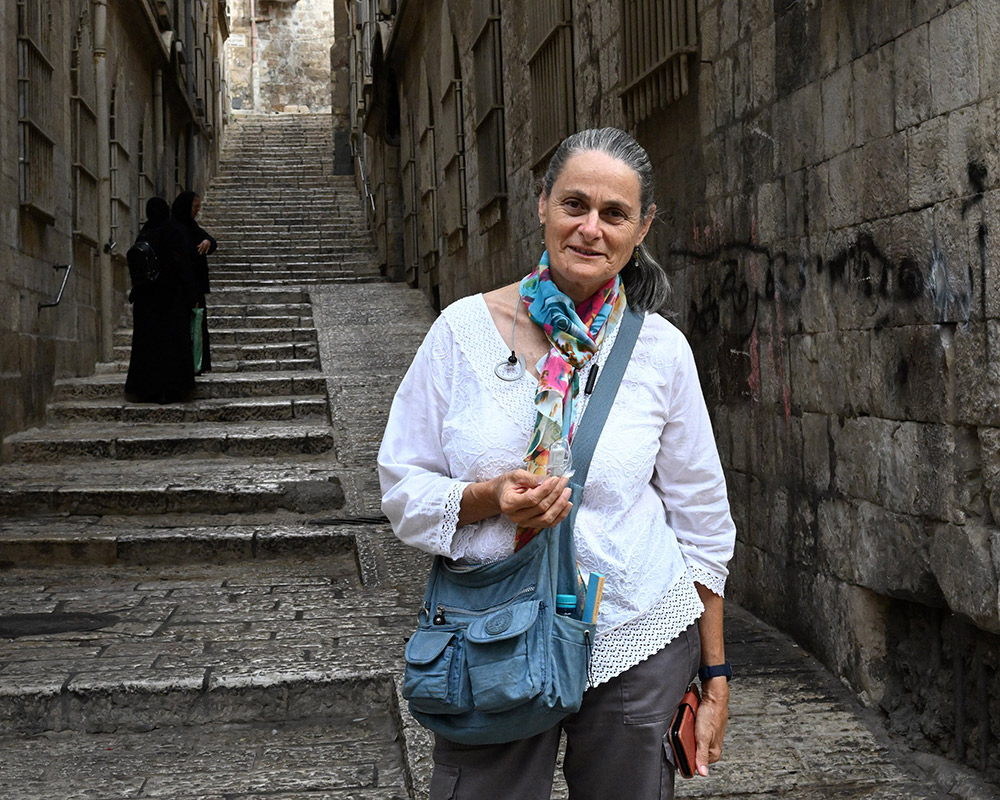
Sr Mayela wears her black veil and habit as she walks to work near where another Catholic nun was violently attacked in Jerusalem’s Old City — but she’s now accompanied by a Jewish volunteer for protection.
Many Christians in Israel, who make up less than 2% of the country’s population, are worried visible signs of their faith will draw harassment, which has increased as multiple conflicts grip the region.
“I’m scared after the sister was beat up,” said Sr Mayela, a Mexican nun who’s lived in Jerusalem on and off for more than two decades. “Before, one could live with more confidence. Some people spat, some said hi. Now we have to live trusting in God.”
She finds resilience in her faith — and in support from Israelis like the volunteers. Even that, though, didn’t prevent a teen from spitting right behind her as they passed a group of ultra-Orthodox Jews recently.
Incidents like that are among the challenges for Christians in Israel, particularly since the Hamas-led attack on October 7, 2023, plunged the country back into war and polarisation. But interfaith leaders and researchers are encouraged by better policing and prosecution as well as the recent appointment of a government envoy to the Christian world, who is Greek Orthodox.
In northern Israel, many Christians say they feel the state isn’t doing enough to protect them from crime because they’re not Jewish. But those concerns didn’t stop groups of Catholics from joining a recent joyous pilgrimage on Mount Tabor, where the Gospels say Jesus appeared transfigured alongside the Jewish prophets Moses and Elijah.
For many Christians and Jews, protecting coexistence in the Holy Land is a moral imperative after their own long histories of religious persecution.
“I don’t want Christians to go out of their house in Jerusalem … and have fear,” said Yisca Harani, the Jewish Israeli educator and activist who escorted Sr Mayela. “I’ve gone through this 2,000 years in my Jewish history. I’m not going to let that happen.”
If you stroll around in your habit, sooner or later you’ll get some spitting next to you”
In the Old City, Jewish men in black hats and tzitzit tassels, Muslim women in hijabs and Christian priests in flowing robes walk past each other daily in the maze of stone alleyways. Many are headed to pray at the Western Wall, the Church of the Holy Sepulchre or the Al-Aqsa Mosque compound. These are some of the most sacred sites respectively for Judaism, Christianity and Islam, and they are close to each other.
“If you stroll around in your habit, sooner or later you’ll get some spitting next to you,” said Fr Alberto Pari, who leads interfaith dialogue and Christian-Jewish relations as secretary to the Custody of the Holy Land, the Catholic order ministering to holy sites across the region. “But it’s important not to generalise, because that unleashes antisemitism.”
Attacks
Religious Freedom Data Center, the organisation that Harani founded to track harassment of Christians, has recorded a near-tripling of incidents in Jerusalem from four years ago to the last three months recorded — about one a day now — virtually all by Jewish religious nationalists.
A Jewish man from a settlement in the occupied West Bank was indicted in the violent attack on the nun in April.
Among those reaching out to Catholic leaders to denounce the attack and offer support was Ambassador George Deek, Israel’s new envoy tasked with building what he calls the “special relationship” between Christians and the country, to both keep Christians safe and partner on issues like fighting antisemitism.
Around the time that the nun was attacked, two other incidents drew global condemnation”
“We believe that every incident against Christians is immoral, illegal and should be prosecuted. That’s exactly what we are going to do,” Deek told The Associated Press. “We want to make sure that Israel continues to prosper and grow as a place where Christians can not only survive, but they can thrive.”
Around the time that the nun was attacked, two other incidents drew global condemnation. An Israeli soldier smashed a crucifix in a family garden and another stuck a cigarette in the mouth of a statue of the Virgin Mary in southern Lebanon, where the military is fighting Hezbollah militants. The soldiers involved received military prison sentences.
Hostility
Most Israelis find harassment unacceptable. But Jewish religious nationalists, particularly uneducated young men, remain a threat, said John Munayer of the Rossing Center for Education and Dialogue, an interreligious organisation in Jerusalem.
Their hostility to Christians is grounded in the history of persecution of Jews in Christian-majority European countries, in faith practices they see as idol-worshipping, and in a “general intolerance” for anyone who’s not Jewish near sacred areas like the Western Wall, Munayer said.
Then there’s the overhanging trauma of the Israeli-Palestinian conflict, since most local Christians in Israel and the occupied West Bank are Palestinian.
In Taybeh, the last entirely Christian village in the West Bank, Jewish settlers recently cut through house fences and destroyed fruit and vegetable gardens, said Fr Bashar Fawadleh, parish priest of Christ the Redeemer Catholic Church.
“All the people here are afraid,” he said. “Settlers come and go every day.”
Israel’s army declared the village a closed military zone early last week to curb the attacks. But concerns about Israel’s ability and willingness to rein in the settlers remain even among evangelicals, who are among the staunchest Christian supporters of Israel.
When the Palestinian members saw that the stage had been set up by an Old City gate flanked by Israeli flags, they refused to play”
“What happens in Taybeh is really troubling,” said David Parsons, spokesperson for International Christian Embassy Jerusalem. “Israeli leaders have realised for some time that Christian support for their nation is not only vital, it’s a strategic interest.”
And yet since the October 7, 2023 attack, “generalised fear and scepticism” pervaded all interreligious work, Pari said. The interfaith music institute he directs, Magnificat, was invited to play at a peace march in Jerusalem. But when the Palestinian members saw that the stage had been set up by an Old City gate flanked by Israeli flags, they refused to play.
“I felt a real failure,” Pari said. “We think that as Christians, we have a very important role to patch things back together. … It will be difficult, but we can do it.”
That faith-grounded resilience prevailed among the Mount Tabor pilgrims, who gathered on the mountain to celebrate the feast of the Transfiguration last week. Rising interfaith tensions and crime have driven many of the area’s Christians to emigrate, several said.
“It’s very difficult that we keep our identity as Christians in the Middle East, but it’s the most important,” said John Akleh, 20, who came with Sr Muna’s group.
Giovanna Dell’Orto writes for The Associated Press. Associated Press journalists Ibrahim Hazboun and Moshe Edri contributed from Jerusalem.