For those who want to save their life will lose it, and those who lose their life for my sake will find it.
The Gospel
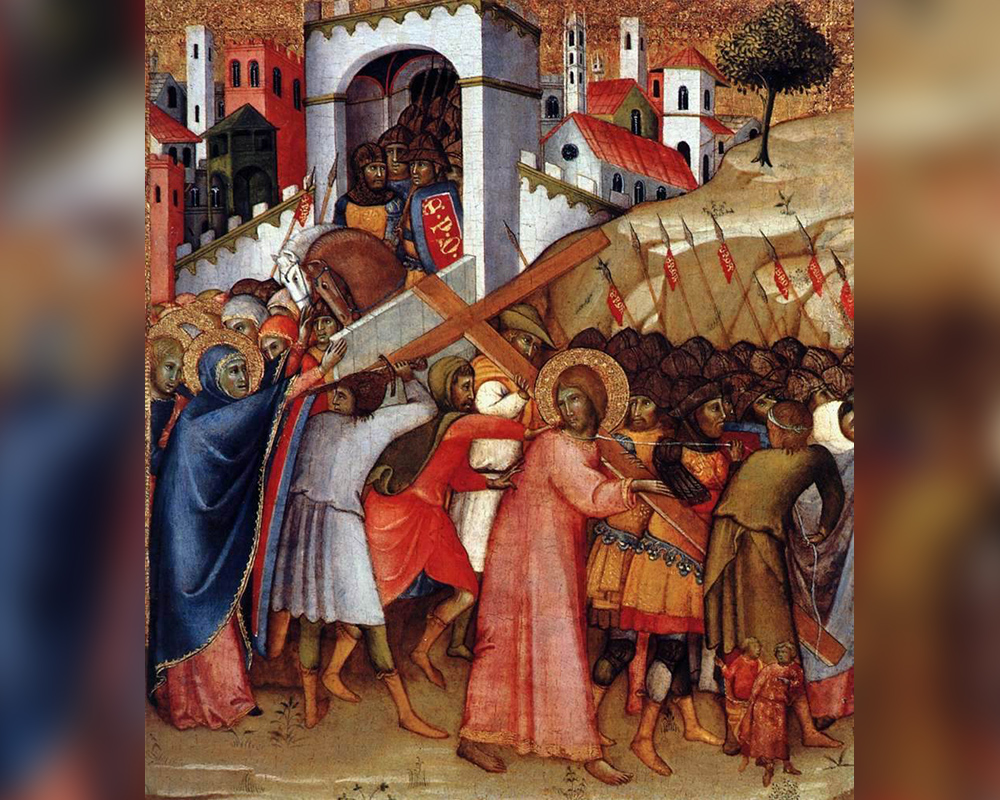
Matt 16:21 From that time on, Jesus began to show his disciples that he must go to Jerusalem and undergo great suffering at the hands of the elders and chief priests and scribes, and be killed, and on the third day be raised.
Matt 16:22 And Peter took him aside and began to rebuke him, saying, “God forbid it, Lord! This must never happen to you.”
Matt 16:23 But he turned and said to Peter, “Get behind me, Satan! You are a stumbling block to me; for you are setting your mind not on divine things but on human things.”
Matt 16:24 Then Jesus told his disciples, “If any want to become my followers, let them deny themselves and take up their cross and follow me.
Matt 16:25 For those who want to save their life will lose it, and those who lose their life for my sake will find it.
Matt 16:26 For what will it profit them if they gain the whole world but forfeit their life? Or what will they give in return for their life?
Matt 16:27 “For the Son of Man is to come with his angels in the glory of his Father, and then he will repay everyone for what has been done.
Matt 16:28 Truly I tell you, there are some standing here who will not taste death before they see the Son of Man coming in his kingdom.”
Initial observations
Our passage is in two parts, vv. 21-23 and vv. 24-27 (really to v. 28). The same sequence can be found in Mark and Luke. There are three predictions of the Passion in Matthew, of which this is the first (16:21; 17:22-23; 20:17-19). The first prediction is the only one followed by the negative reaction of Peter. From a historical point of view, moderate scholars would say that Jesus could have foreseen the outcome of his ministry, along the lines of what happened to penetrating prophets in the OT. The gospels, of course, were written a long time after the events and the same moderate scholars would also understand that the “predictions” have been rendered more precise in the light of what actually happened. It might be worth looking at all three:
Passion Prediction 1
From that time on, Jesus began to show his disciples that he must go to Jerusalem and undergo great suffering at the hands of the elders and chief priests and scribes, and be killed, and on the third day be raised. (Matthew 16:21)
Passion Prediction 2
As they were gathering in Galilee, Jesus said to them, “The Son of Man is going to be betrayed into human hands, and they will kill him, and on the third day he will be raised.” (Matthew 17:22–23)
Passion Prediction 3
While Jesus was going up to Jerusalem, he took the twelve disciples aside by themselves, and said to them on the way, “See, we are going up to Jerusalem, and the Son of Man will be handed over to the chief priests and scribes, and they will condemn him to death; then they will hand him over to the Gentiles to be mocked and flogged and crucified; and on the third day he will be raised.” (Matthew 20:17–19)
It is, of course, surprising that the firm denial by Peter should follow on his firm confession of faith and his commissioning as “the rock”! This is surely historical because Peter was a key figure in the early church and they would never have made up such an awkward story about him. We who are used to the teaching of a crucified Christ should not forget that the expectations surrounding the Messiah included restoration, peace, victory but never really suffering, not to speak of the gross humiliation of the cross. In that sense, Peter’s reaction expresses the reaction of the ordinary hearer and believer at the time. Perhaps even today?
Kind of writing
These are two chreiai, that is, scenes illustrating the “needful.” The first chreia must have included the reaction of Peter. However, the five sayings on suffering which follow come from various sources, but fit well Matthew’s purpose here.
Old Testament background
(i) The OT texts in the background must be the Suffering Servant Songs in Second Isaiah (Is 52-53). For example, Matt 8:17 (This was to fulfil what had been spoken through the prophet Isaiah, “He took our infirmities and bore our diseases”) cites Is 53:4.
(ii) V. 27 is a clear echo of general religious teaching at the time.
And steadfast love belongs to you, O Lord. For you repay to all according to their work. (Ps 62:12)
If you say, “Look, we did not know this”— does not he who weighs the heart perceive it? Does not he who keeps watch over your soul know it? And will he not repay all according to their deeds? (Prov 24:12)
(iii) It is a pity that the excerpt ends at v.27, as the concluding v. 28 is a much more hopeful conclusion (added above).
New Testament foreground
(i) This Gospel teaches clearly that suffering was to be part of Jesus’ ministry. This is clear not only in the Passion Predictions, but also in the teaching of Jesus (20:28—see Is 53:12), in the parables (21:33-42), at the Last Supper (26:26-29) and in Gethsemane (26:36-46).
(ii) The impulsive character of Peter shines through the various stories: his confession followed by his rejection (today’s text), his reaction at the transfiguration (17:1-8), his self-confidence after the supper (26:30-35) and his actual denial during the trial (26:69-75).
(iii) Taking up the cross is also found in Matthew 10:16-19.
(iv) From noon on, darkness came over the whole land until three in the afternoon. And about three o’clock Jesus cried with a loud voice, “Eli, Eli, lema sabachthani?” that is, “My God, my God, why have you forsaken me?” When some of the bystanders heard it, they said, “This man is calling for Elijah.” At once one of them ran and got a sponge, filled it with sour wine, put it on a stick, and gave it to him to drink. But the others said, “Wait, let us see whether Elijah will come to save him.” Then Jesus cried again with a loud voice and breathed his last. (Matthew 27:45–50)
St Paul
For the message about the cross is foolishness to those who are perishing, but to us who are being saved it is the power of God. For it is written, “I will destroy the wisdom of the wise, and the discernment of the discerning I will thwart.” Where is the one who is wise? Where is the scribe? Where is the debater of this age? Has not God made foolish the wisdom of the world? For since, in the wisdom of God, the world did not know God through wisdom, God decided, through the foolishness of our proclamation, to save those who believe. For Jews demand signs and Greeks desire wisdom, but we proclaim Christ crucified, a stumbling block to Jews and foolishness to Gentiles, but to those who are the called, both Jews and Greeks, Christ the power of God and the wisdom of God. For God’s foolishness is wiser than human wisdom, and God’s weakness is stronger than human strength. (1 Corinthians 1:18–25)
Brief commentary
Verse 21 Peter has just made a tremendous confession of faith. The identity and destiny of Jesus continue to be the subject of discussion. Verse 21 is a Passion Prediction. Notice that there is no “in accordance with Scripture” or “for our sins.” Instead, Matthew employ a small Greek word dei meaning “must.” God is always the subject of the divine passive.
Verse 22 Very strong words open a brief conflict story ending in the judgement of v. 23. The primary dictionary meanings are: to express strong disapproval of someone, rebuke, reprove, censure also speak seriously, warn.
Verse 23 Even stronger words. Calling the “rock” Satan is a bit of jolt. A “demonic” mind-set is simply incapable of receiving this further revelation. The necessary help comes later in the story of the Transfiguration (17:1-8). Stumbling block in Greek is skandalon, i.e. a hindrance to Jesus’ calling.
Verse 24 The original is in the singular (“he”) and more direct. The teaching here is for the disciples, not for the crowds in general. The cross was a familiar tragedy. Before Jesus’ time, the Jewish leader, Alexander Jannaeus, crucified eight hundred coreligionists at one time. Shortly after the death of Herod the Great two thousand Jews were crucified. Naturally, “to take up your cross” was not an idiom before the death of Jesus; it makes sense only in the light of Jesus’ death. It is noticeable that to deny and to take up are aorist verbs (once and for all), whereas to follow is a present imperative, indicating an ongoing process of discipleship.
Verse 25 The central paradox expressed in the appropriate chiastic form ABB1A1:
- For those who want to save their life will lose it, and those who lose their life for my sake will find it.
- For what will it profit them if they gain the whole world but forfeit their life?
B1. Or what will they give in return for their life?
A1. For the Son of Man is to come with his angels in the glory of his Father, and then he will repay everyone for what has been done.
Verse 26 Rhetorical questions to which the answer arises in our hearts.
Verse 27 Cf. the so-called parable of the Last Judgment in Mt 25. The sense of assessment fits with v. 25 here.
Pointers for prayer
- Short-term loss is sometimes necessary for long-term gain as a student studying or an athlete training can testify. When have you found that denying yourself proved to be worthwhile because of what you gained afterwards?
- Jesus was teaching his followers that the path of discipleship would involve pain and suffering. Peter would have none of it. When have you found that taking up your cross brought you life, even though at the time it may have been difficult?
- Jesus knew that because his good news message was not acceptable to the authorities he would suffer and die, but God would see that evil would not have the last say. Have you seen a good news message survive even though opponents tried to stifle it?
- Jesus promised that those who suffer for the kingdom would be rewarded. Perhaps, even in this earthly life, you have experienced reward.
Prayer
O God, whose word burns like a fire within us, grant us a bold and faithful spirit, that in your strength we may be unafraid to speak your word and follow where you lead.
We make this prayer through our Lord Jesus Christ, your Son, who lives and reigns with you in the unity of the Holy Spirit, God for ever and ever. Amen.
Thought for the day
Jesus had the gift of saying things directly and plainly, with a power to penetrate all our defences and lead us to a new awareness. Today’s message puts before us the paradox of the Gospel: we gain life by letting go of it. If I put my happiness, my being loved, at the centre of my life, then I will surely fail, even though to be loved and to be happy are really important. If on the other hand I put the happiness of others first and love them unconditionally, then I too will know unselfish love and deep happiness. This is the very insight and wisdom that Jesus puts before us as the key not just to love but to life and within that, the key to authentic discipleship precisely as a way of life.
Prayer
Teach us, Lord, that nothing is more life-giving than to love and be loved in return.
Do not be conformed to this present world, but be transformed
The first reading
Rom 12:1 Therefore I exhort you, brothers and sisters, by the mercies of God, to present your bodies as a sacrifice—alive, holy, and pleasing to God–which is your reasonable service.
Rom 12:2 Do not be conformed to this present world, but be transformed by the renewing of your mind, so that you may test and approve what is the will of God—what is good and well-pleasing and perfect.
Initial observations
The final part of Romans offers teaching on tolerance and inclusivity which is never really out of date. Conflict, however against the ethos of the faith, is normal and every Christian group to a greater or lesser extent stands in need of Paul’s vision and teaching here.
It can also be something of a relief to find ourselves in the last, pastoral section of Romans. Paul’s fourth “movement” is in reality the practical application of the knotty theological arguments in Romans 1-11. This Sunday and the next two offer us very pocket-sized glimpses of Paul’s teaching: Rom 12:1-2 (22A), 13:8-10 (23A) and 14:7-9 (24A). As always, these tiny pieces of the mosaic make sense only in the context of the whole argument Rom 12:1-15:6.
Kind of writing
Given t hat Paul is now applying his teaching in a pastoral way, the language naturally changes to that of appeal and encouragement, and the address changes to you in the second person plural. The vocabulary of mutuality and love is also evident. The broad outline of the argument is as follows:
12:1-2 Christian life as reasonable worship
12:3-13:14 Christian living in the Empire
14:1-15:6 Living inclusively and tolerantly
Thus our reading forms the introduction to and foundation for this final exhortation in Romans.
Origin of the reading
The context within the community is made plain in the very next verse: For by the grace given to me I say to every one of you not to think more highly of yourself than you ought to think, but to think with sober discernment, as God has distributed to each of you a measure of faith. (Rom 12:3) At this point, Paul hopes to appeal to Christ-believers of both Jewish and Gentile inheritance to set aside their divisions, acrimony, judgments and sense of being superior.
Related passages
And we all, with unveiled faces reflecting the glory of the Lord, are being transformed into the same image from one degree of glory to another, which is from the Lord, who is the Spirit. (2 Cor 3:18)
Therefore we do not despair, but even if our physical body is wearing away, our inner person is being renewed day by day. (2 Cor 4:16)
And just as they did not see fit to acknowledge God, God gave them over to a depraved mind, to do what should not be done. (Rom 1:28)
Brief commentary
Verse 1 The opening word in Greek is parakal, which can mean to exhort, to appeal and to encourage. Perhaps all three nuances are at play here. This is a frequent verb in Paul but it makes its first appearance (of 4) here in Romans, when Paul turns to application. The Romans are addressed as “brothers and sisters.” It is fitting that at this point in the letter the use of this address increases noticeably: Rom 1:13; 7:1, 4; 8:12, 29; 9:3; 10:1; 11:25; 12:1; 14:10, 13, 15, 21; 15:14, 30; 16:14, 17, 23. The use of the word “mercies” (oiktirmoi) in the plural is striking: in fact this is the only use of this noun, singular or plural, in all of Paul. Significantly, the verb form is found in one place earlier in Romans: For he says to Moses: “I will have mercy (eleēsō) on whom I have mercy, and I will have compassion (oiktirēsō) on whom I have compassion.” (Rom 9:15) Mercy is mentioned earlier, using a different word: So then, it does not depend on human desire or exertion, but on God who shows mercy. (Rom 9:16) This relatively low frequency is no indication of significance. The whole Gospel according to Paul is one of God’s extraordinary compassion, mercy and love, whatever words are used to express it (see Rom 5:8-11). The “body” is important to Paul. In earlier Greek, the word sōma meant corpse. By contrast, for Paul, body means the human being as a temple of the Holy Spirit, in communion with others, trying to live the Gospel practically in society. The metaphor of the body in Romans 12:4-8, which builds on this, is almost not a metaphor. Sacrifice links our discipleship with the self-gift of Jesus. Paul is thinking of an inner sacrifice as he makes plain in “reasonable service”. The word logikē could also be translated as spiritual. This spiritual gift or transformation of self is exactly what is “alive, holy and pleasing to God.” (The triple formal echoes the close of Romans 11.) Paul’s “version” of God is spirit, and the people who worship him must worship in spirit and truth. (John 4:24).
Verse 2 This verse begins the exploration of what “reasonable service” could mean in principle. Paul will go on in Rom 12:3-13:14 to explore what such transformation means in practice. Paul lays down a negative to begin with: do not be conformed to this present world. By “world” Paul means a whole set of values radically opposed to the Gospel and teaching of Jesus. Settling for the status quo or the conventional wisdom or simply reflecting back to society the values of society has been a temptation for Christians always. On the contrary, being a Christian is all about conversion of heart, through Paul doesn’t used the term metanoia. Instead, he dares to use a term heady with meaning in Greek and Romans culture: metamorphosis. How do we achieve that? By the renewing of our “mind” or nous. It is a very Greek term, without parallel in Hebrew though. It does mean intelligence, but also capacity to judge and the world of convictions and values. Thus, without the word, Paul is encouraging a radical conversion, a true metanoia. The Greek word “to test” means also to approve and so the NET uses two verbs to keep both aspects in view. The three-fold praise—good, well-pleasing and perfect—echoes again the last verses of Romans 11. This great challenge is in tremendous contrast to the start of Romans in 1:28 (see above). The moral life is the kind of integrated worship God desires from us all, as Christians rooted in and responding to the Christ event. Paul’s teaching is not timeless or generic but rooted in God’s salvation in Jesus. The “therefore” of v. 1 is strong!
Pointers for prayer
- How do I try to live practically before God and with others the metamorphosis envisaged by Paul?
Prayer
You love for me, O God, touches all that I am. Give me the grace to love you too with all “all that I am,” my whole self.

For the word of the Lord has become for me a reproach all day long
Jer 20:7 O Lord, you have enticed me,
and I was enticed;
you have overpowered me,
and you have prevailed.
I have become a laughingstock all day long;
everyone mocks me.
Jer 20:8 For whenever I speak, I must cry out,
I must shout, “Violence and destruction!”
For the word of the Lord has become for me
a reproach and derision all day long.
Jer 20:9 If I say, “I will not mention him,
or speak any more in his name,”
then within me there is something like a burning fire
shut up in my bones;
I am weary with holding it in,
and I cannot.
The second reading
Initial observations
The fate of authentic prophets is often difficult, as we see in the case of Jeremiah. Our reading is a lament—but much more than that. It captures the visceral impossibility of holding in the word. It portrays a deep, ultimate trust in God and the whole massage is a kind of dialogue / discernment with himself, in the course of which he moment from lament to praise.
Even so, after the words of trust in v.13, the prophet goes on to speak in a tone very reminiscent of Job 3.
Kind of writing
We have here a classic poem of lament, with the following moments, based on the use of repeated words and phrases in Hebrew.
- 7-9: Complaint against YHWH
- 10: Complaint against the enemies
- 11a: Hope: “YHWH is with me”
- 11b-d: Fall of the enemies
- 12a: Hope: “YHWH sees the heart”
- 12b: Punishment of the enemies
- 13: Praise of YHWH
It would be good to read the whole passage to make sense of the start. In spite of the beginning, it ends in hope.
Origin of the reading
Chapter 20 tells the story of how Jeremiah was beaten and thrown into prison by Passhur, the chief of the temple police (see below for the context). Jeremiah responds robustly in public but, finally alone in his prison cell, he is despondent and very eloquent!
Related passages
Now the priest Pashhur son of Immer, who was chief officer in the house of the Lord, heard Jeremiah prophesying these things. Then Pashhur struck the prophet Jeremiah, and put him in the stocks that were in the upper Benjamin Gate of the house of the Lord. The next morning when Pashhur released Jeremiah from the stocks, Jeremiah said to him, The Lord has named you not Pashhur but “Terror-all-around.” For thus says the Lord: I am making you a terror to yourself and to all your friends; and they shall fall by the sword of their enemies while you look on. And I will give all Judah into the hand of the king of Babylon; he shall carry them captive to Babylon, and shall kill them with the sword. I will give all the wealth of this city, all its gains, all its prized belongings, and all the treasures of the kings of Judah into the hand of their enemies, who shall plunder them, and seize them, and carry them to Babylon. And you, Pashhur, and all who live in your house, shall go into captivity, and to Babylon you shall go; there you shall die, and there you shall be buried, you and all your friends, to whom you have prophesied falsely. (Jeremiah 20:1–6)
Then I said, “Ah, Lord God! Truly I do not know how to speak, for I am only a boy.” But the Lord said to me, “Do not say, ‘I am only a boy’; for you shall go to all to whom I send you, and you shall speak whatever I command you, Do not be afraid of them, for I am with you to deliver you, says the Lord.” (Jeremiah 1:6–8)
Brief commentary
Verse 7 The verb to entice has a variety of meanings: to deceive, to seduce, to persuade. Entice captures some of this, but persuade is the appropriate sense here. This verse opens up a complaint against God, a complaint which takes us back to the call of Jeremiah (see above). YHWH did persuade him, but Jeremiah became a laughingstock.
Verse 8 Jeremiah’s message is always negative and full of horror, which he himself finds hard to bear. The consequences for the prophet are clear in the second half of the verse.
Verse 9 The sense here is “I have decided.” In a graphic way, he is simply unable to hold the message in. The word of the Lord is paradoxically both unbearable and irresistible. The Hebrew word for “I cannot” is the same word used of the Lord’s prevailing over Jeremiah in v. 7.
Pointers for prayer
- The mixture of images and emotions in this lament is very true to life. No situation is ever “neat” and often we experience conflicting pressures. Perhaps you can go back to a moment in your own life when this was very much the case?
- The irrepressible word of God is part of the calling of the prophet. Even if I am not called in the same way, it might be that I have found myself drawn again and again to the word, even when it is awkward and I am resisting.
- The passage embodies a tremendous call to faithfulness, whatever the pressures within and without. This resonates well with our time.
Prayer
When we feel drawn in different ways and are tempted to give up, come to our help, O Lord. Even without understanding, we know that you alone are faithful, full of kindness and compassion. Help us to put our deepest trust in you that we in our turn may live our discipleship in faithfulness to you, the Faithful One.

The Liturgy
Jeremiah 20:7-9; Palm 63 (62); Romans 12:1-2; Matthew 16:21-27
Readings 1 and 3
Just a few verses before, Matthew mentioned Jeremiah: And they said, “Some say John the Baptist, but others Elijah, and still others Jeremiah or one of the prophets.” (Matthew 16:14) This addition—unique to Matthew—alerts us to his understanding of Jesus’ suffering and death as modelled on the destiny of the prophets of old and, in particular, on that of Jeremiah.
The responsorial Psalm
Psalm 63 (62)—the Hound of Heaven in the Psalter—takes up the positives notes from the first reading. Perhaps the last lines establishes the link most clearly: My soul clings to you; your right hand holds me fast..
Sunday introductions
First reading
Jeremiah 20:7-9
For people who tell it like is it (prophets often sounded like whistleblowers) it can be very hard. They hate saying hard things all the time and yet they cannot keep it in. Jeremiah—a whistleblower if ever there was one—was no different.
Second reading
Romans 12:1-2
We all want to discover the will of God, to know what is good and what is the perfect thing to do. Writing to the divided community in Rome, St Paul has a few things to say about this.
Gospel
Matthew 16:21-27
The place of suffering in our lives is a great challenge and, without cheapening it, a kind of mystery. Why do we “have” to suffer? Even more, why did Jesus? Peter—impulsive as ever — captures our bafflement “God’s way.”
Weekday introductions
Monday 31 August
St Aidan, bishop and missionary
1 Corinthians 2:1-5
The Corinthians found Paul a poor speaker and were unimpressed. He turns this around by saying, in effect, “I don’t want you to be impressed by fine speeches and even logic, because at the centre stands the contradiction of the cross.”
Luke 4:16-30
This compact account, brought forward and expanded by Luke, is really a symbolic tableau, anticipating the ministry of Jesus, his destiny and the later expansion of the Way in the Acts. Jesus is portrayed as a prophet, whose word is penetrating.
Tuesday 1 September
1 Corinthians 2:10-16
What should we say of the Holy Spirit in our lives? We could do worse than pay attention to the first and last affirmations of this reading: “The Spirit reaches the depths of everything, even the depths of God.” “But we are those who have the mind of Christ.”
Luke 4:31-37
What kind of authority did Jesus have? Truly effective authority, as we see in this remarkable story.
Wednesday 2 September
1 Corinthians 3:1-9
Continuing his argument with the Corinthians, Paul starts by admitting that after his preaching there was more to be said by the likes of Apollos. Nevertheless, preachers are only those who plant and water. It is God who gives the growth.
Luke 4:38-44
Our Gospel today shows us Jesus as a very busy person who also needed to “recharge his batteries”, as we say. Luke’ underlines throughout the prayer and prayerfulness of Jesus.
Thursday 3 September
St Gregory the Great, bishop of Rome, doctor
1 Corinthians 3:18-23
The Corinthians were inclined to think of themselves as spiritually advanced and, in various ways, superior. Such boasting has no place and Paul knocks it firmly on the head.
Luke 5:1-11
Usually, the call stories are stripped of all human interest. Luke making the response of the first disciples more credible shows that they did indeed have some previous experience of Jesus.
Friday 4 September
St Mac Nissi, bishop
1 Corinthians 4:1-5
Judging others, especially people in leadership, is a constant “pastime”, even in earliest communities of faith. Paul has no truck with such human assessments: only God is his, and our, judge.
Luke 5:33-39
Jesus was challenged because in his ministry he was not traditional. For example, he did not promote fasting. The early church did take up fasting and our Gospel is an attempt to explain why this is okay even if Jesus himself did not promote it. The marriage symbolism is part of the preaching of the Kingdom.
Saturday 5 September
1 Corinthians 4:6-15
Once more, Paul tries to set aside party politics in the life of the community. He gives a very moving account of the lowly role of the apostle—a tour de force. At the same time, he does not neglect to remind the Corinthians of the origin of the faith among them and he (alone!) is their one father.
Luke 6:1-5
Today’s Gospel is an funny little story and one could be bold and ask what were the Pharisees doing in a cornfield on the Sabbath!! The main point, however, cannot be missed: Jesus’ ministry was utterly new, calling for novelty in thought and practice.