Because J.R.R. Tolkien was a serious Catholic, one might assume religion would be obvious in his literary masterpiece. Yet there is no religion in The Lord of the Rings in the usual sense. There is magic and even glimpses of the demonic, but the world Tolkien creates is wholly contained within itself: large, old, mythological, but internally complete.
This was not unintentional, nor was it a rejection of Tolkien’s Catholicism. As Tolkien wrote to a priest friend in 1953, The Lord of the Rings is “a fundamentally religious and Catholic work”, though “unconsciously so at first, but consciously in the revision”. That is why, he explained, he cut out almost all references to “religion”, cults or practices in the imaginary world: “For the religious element is absorbed into the story and the symbolism.”
Tolkien’s Catholic worldview has drawn renewed attention after Pope Leo XIV referred to him in Magnifica Humanitas, his first encyclical, on safeguarding the human person in the age of artificial intelligence. The pope quoted Gandalf’s words in The Return of the King: “It is not our part to master all the tides of the world, but to do what is in us for the succour of those years wherein we are set.”
That sentence captures something central to Tolkien’s vision: the call to small, steadfast acts of fidelity in the face of forces that appear overwhelming.
The first Catholic note in The Lord of the Rings is its disarming of power. The Ring of Power is not defeated by being wielded more cleverly or more righteously than Sauron would wield it. Its power is resisted, not used. It is borne by the least likely and carried toward its own destruction. The logic of the quest is not domination, but renunciation and fellowship.
Logic
That same logic appears in Galadriel, one of the great figures of Middle-earth. Offered the Ring, she sees clearly what she could become if she took it. Her greatness lies in refusing the temptation. Like John the Baptist, she must decrease so that another mission may increase. In Tolkien’s Catholic imagination, the mighty are not saved by clinging to power, but by yielding it in service of something greater.
A second Catholic theme is hope. In Tolkien, hope is rarely loud or easy. It often appears as a rumour of dawn, a crack of light, a possibility that survives beneath the shadow. Théoden, King of Rohan, gives one of the clearest examples. Under the influence of wicked counsel, he has become weary, diminished and almost captive in his own mind. Gandalf does not replace one domination with another. He calls Théoden back to himself. Hope restores dignity; it does not erase freedom.
This is one of Tolkien’s most Christian insights. Evil persuades people that nothing can be done, that all roads lead only to ruin. Hope does not deny the darkness, but it refuses to let darkness have the final word.
Discernment
A third theme is discernment and responsibility. The characters in The Lord of the Rings are repeatedly forced to choose between competing goods, not merely between obvious good and obvious evil. Samwise Gamgee’s crisis after he believes Frodo dead is especially powerful. Should he remain with his friend, return home, or take up the Ring and continue the mission alone? His choice is not abstract. It is born of friendship, duty, grief and love.
Sam’s greatness is not that he sees everything clearly. He does not. His greatness is that, even in confusion, he remains faithful. Tolkien’s moral universe is Catholic in this sense too: grace does not abolish responsibility, and even small persons must freely choose the good placed before them.
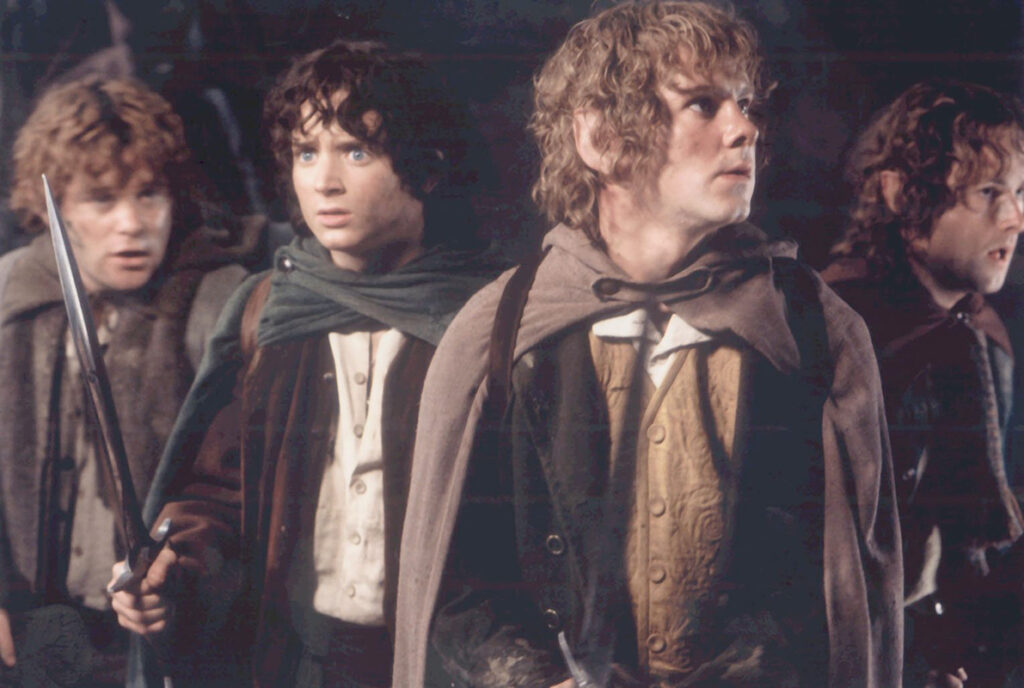
Finally, Tolkien elevates the weak. The journey to destroy the Ring belongs not chiefly to the strong, wise and mighty, but to the small, foolish and meek. The hobbits become bearers of hope precisely because they seem so unlikely. Their courage is hidden from the calculations of evil.
After the great journey to Mount Doom, the hobbits return not to fantasy or self-glory, but to the ordinary world of the Shire. They have learned to love more deeply what was entrusted to them. The meek do not merely inherit Middle-earth. In their fidelity, friendship and hope, they help redeem it.
That is why The Lord of the Rings remains a Catholic journey. Its faith is not pasted onto the surface. It is absorbed into the story: in power renounced, hope guarded, freedom exercised, and the weak raised up as instruments of salvation.
Leonard J. DeLorenzo, Ph.D., works in the McGrath Institute for Church Life and teaches theology at the University of Notre Dame.