All across Ulster, there is one game that reigns supreme. As hurling defines Munster and much of south Leinster, Gaelic football is the lifeblood of the northern province. In towns and villages from Fermanagh to Antrim, it is more than a sport; it is a ritual. In every parish across the province, the local GAA ground becomes a cathedral of colour and noise at the weekends with the thump of a football, and championship summer carries a reverence all its own.
Donegal
Nowhere is that truer than in Donegal. The O’Donnell County is famed for its rugged wild Atlantic headlands and empty mountain roads, but just as defining is its football heritage. Sometimes known as ‘the Forgotten County’, it is a place where geography can isolate and winter nights can feel long and lonesome, but the local GAA pitch has always been a rallying point, a place where scattered communities gather, argue, celebrate and belong.
Two All-Ireland titles and twelve Ulster crowns testify Donegal’s football pedigree. Every year, the gold and green travel in their thousands, from Clones to Croke Park, carrying with them a sense of defiant pride that bleeds a unique northern hardiness. But tucked away near the Derry border, in a small parish where the flatlands meet Lough Swilly, the big ball plays second fiddle.
When Croke Park outlawed cross-county allegiances, Burt realigned with Donegal, weathered the lean 1940s of emigration and wartime rationing”
In Burt, the sound that carries on a summer evening more often than not is the crack of ash on a sliotar rather than the hollow bounce of a Gaelic football. One of the oldest GAA clubs in Ulster, founded in 1887, Burt is the historic heartland of Donegal hurling. Playing out of Hibernian Park in primrose and blue, the club has long stood apart in a county dominated by football and framed by rugged, barren ranges.
In the early 20th century, when GAA structures in Donegal were weak, Burt competed under the Derry county board, capturing back-to-back senior titles in 1930 and 1931 and completing a remarkable double with the Derry senior football championship in ’31.
When Croke Park outlawed cross-county allegiances, Burt realigned with Donegal, weathered the lean 1940s of emigration and wartime rationing, and re-emerged in the 1950s with renewed force, claiming a county title in 1952 and a three-in-a-row from 1955 to 1957.
What followed was dominance. Burt would come to define Donegal hurling, amassing more county titles than any other club in Ireland. Between 1991 and 2006, they captured sixteen in a row, a staggering run ended only by Setanta, another of the county’s hurling strongholds.
Grown
Since then, the game in Donegal has grown steadily. Burt, Setanta and Letterkenny’s St Eunan’s now regularly contest honours at a provincial level, with Setanta competing in the Ulster Senior Championship and Burt recently claiming the provincial junior crown. At the centre of the club’s modern story stands Liam McKinney.
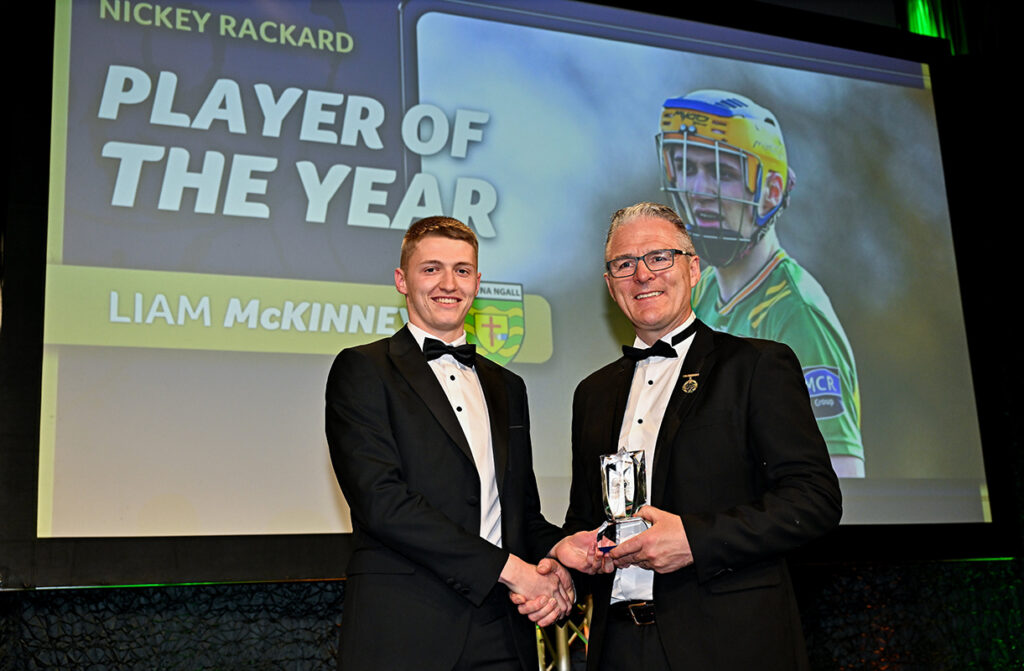
Just 22 years old and standing 6 foot 2 inches, McKinney is already the talisman for both club and county, having been part of the Donegal panel for the past five years. Revered inside the county and increasingly respected beyond it, he was named Nicky Rackard Player of the Year in 2024 and earned a place on the Championship 15, hurling’s equivalent of an All-Star at that grade.
“It’s one of the oldest clubs in Ulster, but we’re from Donegal, so naturally we play a bit of football as well,” he says. “There’s always been a very strong tradition of hurling in Burt, going back to the late nineteenth century. We would’ve played in Derry and against other Ulster teams a long time ago because there just wouldn’t have been much hurling at all in Donegal, but there was always hurling here in Burt.”
“There’s a lot of football-mad people around here because it’s still Donegal at the end of the day. But we have plenty of hurling people too. They just love the sport, especially when we’re going well. There are a lot of people who care really deeply about the game.”
“There’s a massive hurling tradition in the club, and so many players have represented Donegal and Ulster Railway Cup teams. That’s filtered down into very successful teams over the years, and a lot of those lads are now involved at underage.”
“That heritage is very strong here in Burt. You would feel pride wearing any club jersey, but it just feels special when you pull on the Burt jersey. When you think of the players who’ve worn it before you, it really does mean something.”
Donegal have steadily climbed the ranks of the hurling ladder and are now established at Christy Ring Cup level, the third tier of the inter-county game. Alongside Burt, Setanta and St Eunan’s, new pockets of hurling have begun to emerge in areas once considered unlikely strongholds.
Dungloe, the largest town in the Donegal Gaeltacht, is now a proud dual club, while Carndonagh, on the Inishowen peninsula continue to develop their own presence in the game.
Push
Beyond the county bounds, a broader push is underway. As part of Jarlath Burns’ tenure as Uachtarán CLG, a concerted effort has been made to grow hurling outside its traditional heartlands in Munster and south Leinster. Late last year, forty-five new clubs were awarded starter packs to develop the game at grassroots level, in an initiative spearheaded by William Maher and the Hurling Development Committee.
Of those forty-five, seven have been established in Donegal, a sign of the game’s growing foothold in the county. Among them are Na Rossa in the rural West Donegal community of Lettermacaward; Kilcar, a short drive from Sliabh Liag; and Na Dunaibh in the Gaeltacht village of Downings.
For McKinney, the growth of the game, particularly at underage level, is a hugely encouraging step, though he acknowledges there is still massive work to be done.
We still have a lot of work to do in Donegal. The numbers at underage aren’t as high as they should be”
“It’s fantastic to see. Hurling is a brilliant sport, and any child who gets the opportunity to play it should take it. I know some of the coaches involved in developing the game here; they’re brilliant and full of passion, and that’s exactly what you need.”
“We still have a lot of work to do in Donegal. The numbers at underage aren’t as high as they should be. We need to build those numbers, and that comes from development within clubs, and the new clubs that have been established will be huge for that.”
“We need to get as many children playing as possible. Even if they just start watching it, they’ll realise how great the game is and how enjoyable it is to play. That’s the key.”