The belief that Jesus of Nazareth rose from the dead is the single most important element of the Christian faith. In 1 Cor 15:14, St Paul argues that the truth of Christianity depends on the truth of the resurrection of Christ. If it never happened, then the Gospel message is empty. The fact that the apostles were willing to be martyred for proclaiming the resurrection of Jesus is a powerful witness to the reality of this event.
Christians believe that the resurrection confirmed Jesus’s identity as the Son of God and his victory over death itself. The resurrection of Jesus took a surprising turn for the apostles themselves, by upending the Jewish expectation of the Messiah as a political saviour. Rather than seeking to establish an earthly, political kingdom by overthrowing the yoke of Roman rule, Jesus announced that his kingdom was not of this world (Matt 6:19-20).
While the Pharisees believed in a bodily resurrection of the dead, this event was expected to take place at the end of time, rather than being located within the midst of human history. By promising the Good Thief that “today you will be with me in paradise” (Luke 23:43), Christ situated the hope of resurrection in the here-and-now.
Reunited
Even though Catholics similarly believe in the general resurrection of the flesh at the end of the world, when our souls will once again be reunited with our physical bodies, we also look forward to the immediate resurrection of the soul after death in our present state, when each of us will face a particular judgement. This is where we meet our ultimate fate, and enjoy the fruits of our eternal destiny even before the final judgment, which takes place after the general resurrection of the dead at the Second Coming of Christ.
Christ’s soul descended into ‘the lower parts of the earth’ (Eph 4:9) so that he could proclaim the Gospel to the righteous souls that had been imprisoned there”
By revealing that the true nature of Christ’s messianic role was to triumph over death itself, described by St Paul as the last enemy to be destroyed (1 Cor 15:26), the resurrection ushered this future hope into the present age of the world. By overcoming death, Jesus burst open the doors to eternal life, liberating us from the cycle of evil which had enslaved humanity since the dawn of civilisation. To help them understand the true significance of the resurrection, the early Christians looked to various scriptural passages, which witnessed to the event and are known in Catholic tradition as the ‘Harrowing of Hell.’
This event, which is professed as an article of faith in the Apostle’s Creed, concerns the short period of time between the crucifixion and the resurrection, when Christ’s soul descended into “the lower parts of the earth” (Eph 4:9) so that he could proclaim the Gospel to the righteous souls that had been imprisoned there (1Pet 3:18-20).
Later tradition would interpret passages such as Zech 9:11 and Isa 42:7 to envision Christ leading the righteous dead out from the realm of Hades, and into the gates of paradise, which had been newly opened through Christ’s victory on the Cross. Because of this, Jesus is shown standing with the “keys of death and Hades” in Rev 1:18. With these, he is able to fulfil the prophetic words he read aloud in the synagogue at Nazareth at the very beginning of his ministry in Luke 4:16-20, by proclaiming “liberty to the captives, and the opening of the prison to those who are bound” (Isa 61:1).
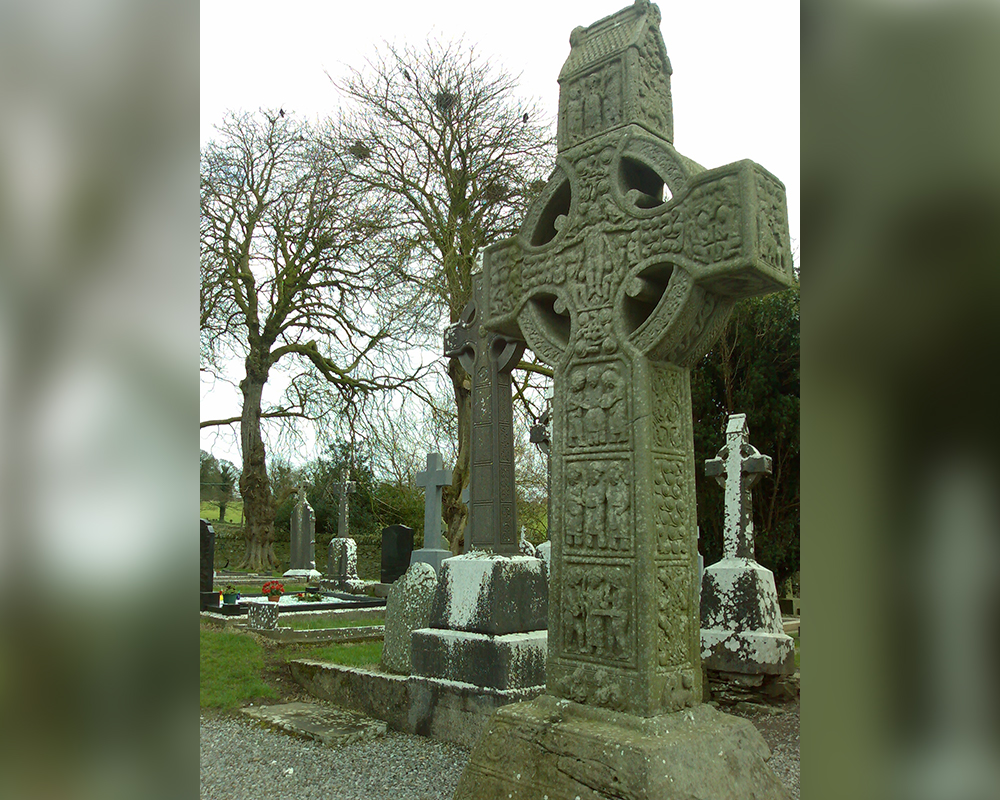
Monasterboice
On the West Cross at Monasterboice, Co. Louth, dating back to the ninth century, Christ is depicted as a divine warrior holding a shield and spear during his descent into Hades, armed for rescuing the prisoners from the enemy stronghold. This imagery of Christ as victor is thought to be inspired by Ps 24:7-8, which was also traditionally associated with the Harrowing of Hell: “Lift up your heads, O gates! And be lifted up, O ancient doors, that the King of glory may come in. Who is this King of glory? The Lord, strong and mighty, the Lord, mighty in battle!”
Elsewhere at Monasterboice, Christ is shown grabbing Adam by the wrist, as the first of the chain of captives that are led out of Hades, followed by the other righteous Old Testament prophets and patriarchs who were waiting to be freed. This echoes the words of an ancient homily for Holy Saturday, where the Lord is shown wielding his victorious weapon, which is the cross itself.
Through Christ’s sacrifice on the cross, the permanence of death is undone, and by the power of his resurrection, we also get to share in eternal life”
Here, Christ descends to Hades in search for Adam and his fellow-prisoner Eve, to rescue those “who sit in darkness and in the shadow of death” (Isa 9:2). When he finally finds his lost sheep, the Lord issues the command to “awake, o sleeper, for I have not made you to be held a prisoner in the underworld. Arise from the dead, for I am the life of the dead.”
This raising of the dead to new life was not limited to those righteous souls that had died without hearing Christ’s salvific message, but marks a new reality which extends throughout every age and is offered to all. Through Christ’s sacrifice on the cross, the permanence of death is undone, and by the power of his resurrection, we also get to share in eternal life.
Prefigures
By once again taking up his physical body, Christ’s resurrection prefigures the bodily resurrection of the dead at the end of time, when creation is restored to its original intended state. As the first-born from the dead (Col 1:18), Christ pre-empts the new creation which awaits us at the end of the world – he is the alpha and the omega – the Word made flesh, through whom all things are made.
The resurrection is not merely an ancient historical event to be remembered, but the breaking of a new dawn”
Even though we will not reach this final state of perfection until after the Last Judgment, through Christ’s resurrection, the souls of the just are able to immediately enter the vision of God. In the end, the resurrection is not merely an ancient historical event to be remembered, but the breaking of a new dawn that transforms our present reality – it is the definitive proof that God’s love is stronger than death.
Dr Emmett O’Regan has recently graduated with a PhD in theology from the Loyola Institute, Trinity College Dublin. His work has been published in Theological Studies, Nova et Vetera and the Catholic Truth Society.