Recently I’ve travelled the road to Damascus, visiting parishes and speaking with Christians communities as I made my way home through a region at war.
The conflict began during a research trip in Iraq and soon disrupted my planned return to studies in Cairo. The airspace closed, and the situation in Baghdad deteriorated rapidly. Though spared much of the horror experienced across the region, I watched as the US embassy came under drone attack and felt the ground shake as an airstrike hit a nearby militia hideout. My hosts feared reprisals from Iran-backed groups against foreigners, and a last-minute plan was made to spirit me out of the country: a twelve-hour drive through the desert to Amman in neighbouring Jordan.
Military
In the dead of night, our taxi was stopped by the military somewhere in the freezing plains of Anbar province, as missiles traced arcs across the sky towards the Levant. An elderly man beside me mentioned that he was a Chaldean Catholic who had emigrated to Michigan during the war to escape this sort of turmoil. When I asked which war he meant, he chuckled before clarifying: the Iran-Iraq war of the 1980s. Such is the Middle East: one must first ask which war is meant.
Reaching the home of a priest friend in the Jordanian capital, I apologised for imposing myself so unexpectedly. “Ma’alesh, ma’alesh,” he reassured me, beckoning me into the convent. “Ahlan wa sahlan” he beamed, a welcome that makes a stranger feel at home. Over glasses of sweet mint tea, Fr Rasheed sighed when I asked about the present situation. “Dayman harb?” – “always war?” – he asked exasperatedly. “Fysh qussa taania?” he asked, “no other story?”
Fr Rasheed insisted that life must continue – his school would remain open – and prayed that some semblance of peace might soon return”
Over the coming days, sirens would wail dozens of times to give warning of incoming missiles, though no shelters exist to give protection from the interceptions taking place in the skies above. Fr Rasheed insisted that life must continue – his school would remain open – and prayed that some semblance of peace might soon return.
As Ramadan drew to a close and preparations for Eid al-Fitr began, I remained preoccupied with how to reach Cairo. Ironically, the safest route lay not south, but north towards Syria. After years of devastating conflict, the country had, for now, avoided being drawn into the latest regional escalation. Thus, it was along the road to Damascus that I would continue my journey home.
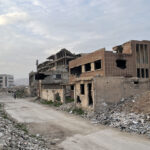
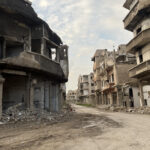
Crossing the border, the green plains of Daraa stretched out before us. Yet beneath their springtime calm lay the scars of more than a decade of war: shattered buildings, abandoned homes, entire districts hollowed out. Closer to the capital, the destruction intensified, with whole neighbourhoods reduced to rubble.
Bassem
Travelling beside me was Bassem, a Syrian returning home after more than a decade in the United States. His American accent was unmistakable, his sentences peppered with colloquial slang like ‘man’ and ‘bro’ that he’d picked up on the south side of Chicago. He had fought with the Free Syrian Army against the government of Bashar al-Assad until a bullet to the chest lodged in his spine, leaving him paralysed from the waist down. Gazing out at the devastation, he spoke quietly: “This is a broken country, man. People want results overnight, but this is going to take time to fix.”
Dressed in jeans or tracksuits, with Kalashnikovs slung over their shoulders, they presented a jarring image of a country still in transition”
An uneasy calm prevailed as we passed through a succession of checkpoints. They were manned by men who, until recently, had been fighters with the Islamist group Hayat Tahrir al-Sham. Their leader had now become Syria’s new president, and they had been absorbed into the demobbed police forces. Dressed in jeans or tracksuits, with Kalashnikovs slung over their shoulders, they presented a jarring image of a country still in transition.
Arriving at the Latin parish in Damascus, I fumbled with payment as Syria introduces a new currency, removing two zeros from the old notes. It is a small sign of a country attempting to reset after years of economic collapse. At the parish gate, I was greeted by Najla, an administrator with a church aid agency and a mother of two, whose family originally came from Lebanon. Within minutes she was leading me through the Christian Quarter, pointing out churches that had endured both time and turmoil.
Dweilaa
At Mar Elias Church in Dweilaa – where a shooting and suicide bombing killed 21 worshippers last year – we paused in prayer. “Our situation is difficult,” she said. “We are afraid for the future. There is now a clear divide between majority and minority communities that did not exist before. People fear these sorts of attacks could happen again, because there is no real security and no trust in the police.”
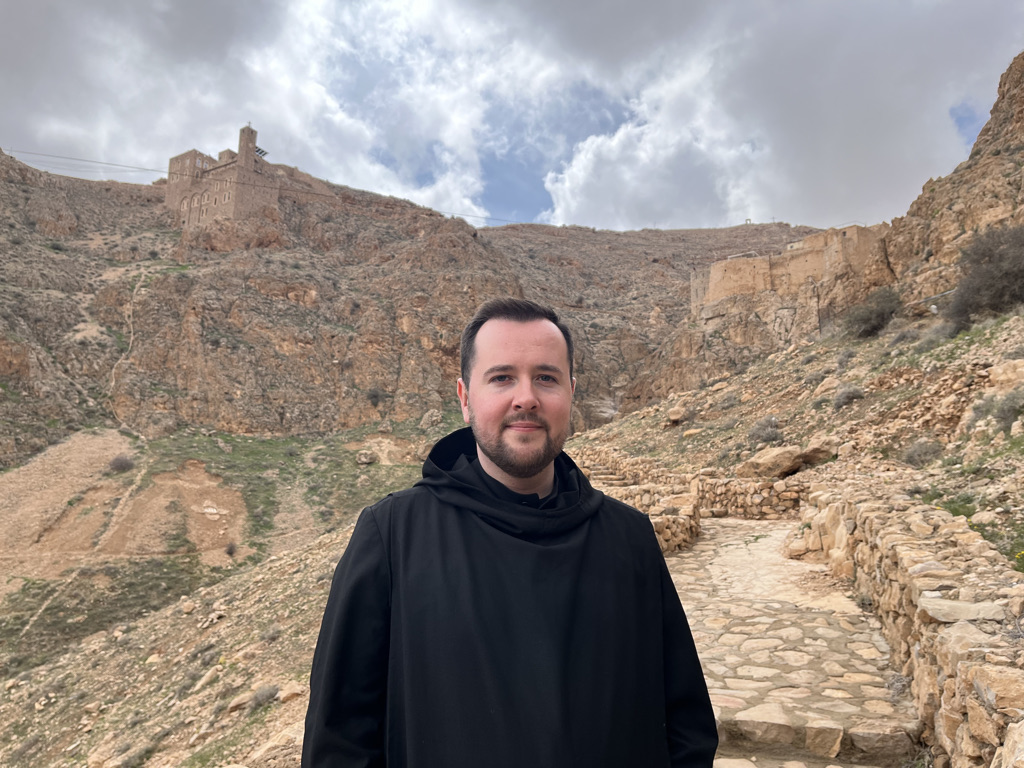
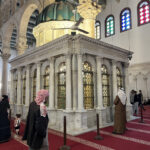
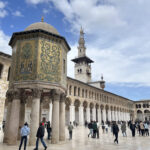
My stay in Damascus was brief, but long enough to glimpse the city’s layered history: Roman ruins; places associated with St Paul’s conversion; the great Umayyad Mosque – once a cathedral – housing a shrine believed to contain the head of John the Baptist; and a visit to the renowned Syriac Catholic monastery of Mar Mousa, whose Jesuit superior is among the disappeared of the civil war.
I don’t want to see a day when there are no Christians here. The first Christian communities began in this region and we are part of its foundation”
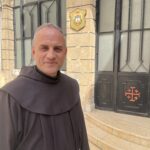
Fr Nirwan, the Latin parish priest, drove me to the taxi office for my onward journey. An Iraqi-born priest who spent years ministering in Palestine before coming to Damascus, he spoke with quiet conviction. “I am always optimistic,” he said, navigating the crowded streets. “Peace will return to these lands – I’m sure of it – but I don’t know how.”
He paused before continuing. “I don’t want to see a day when there are no Christians here. The first Christian communities began in this region and we are part of its foundation. Wherever Christian life is lived, there is peace. I pray for peace, and for a time when people can live with dignity, without fear, without feeling like strangers in their own country.”
As I now cross the border into Lebanon to catch a flight onwards to Cairo, Fr Nirwan’s words linger. The present regional war hangs heavily over everything, casting a long shadow across already fragile societies and deepening a sense of uncertainty among Christian communities who have endured so much in recent decades. And yet, their response is neither one of resignation nor retreat. In parishes, schools, and homes, I encountered a quiet determination to remain, to hope, and to bear witness despite yet another conflict. This journey through the Middle East, born of necessity, has become something more for me: a pilgrimage through lands marked by suffering, sustained by faith, and carried forward by a fragile but enduring conviction that peace, however distant, will one day prevail.
Justin Robinson OSB is a Benedictine monk of Glenstal Abbey in Co. Limerick, currently residing in Cairo.