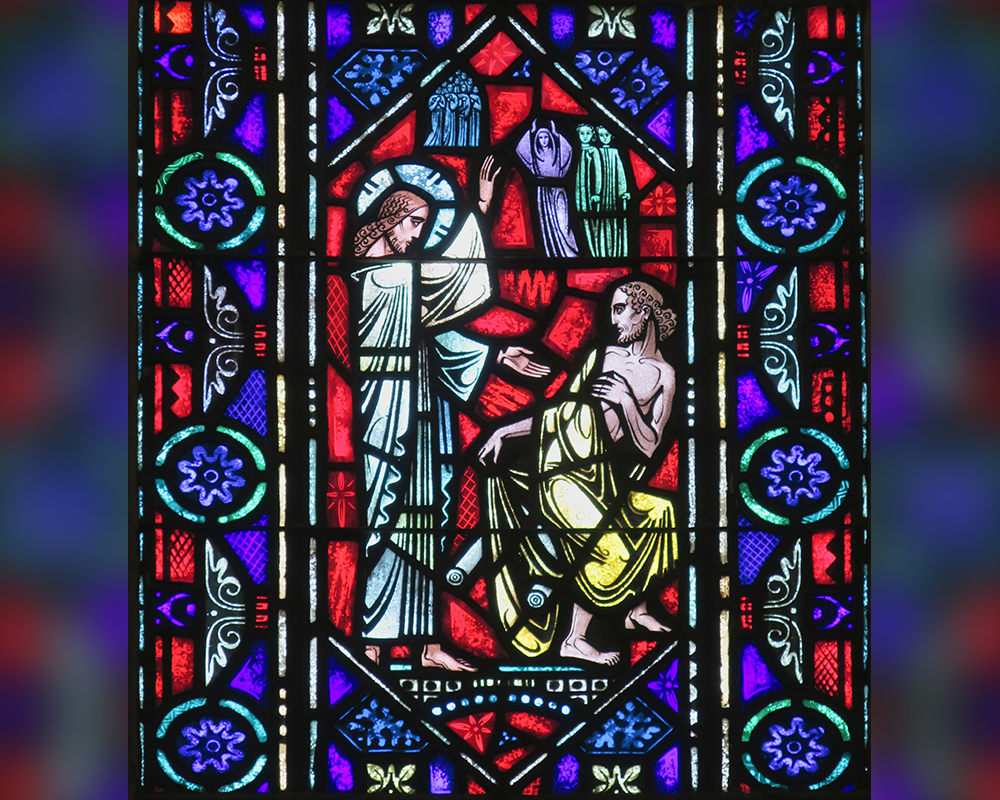
As this gospel reading is quite long, you are invited to use your own Bible to read the text.
Initial observations
This story is found only in the Fourth Gospel, although the other Gospels do tell of people being raised from the dead (Jairus’ daughter, the son of the widow of Nain). Our story, very much longer than these other stories, is the seventh (the climax) of the seven signs: the Wedding Feast at Cana, Woman at the Well, the royal official’s son, the Loaves, the walking on the water, the Blind Man and Raising of Lazarus. The writer has expanded the narrative into a moving drama, thus exploring in a very human way the teaching about Jesus and the resurrection.
Kind of writing
This is the last and most significant symbolic tableau in the Fourth Gospel. It explores the meaning of the resurrection of Jesus for believers. It is the climax of “seven signs”, which undergird the narrative of the Fourth Gospel, thus taking us to the heart of this Gospel’s teaching.
Old Testament background
(i) By and large in the Old Testament, there is no real conviction about a genuine life after death. There are exceptions. Ezekiel, writing during the Babylonian Exile (587-539 bc) and speaking metaphorically, describes the future restoration of the next generation using the language of resurrection (Ezekiel 37 – the Valley of the Dry Bones). The Book of Daniel teaches the resurrection (Daniel 12:2), as does 2 Maccabees 12. The context here is martyrdom. In that context, the question of God’s faithfulness to those who have been faithful till death became acute. In order to continue to speak of God as just, a teaching about reward and resurrection in the next life emerged. The driving force is not speculation about the human condition but the need to continue to speak of God as just. Finally, in some of the psalms there is a possible hint at something more: Psalms 16:9-11, 49:15.
(ii) The Fourth Gospel has many “I am” sentences, on the lips of Jesus: I am the bread of life, the true vine, the Good Shepherd, the light of the world, the way, the truth and life. These are intentional echoes of God’s self-revelation to Moses as I am who I am (Exodus 3:14).
New Testament foreground
- i) Links with the rest of the Gospel (relatively unusual in this text):
Lazarus is mentioned elsewhere: 12:1, 9, 17. Mary appears again in 12:3. She is not Mary Magdalene. Martha gets mentioned in 12:2. Caiaphas returns in 18:13, 14, 24, 28. Thomas 14:5; 20:24, 26; 21:2. Judas (6:71); 12:4; 13:2, 26, 29; 14:22; 18:2, 3, 5. Pharisees 12:19, 42; 18:3.
There is also an unusual direct reference to a previous story—the man born blind—the link is Jesus himself, as the one having light and giving sight.
(ii) Location within the Gospel:
The full setting is 10:40-12:11, unfolded over five grand scenes, resembling a play or a drama. I. Across the Jordan (= Bethany), many believed in him (10:40-42) II. Jesus, Lazarus, Mary, Martha, Bethany; cross references (11:2) and burial (11:1-44) III. This is the centre – because the plot against Jesus takes off (11:45-57) II*. Jesus, Lazarus, Mary, Martha, Bethany; cross references (11:2) and burial (12:1-8) I*. House of Lazarus (= Bethany); many believed in him (12:9-11). Within that wider “plot”, our story has its own outline and centre.
(iii) Our Gospel excerpt:
Our excerpt, 11:1-45, is no. II above, with a line from III. It exhibits its own meaningful pattern, where the physical central passage (C. in the box) is also the centre of meaning.
Jesus said to her, “Your brother will rise again.” Martha said to him, “I know that he will rise again in the resurrection on the last day.” Jesus said to her, “I am the resurrection and the life. Those who believe in me, even though they die, will live, and everyone who lives and believes in me will never die. Do you believe this?” She said to him, “Yes, Lord, I believe that you are the Messiah, the Son of God, the one coming into the world.” (John 11:23–27)
(iv) Jesus preached the Kingdom of God; the earliest communities preached the king, Jesus risen from the dead. The Johannine community takes this one step deeper and teaches not only that Jesus is risen, but that he is himself personally the Resurrection. Our trust is not in a teaching but in a person. This conviction emerges earlier in the Gospel and in many ways, today’s Gospel excerpt is a comment on this momentous earlier passage:
Indeed, just as the Father raises the dead and gives them life, so also the Son gives life to whomever he wishes. The Father judges no one but has given all judgment to the Son, so that all may honour the Son just as they honour the Father. Anyone who does not honour the Son does not honour the Father who sent him. Very truly, I tell you, anyone who hears my word and believes him who sent me has eternal life, and does not come under judgment, but has passed from death to life. “Very truly, I tell you, the hour is coming, and is now here, when the dead will hear the voice of the Son of God, and those who hear will live. For just as the Father has life in himself, so he has granted the Son also to have life in himself; and he has given him authority to execute judgment, because he is the Son of Man. Do not be astonished at this; for the hour is coming when all who are in their graves will hear his voice and will come out—those who have done good, to the resurrection of life, and those who have done evil, to the resurrection of condemnation. “I can do nothing on my own. As I hear, I judge; and my judgment is just, because I seek to do not my own will but the will of him who sent me. (John 5:21–30)
(v) There are important links with the resurrection of Jesus himself:
The dead man came out, his hands and feet bound with strips of cloth, and his face wrapped in a cloth. Jesus said to them, “Unbind him, and let him go.” (John 11:44)
Then Simon Peter came, following him, and went into the tomb. He saw the linen wrappings lying there, and the cloth that had been on Jesus’ head, not lying with the linen wrappings but rolled up in a place by itself. (John 20:6–7)
The unusual detail about the head band serves two purposes, to connect and distinguish the resurrection of Jesus and that of Lazarus. The distinction: the resurrection of Lazarus is qualitatively different—he still needs to be unbound; contrariwise, the resurrection of Jesus is definitive and effective—he no longer needs unbinding, but has passed from death to life. The connection: Jesus raised Lazarus because he loved him (11:36 “See how much he loved him”).
The Fourth Gospel teaches that, just as Jesus dies for love of us (3:16a), he also rises from the dead for love of us (3:16b). In a word, the gift of new life transcending death is the measure of the love of God for humanity and for each of us. This aspect of resurrection faith is brought out uniquely in this Gospel, especially by the careful linking of the raising of Lazarus and the rising of Jesus.
St Paul
See 1 Corinthians 15:42–49.
Brief commentary
Verses 1-5 The narrative opens with the significant people named and the problem — Lazarus’ illness and death — is identified. V. 2 is an anticipation of chapter 12. V. 4 alerts the reader to a different level of meaning.
Verse 6 This is a surprise (creating suspense), especially after the story of the Blind Man, where Jesus initiates the cure. The delay—unexpected and unexplained—seems not to make sense.
Verses 7-10 The disciples try to dissuade Jesus from making a journey that could threaten his life, unaware that the cross leads to resurrection. V. 9 recalls “I am the light of the world” from chapters 8 and 9.
Verses 11-16 As often in this Gospel, people close to Jesus radically misunderstand him. The reader is invited to reflect deeply, looking at these stories with the 20:20 vision of Easter hindsight.
Verses 17-27. Jesus and Martha: a disclosure leads to an act of faith. This is an intense one-to-one encounter, typical of this Gospel and resembling the early quest stories of the Samaritan woman and the man born blind
Verses 28-32. Jesus and Mary: the gesture of imploring implies faith. This is a second, even more intense one-to-one encounter.
Verses 33-43. Jesus himself is moved profoundly to act for his friend. Certainly, this is the emotional and theological climax of our Gospel excerpt.
Verse 44 The “illness” of Lazarus is reversed; note however that he has to be nevertheless unbound – unlike Jesus in this Gospel: … the cloth that had been on Jesus’ head, not lying with the linen wrappings but rolled up in a place by itself. (John 20:7).
Verse 45 This apparent affirmation leads directly to the plot against Jesus, as the very next verse 46 makes clear.
This intensely human account has a profoundly consoling message: the resurrection, realised and offered in the person of Jesus, is the supreme gesture of God’s love towards humanity. In Jesus, God reaches out to the tragedy of the human condition and to each one of us. This is the “tender mercy” of our God (Luke 1:78).
Pointers for prayer
- Martha and Mary are portrayed as people of faith but Jesus led them to an even deeper faith. Who were the people who led you to a deeper faith in Jesus? Remember them and give thanks.
- Martha and Mary were struggling to come to terms with their bereavement. What has helped you in similar situations?
- The concern of Jesus is palpable and touching. Recall those who matter to you and to whom you matter. Such love mediates God’s love, which surpasses human love with the gift of new life and Easter joy.
- One can imagine Lazarus as a symbol of people and groups that are written off as dead (sometimes by themselves), and yet through faith come back to life again. Have you had the experience of being revived by faith? Has faith helped to free you from what held you in bondage, or was destructive of your life?
Prayer
Merciful God, you showed your glory to our fallen race by sending your Son to confound the powers of death.
Call us forth from sin’s dark tomb: break the bonds which hold us, that we may believe and proclaim Christ the cause of our freedom and the source of life, who lives and reigns with you in the unity of the Holy Spirit, for ever and ever. Amen.
A. vv.1-19 Jesus, the illness and death Lazarus, the disciples and the Jews
B. vv.20-22 Jesus and Martha
C. vv.23-27 Jesus reveals himself as the resurrection and the life
B* vv.28-32 Jesus and Mary
A* vv.33-44 Jesus, the resurrection of Lazarus, Mary and Martha, and the Jews
Thought for the day
The historical Jesus was guarded in declaring his identity but by the time the Fourth Gospel was written, Christians had arrived at a rich understanding of the mystery of Jesus, the Son of God. John’s Gospel puts before the believer a grand assemblage of 7 “I am” sentences, rooted in the name of God in Exodus 3:14, I am who I am. I am the bread of life. (John 6:35, 48, 51); I am the light of the world (John 8:12; 9:5); I am the gate for the sheep (John 10:7, 9); I am the good shepherd (John 10:11, 14); I am the resurrection and the life (John 11:25); I am the way, and the truth, and the life (John 14:6); I am the true vine (John 15:1, 5). We are reminded that we believe first of all in a person, not in a philosophy. Anyone one of these images would take us deeply into our encounter with the Risen Lord, none more so than “I am the resurrection and the life.”
Prayer
Jesus, present to us always, you wept at the tomb of your friend Lazarus. As we face the mystery of death, our own and that of those we love, help us to place our trust in you, the resurrection and the life. Amen.
First reading
Rom 8:8 Those who are in the flesh cannot please God.
Rom 8:9 You, however, are not in the flesh but in the Spirit, if indeed the Spirit of God lives in you. Now if anyone does not have the Spirit of Christ, this person does not belong to him.
Rom 8:10 But if Christ is in you, your body is dead because of sin, but the Spirit is your life because of righteousness.
Rom 8:11 Moreover if the Spirit of the one who raised Jesus from the dead lives in you, the one who raised Christ from the dead will also make your mortal bodies alive through his Spirit who lives in you.
Initial observations
The readings for the fourth Sunday of Lent are exceptionally united around the resurrection. Our passage from Romans brings its own perspective, which focuses not only on our future afterlife but also on our present life in the Spirit. This gives the second reading an immediate and practical relevance.
Kind of writing
Paul’s account of all we have received in Christ comes to a climax with this great “hymn” to the Holy Spirit.
Origin of the reading
Within the Roman Christian house churches, a conflict had arisen over how much of the Torah regulations to retain. It looks as if Christ believers of Gentile background did not observe the dietary laws etc., and, in their “higher” freedom, looked down on those who did keep the such laws. On the other hand, Christ believers of Jewish origin put a great deal of store on their fidelity to tradition and, in their “greater” faithfulness, looked down on those who did not keep the Law. In the first four chapters of Romans, Paul destabilises both groups, showing that they are equally “successful” in sinning and equally in need of both grace and faith. Moving from this negative evaluation, in chapters 5-8, Paul lays out in chronological order the wonderful gifts of salvation received by all. His purpose is once more to show that both at the level of need and at the level of grace, “there is no distinction.”
Related passages
The role of the Holy Spirit is evident from the very start of Romans 5.
Therefore, since we have been declared righteous by faith, we have peace with God through our Lord Jesus Christ, through whom we have also obtained access by faith into this grace in which we stand, and we rejoice in the hope of God’s glory. Not only this, but we also rejoice in sufferings, knowing that suffering produces endurance, and endurance, character, and character, hope. And hope does not disappoint, because the love of God has been poured out in our hearts through the Holy Spirit who was given to us. (Rom 5:1–5)
Romans 8 should be read as a whole to see the role and significance of the Spirit in St Paul’s theology: Romans 8:2, 4–6, 9–11, 13–16, 23, 26–27. See also 1 Corinthians and Galatians:
God has revealed these to us by the Spirit. For the Spirit searches all things, even the deep things of God. For who among men knows the things of a man except the man’s spirit within him? So too, no one knows the things of God except the Spirit of God. Now we have not received the spirit of the world, but the Spirit who is from God, so that we may know the things that are freely given to us by God. (1 Corinthians 2:10–12)
Now the works of the flesh are obvious: sexual immorality, impurity, depravity, idolatry, sorcery, hostilities, strife, jealousy, outbursts of anger, selfish rivalries, dissensions, factions, envying, murder, drunkenness, carousing, and similar things. I am warning you, as I had warned you before: Those who practice such things will not inherit the kingdom of God! But the fruit of the Spirit is love, joy, peace, patience, kindness, goodness, faithfulness, gentleness, and self-control. Against such things there is no law. (Galatians 5:19–23)
Brief commentary
Verse 8 While it can be confusing, it is evident that flesh does not refer to the body or to material existence. Later, in Christian spirituality under the influence of Platonism, a distinction did indeed arise between the high spiritual self and the lower bodily self. But Paul remains Jewish and respects the biblical intuition that the material order is God’s creation and therefore good in itself. By “flesh”, Paul means our whole human nature as such, viewed as belonging to this world, that is, apart from God and Christ, being both independent and powerless.
Verse 9 The affirmation in v. 9 makes it clear that flesh is not the body as such, because the Romans are definitely “in the body”! To be in the Spirit means to have received the Spirit and to have the mind of Christ. The verse is in two parts, saying the same thing first positively and then negatively. The indwelling of the Spirit echoes God’s presence or shekinah in the Temple, now realised in the hearts of all believers. (For Paul, Spirit, Spirit of God and Spirit of Christ are all the one presence and gift.)
Verse 10 Christ himself is in believers’ hearts because of the Spirit’s indwelling. The body being dead is a reference to the human condition under the power of sin and death, explored earlier in Romans 5 in the discussion of Adam. Physical/bodily death is the evidence and proof of this condition. By contrast, the Holy Spirit counteracts the power of sin and death by making alive in our hearts the righteousness of God—God’s faithfulness and compassion disclosed in Jesus and given to us in the Spirit (Romans 3:21-26). As a result, we too can be both faithful and righteous, in this present life.
Verse 11 This verse is the climax of this reflection. God’s faithfulness to Jesus in resurrection is the first instalment of God’s faithfulness to all humanity. Jesus’ resurrection—the first fruits of all who sleep—already anticipates and enables our own resurrection. The indwelling Spirit, a kind of down payment (2 Corinthians 1:22), is the guarantee, even proof, of that future reality. Our bodily reality, far from being neglected or set aside, will also be part of that new reality, however we may imagine it (see 1 Corinthians 15:35-49).
Pointers for prayer
- Living “without God” is part of all our experience, at least from time to time. Can I recognise this reality in myself?
- God’s presence within—his shekinah in all of us through Jesus’ Spirit—means that our prayer is simply a “yes” to gift and reality.
Prayer
O God, you are within us all, through the Holy Spirt. Help us to acknowledge your gift and presence through prayer and meditation. Help us to live the gift of your faithfulness by being faithful to you, in how we live and move and have our being. Amen.

Second reading
Ezek. 37:11 Then he said to me, “Mortal, these bones are the whole house of Israel. They say, ‘Our bones are dried up, and our hope is lost; we are cut off completely.’
Ezek. 37:12 Therefore prophesy, and say to them, Thus says the Lord God: I am going to open your graves, and bring you up from your graves, O my people; and I will bring you back to the land of Israel.
Ezek. 37:13 And you shall know that I am the Lord, when I open your graves, and bring you up from your graves, O my people.
Ezek. 37:14 I will put my spirit within you, and you shall live, and I will place you on your own soil; then you shall know that I, the Lord, have spoken and will act,” says the Lord.
Initial observations
Along with Isaiah and Jeremiah, Ezekiel is one of the major prophets. According to the book itself, the author was a priest who was deported to Babylon in 597 bc. The text is the fruit of penetrating theological reflection on why the disaster of exile befell Israel. Although it does exhibit typical features of prophetic speech, the book is so carefully written, with consistent themes and magnificently elaborate metaphors, that we may view it as a chiefly literary work.
Kind of writing
Ezekiel 37:1-14 is a vision report, in two parts 1-10 (the oracle) and 11-14 (the interpretation, our reading substantially). Vv. 11-14, like the vision report, are in two parts, one negative (v.11), the other positive (vv.12-14). The phrase “says the Lord” acts a frame around the positive parts.
Origin of the reading
Traditionally, the book was seen to be in two parts: chs. 1-24 (doom) and 25-48 (consolation), not unlike the book of Jeremiah. Nowadays, scholars notice that the book is shaped by three great visions of God: Ezekiel 1, 8–11, 40–48. A proposed layout looks like this:
1-7: First vision, call, preparation
8-39: Ezekiel among the exiles
40-48: The New Kingdom
Layout of the middle section:
8-11: Temple abominations
12-15: Contra Jerusalem leaders
16-23: Abominations revealed
24-33: YHWH against rebels
24: Jerusalem siege (start)
25-32: Against the nations
33: Jerusalem siege (end)
34-39: YHWH restores Israel
Our reading, therefore, comes from that part where the prophet turns to restoration and new life, which is to be developed fully in Ezek 40-48.
Related passages
I will take you from the nations, and gather you from all the countries, and bring you into your own land. I will sprinkle clean water upon you, and you shall be clean from all your uncleannesses, and from all your idols I will cleanse you. A new heart I will give you, and a new spirit I will put within you; and I will remove from your body the heart of stone and give you a heart of flesh. I will put my spirit within you, and make you follow my statutes and be careful to observe my ordinances. Then you shall live in the land that I gave to your ancestors; and you shall be my people, and I will be your God. (Ezekiel 36:24–28)
Brief commentary
Verse 11 The divine voices speaks again (see vv. 3, 4 and 9). A corporate interpretation is given to the symbolic discourse. In the three-fold lament, we overhear the searing complaint of the exiles. “We are cut off” means we have experienced death. Bitter experience has sapped the life out of them.
Verses 12-13 Building on the gruesome images of revived corpses in vv. 1-10, the prophet offers a plain meaning: the return and restoration of Israel. The Exile was experiences as a graveyard for the people; correspondingly, the return from Exile is portrayed as a resurrection. Notice how the triple lament is matched by a three-fold offer of salvation. In this new exodus, God saves Israel again. Even more importantly, God reveals his true self. In Ezekiel, salvation is a meant to an end, the unveiling of God. Thus, at its heart, redemption by God is a revelation of God. (Likewise, the raising of Lazarus tells us who Jesus is.)
Verse 14 The strong conclusion ties the interpretation to the oracle in vv.1-10, but also links with earlier equally significant affirmations about the new heart and the new spirit (see above Ezek 36:24–28). The nine repetitions of breath/spirit in 37:1-4 should also to be kept in mind. This makes our references here the ninth, climactic affirmation. While not always clear in translations, the Hebrew word for breath/spirit rûah is used throughout.
Ezekiel does speak of national restoration, making metaphorical use of resurrection. It may be presumed that this made sense to his audience, reflecting some conviction about life after death.
Pointers for prayer
- There is a lament at the start of there reading, a real cry from the heart. Does it resonate with any happenings in my own life?
- The words of Julian and Norwich come to mind: all shall be all, all shall be well and all manner of thing shall be well. Faith alone helps.
Prayer
God of all life, we are in your hands and into your hands we commend our spirt, our life, our all. Strengthen us when we feel all hope is gone and let us know your presence in our lives. Amen.
| 1. Gen 2:7-9; 3:1-7 | Adam and Eve | Rom 5:12-19 | Adam and Jesus | Mt 4:1-11 | The Temptations |
| 2. Gen 12:1-4 | Abraham | 2 Tim 1:8-10 | God’s grace | Mt 17:1-9 | Transfiguration |
| 3. Ex 17:3-7 | Moses | Rom 5:1-2, 5-8 | God’s love | Jn 4:5-42 | The Samaritan |
| 4. 1 Sam 16:1, 6-7, 10-13 | David | Eph 5:8-14 | Light of Christ | Jn 9:1-41 | Man born blind |
| 5. Ezek 37:12-14 | The Exile | Rom 8:8-11 | Jesus will give life | Jn 11:1-15 | Lazarus |

Themes across the readings
Our first reading is not really about personal resurrection. Nevertheless, it affirms faith in God who has power over death and life. It names something of the tragedy of the human condition and God’s responding offer of salvation.
Ezekiel’s promise of a new heart and a new spirit finds an echo in Paul’s great chapter 8 to the Romans. The link between the Spirit of him who raised Jesus from the dead and our own experience of the indwelling Spirit is the key.
Like the first reading, the Lazarus story names the human condition. What is God’s response? The phrase “see how much he loved him” is a clue. Only in the Fourth Gospel do we find the explicit teaching that God loves us enough to raise us from the dead.
The responsorial Psalm
The De profundis voices a response which perfectly matches the tone of both longing and consolation. In particular, the mention of daybreak is very powerful.
Sunday introductions
First reading Ezekiel 37:12-14
This vision was spoken at a time when all hope seemed futile and the future looked truly bleak.
Second reading Romans 8:8-11
Is there a link between our present spiritual experience and our final hope in God? Paul says a resounding “yes”, because of the Holy Spirit, who dwells in us.
Gospel John 11:1-45
The raising of Lazarus portrays a very human Jesus, sad at the lost of his friend: “See how much he loved him.” It also teaches us that God raises the dead out of love for us! Stupendous!
Weekday introductions
Monday 23 March
St Turibius of Mongrovejo, bishop
Daniel 13:1-9, 15-17, 19-30, 33-62
This dramatic reading follows on extremely well from yesterday’s Gospel about the woman caught in adultery. Many dimensions could help us, but perhaps the courage and intelligence of Daniel could be underlined.
John 8:12-20
The theme of judgement unites the two readings—by which standards do we judge? In the discussion with the Pharisees, the Fourth Gospel offers us a deep and still challenging understanding of Jesus. Who was he? Who is he?
Tuesday 24 March
St Macartan, bishop
Numbers 21:4-9
We know from our human experience that when something is harming us, we need to face it. Something of that ordinary experience lies beyond this extraordinary story. The image of the serpent lifted up is found on the lips of Jesus in the Fourth Gospel, speaking of his own death and resurrection.
John 8:21-30
The image of “lifting up”—so central to John’s Gospel—is taken from the story of the bronze serpent. The evangelist reminds us of our need the healing that God provides in Jesus.
Wednesday 25 March
The Annunciation to the BVM
Isaiah 7:10-14, 8:10
The birth of a child—as in this reading—is always a sign of hope.
Hebrews 10:4-10
Our reading today reflects on the death of Jesus, in the light of the incarnation.
Luke 1:26-38
There are several annunciation stories in the Old Testament. Our annunciation is similar, yet significantly different on account of the child to be born — son of the Most High, descendant of Jacob and David, Jesus the Messiah.
Thursday 26 March
Genesis 17:3-7
The reading today picks out an emblematic story about Abraham, as a preparation for the Gospel, where Abraham is mentioned again. He was the original man of faith, our father in faith, as Hebrews puts it, who put his trust in God and in a way God puts his trust in Abraham.
John 8:51-59
In the Fourth Gospel, there are seven I Am sentences, always qualified by some image or affirmation such as the good shepherd. The I Am in today’s reading is without qualification, an absolute claim to identity with God. While clearly “theological, it may have a grounding in history: Again the high priest asked him, “Are you the Messiah, the Son of the Blessed One?” Jesus said, “I am.” (Mark 14:61–62)
Friday 27 March
Jeremiah 20:10-13
Right up to today, good people are made to suffer when they tell the truth and say it like it is. This was true also in the past: Jeremiah suffered greatly for his convictions and prophecies, in the same way as Jesus would, much later.
John 10:31-42
As often in John’s gospel, we are overhearing later disputes about the identity of Jesus and the arguments for and against. Only in the light of the resurrection did the early Christian really grasp who Jesus was and who the risen Jesus is today.
Saturday 28 March
Ezekiel 37:21-28
This short reading was written a time of national disaster and disgrace. As we listen, we might keep in mind what picture of God comes out of this picture? Can it help me or us today?
John 11:45-56
Today, our reading takes us to the consequences of the story of Lazarus. John’s Gospel is looking back after many year’s of prayer and reflection. The evangelist see that the cause of Jesus’ death was really who he was — the Messiah and the Son of God. This Gospel has many examples of irony. Caiaphas speaks the a deep truth, even if he doesn’t know what he is really saying: it is better for one man to die for the people.