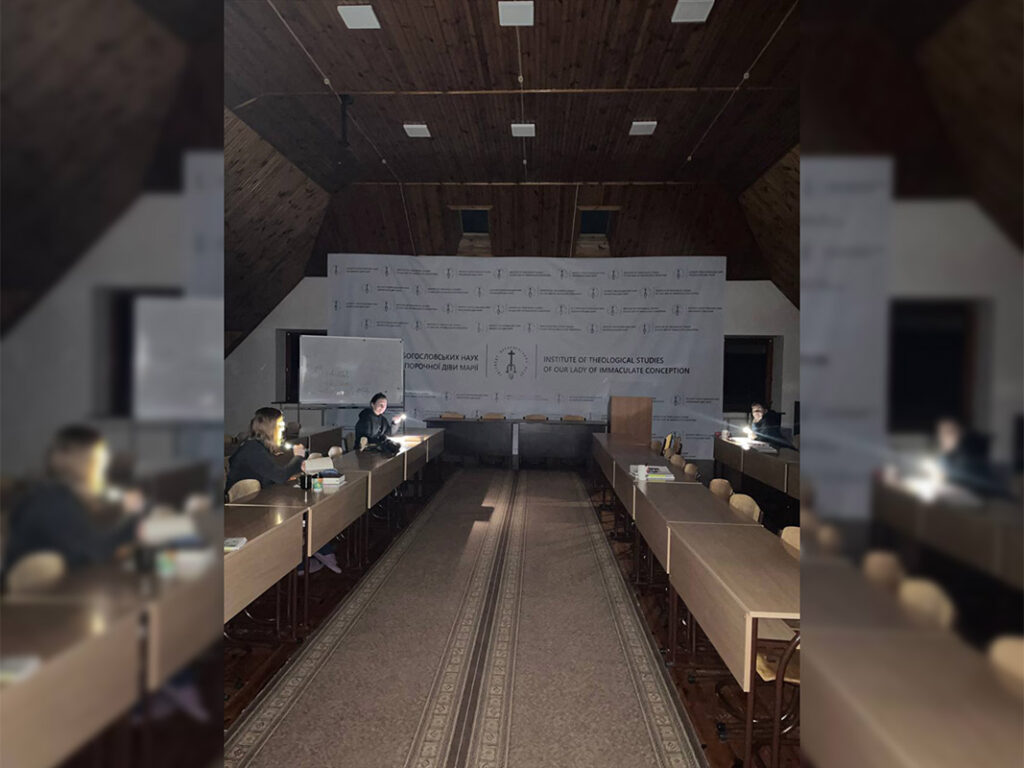
This winter in Ukraine has been a special challenge for everyone who studies and teaches. This includes us, the students of the Institute of Theological Sciences of the Immaculate Virgin Mary in the town of Horodok, Khmelnytskyi region. Prolonged power outages—sometimes up to 18 hours a day—brought cold temperatures indoors, heating difficulties, and water supply interruptions. Classes are held in the dark, in warm clothes (several layers), often by candlelight or flashlights, with constant uncertainty: will there be light, will we be able to recharge our phones and flashlights, will we have enough strength?
In such conditions, the study of theology takes on a special depth. Reflections on the Light of Christ cease to be just a beautiful metaphor — they become an experience. When the external light disappears, the need for internal light is felt even more clearly: for truth that cannot be turned off, for God’s presence that does not depend on circumstances. Knowing God becomes a real struggle—a struggle for Truth, for meaning, for fidelity to one’s calling.
For example, during the last week-long session, the batteries froze, and there was no heat or water, as electricity was only available for two hours a day. This is an educational institution where students live, study, and pray for a whole week once a month. However, despite such extreme conditions — wearing coats and gloves, by the light of lanterns, sleep-deprived and exhausted by terrible inconveniences — the students and teachers — not only listened diligently to lectures on theological disciplines and prayed the Liturgy of the Hours and Holy Mass in an incredibly cold chapel, but also organised a real Christmas gathering, full of comfort, joy, hospitality, and carol singing.
Dedication
Our assistant vice-rector shared with me a story about a planned interview for Catholic television. Due to the lack of electricity at the Institute, she had to ask the local parish priest, who had a charging station for her computer. During the hour-and-a-half interview, she got so cold that her voice was shaking and she couldn’t bend her fingers to pick up a cup of coffee.
Given this, our education is no longer something automatic or convenient. It becomes a conscious choice: to study despite everything. To read, think, pray, listen — even when it is cold, difficult, and dark. It is in these conditions that theology reveals itself not only as an academic discipline, but as a way of life and trust in God.
At the same time, we realise that people do not only need spiritual light, but also physical light. Basic conditions are necessary for learning—electricity, heat, water. Caring for these things does not contradict faith, but is a sign of respect for human dignity and intellectual work.
The formation takes place in four dimensions: human, intellectual, spiritual, and pastoral”
Studying theology this winter is a testimony of steadfastness, hope, and love for the Truth. In the darkness and cold, we discover even more deeply the Light of Christ, which never fades, and we learn to know God more closely—not despite difficulties, but precisely because of them.
The Institute of Theological Sciences of the Immaculate Virgin Mary is a higher educational institution of the Kamyanets-Podilskyi Diocese of the Roman Catholic Church in Ukraine, founded in 1997 with the aim of training lay people for service in various areas of the Church.
The formation takes place in four dimensions: human, intellectual, spiritual, and pastoral. That is why the Institute offers theological studies in four specialisations, covering catechesis, work with families, mass media, and biblical apostolate, as well as a School of Sacred Music. Today, about 100 students study at the Institute.
Sr Mariia Liuba is a religious in the Missionary Sister Servants of the Holy Spirit based in Ukraine.