“The more you farm out to an AI what you should be doing yourself, the more you make yourself obsolete… Mediocrity is going to put a lot of people out of work,” said Fr Phillip Larrey.
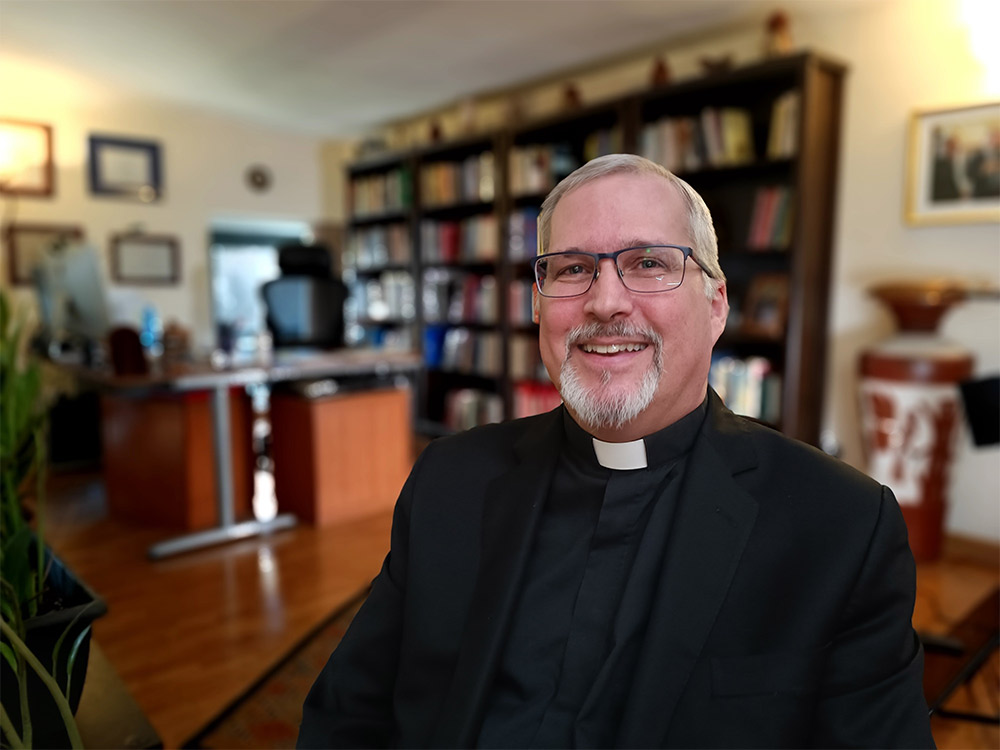
Fr Larrey, PhD, is a Catholic priest and professor of philosophy at Boston College. He previously served as dean of the philosophy department at the Pontifical Lateran University in Rome, where he taught the philosophy of knowledge for over 30 years. He began working on AI in the 1990s — during what he calls the “winter of AI” — and he’s no stranger to Silicon Valley, having grown up there and maintained close ties to the tech world, frequently rubbing shoulders with tech moguls like Sam Altman and Demis Hassabi.
In a time when artificial intelligence can paint, compose, and even imitate love, Fr Larrey argues that what sets us apart is not information or even creativity – but what Pope Francis calls “the wisdom of the heart,” – the capacity for love, for empathy, conscience, and communion. Machines can calculate — but they can’t love.
Implications
In February, Fr Larrey visited Belfast to speak on AI and ethics at the Catholic Chaplaincy — a talk that drew a diverse audience, not just Catholics. The following day, he addressed the computer science department at Queen’s University.
“It was unusual,” he said. “They’re technicians. Professors who teach coding. Not humanistic studies.” But the questions they asked surprised him: “They wanted to know about the philosophical implications. I asked them — you’re building AI in the lab. Have you ever thought about the ethical or moral considerations of what you’re doing?”
The answer, bluntly, was no. “We just go with what works,” they told him. “Why should we even talk about these things?”
“Because you’re creating the future,” Fr Larrey told them. “Artificial intelligence and technology will shape everything — how we live, work, even think. You can’t assume you don’t have responsibility for these bigger questions.”
‘AI has to consider us as a meaningful part of the universe.’ Because we are giving more and more autonomy to AI platforms”
To his surprise, the exchange sparked something. The professors now meet regularly to discuss the ethical implications of their work.
“Are they aligned with human value?” Fr Larrey asks. “We have to ensure that these platforms are aligned with our values and like Elon Musk said at MIT four years ago “AI has to consider us as a meaningful part of the universe.” Because we are giving more and more autonomy to AI platforms.”
Creativity
So the question remains: what separates human intelligence from artificial intelligence? What makes us, in Musk’s phrase, a meaningful part of the universe?
For some, the answer lies in creativity — the poetic spark that defines the human soul. But even this is no longer a given. With the rise of generative AI, machines now have the power to compose, paint, and produce with remarkable fluency.
“In France,” Fr Larrey noted, “they’ve allowed AI to hold copyright. There have even been paintings sold by Christie’s in London that were created entirely by AI.”
Sceptics argue that these machines are merely remixing the past — performing variations on a theme. But Fr Larrey pushes back: “Well, it’s just doing a variation on Beethoven. Yeah — but isn’t that what we do too?”
So what does it truly mean to possess human intelligence?
In our discussion, Fr Larrey pointed to Antiqua et Nova – the Vatican’s 2024 document on artificial intelligence, which gathers the seven addresses Pope Francis gave on the subject into one collected framework. Central to this document is the reminder that human intelligence is not disembodied. It is incarnate – rooted in what the Pope calls the “wisdom of the heart.”
Summarising this core insight, Fr Larrey said: “Human beings, when they relate to each to each other, they do so through their bodies, with their bodies, in their bodies. Human beings are incarnate spirits. They’re not just pure spirit. You could maybe look at an AI as being a disembodied spirit.”
Things that are part of human nature. That a machine can’t match”
This echoes a luminous insight from St Hildegard of Bingen, who described the human being as a unity of soul, body, and senses.
“The soul provides the body with life like fire flooding the darkness with light… it has two major powers: the understanding and the will.”
“What Pope Francis is talking about,” said Fr Larrey, “is the component of human intelligence that a machine cannot match. Again, remember what machines are doing are calculating logical operations on the basis of very complex algorithms, but they don’t have access to wisdom.
“They don’t have access to the heart, so to speak, which is that aspect of human intelligence that has to do with the will, that has to do with love, which has to do with empathy, which has to do with friendship. things that are part of human nature. That a machine can’t match.”
Relationships
Fr Larrey acknowledges that AI can simulate aspects of the emotional intelligence — depending on how it’s trained. But when machines mimic the heart too convincingly, the consequences can be dangerous.
One example is Character AI, a platform designed to help people overcome loneliness by forming simulated relationships. “You may have heard of an AI girlfriend or boyfriend,” Fr Larrey said. “These are chatbots trained to understand human emotion. Like the movie Her.”
In Her, Spike Jonze’s 2013 film, a lonely man played by Joaquin Phoenix falls in love with his AI operating system, voiced by Scarlet Johansson. Over time, the AI – named Samantha – learns how to make him fall for her.
“Don’t be deceived,” Fr Larrey warned. “An artificial AI girlfriend cannot solve your loneliness problem. Only people can solve the problem of loneliness”
This warning feels all the more urgent in light of a recent case in Florida, where a teenage boy took his own life after falling in love with a chatbot on Character AI. When he finally realised it was only an algorithm – that the affection he felt could never be returned – he fell into a deep despair which proved overwhelming.
In response, legislators are now working on laws to ensure users are explicitly informed that these bots are not human. “What I think the advantage of Character AI was,” Fr Larrey said, “is that it convinced the boy it was a person — when in fact, it wasn’t.”
You’ve got to do better than the machine — or you’re going to be left behind”
If an AI can simulate love well enough to cause real heartbreak, what else might it quietly replace? The danger is not only emotional — it’s also intellectual. And in many ways, that’s already happening.
“The more you farm out to an AI what you should be doing yourself,” Fr Larrey tells his students, “the more you’re making yourself obsolete in the future.”
Skills, he warns, can atrophy. And as AI grows more powerful, the stakes grow higher. “In the future, when these platforms become even more powerful, it’s going to come down to you versus an AI,” he said. “So the question is: what do you bring to the table that the AI doesn’t?”
Many of his students admit they leaned heavily on AI when they first arrived at university — only to realise, later, that they hadn’t actually learned anything, a trend which worries educators. “Another professor at BU told me, ‘Mediocrity is going to put a lot of people out of work,’ and I thought that was a good insight,” Fr Larrey said.
“The standard is a B+. If an AI can produce B+ work, and all you can manage is a C or C-, you’re out of your league. You’ve got to do better than the machine — or you’re going to be left behind.”
To make his point, Fr Larrey recounted how he once asked ChatGPT to write a paper on ‘the nature of the Soul in Aquinas’. It was decent, he said, and after adding a few targeted quotes and insights of his own — it was good enough for a colleague to grade it an A-.
Integrate
“We need to use it in a smart way,” he said. “Let AI enhance what I have to bring — but it shouldn’t substitute me.”
So how do we do that? How do we integrate AI into our lives in a way that strengthens rather than replaces us?
If you give an assignment that can be done by an AI, that assignment is useless”
Fr Larrey offered the example of his niece, a specialist in job interview preparation. She trains herself on AI by asking ChatGPT how an employer might approach a particular situation. It returns several pages of useful expectations and frameworks — which she then studies, absorbs, and transforms into her own personal, generative responses.
“She’s not substituting herself with an AI. That’s the important thing, but she’s using AI in order to make her better – to help her achieve her goals. And I think that’s the key.”
The same principle, he says, applies in education: “If you give an assignment that can be done by an AI, that assignment is useless.”
Understand
In his own classes, he’s shifted the focus away from information retrieval and toward personal engagement. Instead of assigning a standard term paper, he now asks students to write reflective assessments of the texts they read. “That’s easier to do in philosophy,” he admitted. “It’s harder in fields like maths and science, where AI performs so well.”
Still, he insists, the solution isn’t to avoid AI — but to understand it. “Students need to learn how to use an AI. I totally agree with that.” And for that to happen, he says, teachers must first become familiar with the tools themselves. “Because tomorrow, these students are going to be out in the workforce — and they’re going to need AI to help them in their work.”
Fr Larrey also highlighted Magisterium AI, an artificial intelligence trained exclusively on official Church documents. “And it’s always accompanied by references!” he added with a grin.
Tools like that, he believes, can be helpful for learning. But there’s a difference between learning about God through AI — and actually loving Him.
For all its remarkable feats, artificial intelligence remains, at its core, disembodied. And that, Fr Larrey says, is precisely the point. Antiqua et Nova makes it clear: what makes the human person unique is not our ability to calculate, but our capacity to love. We are not abstract minds. We are incarnate spirits, made in the image of God, sealed with His stamp.
The Church’s role is not to reject it outright, but to remind the world of what cannot be replaced”
We love not just with our words, but with our bodies. We suffer, struggle, and overcome. We are capable of joy, sorrow, and sacrifice. We are people of the Resurrection.
As artificial intelligence becomes more powerful and more embedded in daily life, the Church’s role is not to reject it outright, but to remind the world of what cannot be replaced. The wisdom of the heart tells us not just what we are, or even who we are — but Whose we are.