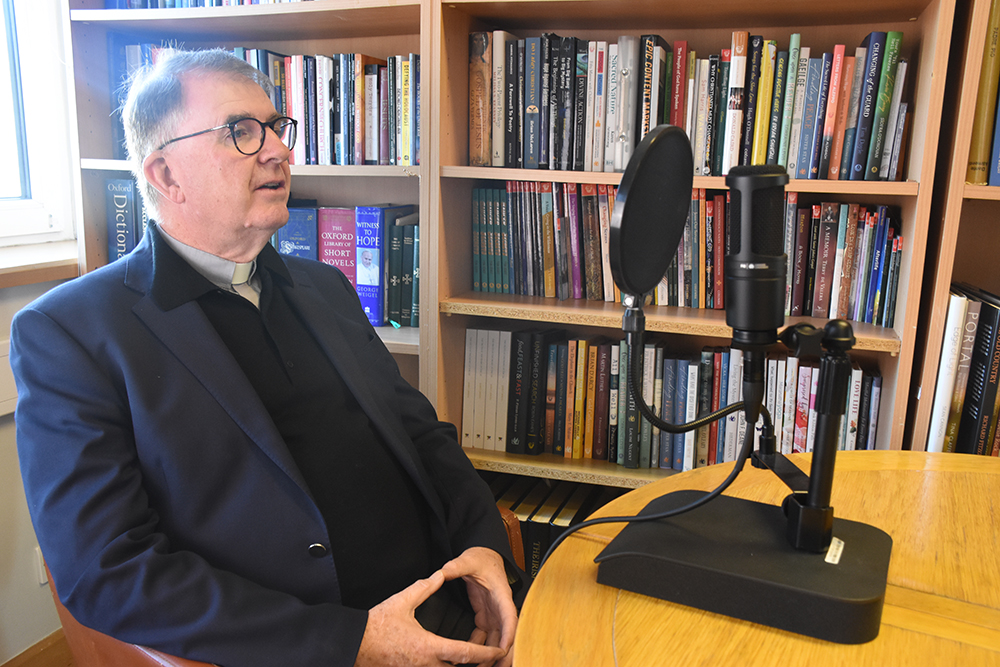
Fr Joe Mullen
I once heard an amusing description of the three stages of priestly ministry. Seemingly it begins at ordination with a big head, continues in middle years with a big belly and concludes when the Lord calls one home with a big funeral! As so often with the dig of gentle humour, there is a hint of truth, which triggers our laughter. I am close to my 40th ordination anniversary, a clerical life which began by entering Clonliffe College in 1979, days after Pope John Paul II’s visit to Ireland, then six years later with diaconate in the College Chapel in Maynooth and finally a year later, in 1986, with a beautiful ordination celebration in my home parish, of St Joseph’s, Ballymartin, Co Down. The memories of both those days celebrated alongside my parents, family and friends remain with me and sustains me ever since.
Beginning
The Diaconate was organised by highly competent liturgists, accompanied by excellent musicians and was an expression of all the talents and gifts which abounded in the Maynooth of that time. The student body numbered in the hundreds and we were so many for ordination that each one had a limited number of invited guests, just enough for the family and a couple of close friends. We had recently completed our Divinity degree and that ‘big head’ came from years of study, essay writing and exams. But the formation also had a spiritual dimension and pastoral placements to ensure that we had a rounded preparation for a celibate life of service. There was an overarching sense of being part of a big, busy and engaging church, with a need for priests and which offered work alongside many colleagues and friends, lay and clerical.
From his perspective influence could be exerted with a cheque book”
The ordination to priesthood was permitted in my home parish, in a diocese far from where I was to serve as a priest, requiring a certain amount of negotiations with bishops and diocesan offices. This was an early introduction to the reality that as a priest you are not self-determining, choices and preferences are filtered through the hierarchal structures and the bishop decides what’s permissible and allowed. During these negotiations my uncle from Chicago was visiting, the permission to have the ordination in my home parish was still pending. When he heard this he asked, “Doesn’t the church need a new roof, get your dad to make a donation to the building fund!” From his perspective influence could be exerted with a cheque book, gladly this didn’t prove to be necessary in this case.
Transition
The ordination was a first in our little local church and the whole community embraced the occasion and excelled in hospitality, welcome, music and liturgy, not in the same formal tone as Maynooth a year earlier, but as an expression of joy and wellbeing of the parish. The Auxiliary Bishop of Dublin, Des Williams travelled North and conducted a warm and prayerful celebration. In the homily he spoke of my becoming a priest of the Dublin Diocese and he assured all present that I was joining one of “the best clubs in the world.” Looking at the sanctuary that day, packed with priests, young and old, each coming forward first to lay hands on my head as part of the ritual and then for a firm hug, and back slap at the sign of peace, you could see what he meant. As a newly minted priest, who had been called from his place with the family in the pew, who now stood at the altar to concelebrate the Mass, the transition was clear, life would be lived in the sanctuary looking out at the people, no longer sitting with them. The ritual that day emphasised priestly ministry as service to God’s holy people, a life of sacraments, prayer and obedience to the bishop, here called ‘your ordinary’ and his successors. The whole preparation for priesthood took seven years of seminary life, and was shaped by the local community, school and friends, priests who made an impact and my grandmothers with their quiet devotion and total commitment.
The early years of priesthood flew by, it was great to minister in a school, help out in a parish, head off to the States each summer and learn to fit into the hopes and expectations of parishioners and others. I say that because so much of a priest’s life is centred on pleasing people, doing what they need, when they need it, in a personable and pleasant way. The ‘can do’ response to almost every request wasn’t so difficult in those early years when there were a lot of us around, and I recall often handing on some of the more challenging requests to my senior colleague, a man who had ministered in the Philippines for decades, and to put it nicely he wasn’t as concerned with the rules and regulations as I was back then. It didn’t happen often, but just every now and again people would ask for something that we don’t quite do, and if a request is refused, and the parishioner is upset, then life is not just so comfortable. In those first 10 years alongside all the parish work, post graduate study, seminary teaching there was still plenty of time for bike rides, golf, holidays, walks with friends, meals in an out and I don’t think I ever experienced pressure, undue tiredness of any sense of being overwhelmed. The belly was still firm! Life was good.
This was my first conscious exposure to the reality of the abuse of children”
Around the time I was celebrating that 10th anniversary I went back to a parish in States where I had been previously for a six week summer stint. On that first visit I enjoyed the company of a retired Monsignor, who had been the pastor and had stayed on in retirement at the parish rectory. However on my return I discovered that he had been moved to a diocesan facility far from the parish. His name wasn’t mentioned often and the reason for the unexpected move never discussed. I learned later that there were historic accusations against him, involving the sexual exploitation of children. Some years later he was dismissed from the clerical state and died a layman. This was my first conscious exposure to the reality of the abuse of children, the church’s modality for dealing with offenders and how a much loved priest, with a great parish community, could do harm, fall from grace and leave with everyone disappointed, defensive and struggling to learn to be victim centred in their response.
Pressure
From that day, until the present moment, the story of abuse has been told over and over again, here in Ireland, and across the world. So much suffering has been revealed, so many priests have fallen far short of ordinary human decency and those entrusted with authority over them failed victims again and again and again. It is hard to express just how much we have all been affected by this grim reality which has diminished the church, disheartened priests and caused many people to walk away in anger, sadness or despair. During the disclosures about my own diocese of Dublin, in the Murphy Report, I was interviewed on the Vincent Browne show. Live television is always demanding and after listing a litany of the failings of priests, bishops and church people, Vincent glared at me and snapped, “So Father Joe Mullan are you proud or ashamed of the Church you serve?” He barked the question over and over, wanting only a one word answer, proud or ashamed. I answered, that I was proud of all the good the Church does, and deeply ashamed of the harm, but he wasn’t having it, nuance and finesse were weasel words, I was to accept or reject the whole package. It’s not hard to understand why so many people have simply walked away from the church, parish and sacraments, for some people the progress is too slow, the hurt unbearable and they have quietly shut the door.
As long as complacency doesn’t take hold, this will be for the lasting good of all”
The Murphy Report was a blessing in disguise, having the facts laid out in public about the various men whose ministry was tainted with degrees of abusive behaviour, and seeing how it was dealt with, created a culture where we could embrace Child Protection Polices and involve many professional and lay people in our common task to make the church a safe place for children. Priests and all with access to children now are Garda vetted, safeguarding committees abound and quality training for all church members is promoted. Victims have been heard, their stories believed and the suffering of both the victims and their families acknowledged and compensated for. The landscape of church has changed, for the better, and as long as complacency doesn’t take hold, this will be for the lasting good of all.
Support
But it’s been a lot of pressure for me personally and I believe for priests in general. There have only been very limited ways to process anger and disappointment, both with the offending priests and the Church authorities. We are a fraternity of men in ministry and as a diocesan family, expected to know, care and support each other, but the confusion, hurt and loss makes it difficult to untangle the feelings and emotions, and sometimes they just get suppressed or denied. Maybe that big belly has come in this era as much from stress, anxiety and overwork as from the over indulgence of food and drink for pleasure. Celibacy has become an ever more demanding aspect of my priestly life as time unfolds. A cancer diagnosis, surgery and recovery left a lot of time to dwell on the lack of intimacy in the day to day clerical life. Going to a myriad of appointments in the Urology department gave me time to observe my fellow patients, all men with some form of Prostate cancer and most accompanied by a very caring and attentive woman. The men often looked dazed, stressed, uncomfortable, even sad as they came and went from rooms where bad news is shared, uncomfortable procedures happen and sometimes instructions are made. It seemed to be the woman who took it all in, offered the quiet supportive word, squeeze, hug, and hope. I didn’t have a mirror, but I guess I was just as challenged as the others, but there was no partner to hold my fear, anger and distress. Priest friends were fantastic for offering encouragement, coming to visit, bringing tasty meals to heat at home and supporting recovery and rehabilitation, but in general they didn’t talk much about the cancer itself and what the surgery had taken away and the post operative trauma. How could they when we rarely talk about these things when everything is still working normally!
As with dioceses all over the world we are busy with trying to match resources, manpower and mission”
Passing through first a 25th, than a 30th and hurtling towards a 40th anniversary of priesthood is to realise of course that there is just limited time left. In a perfect world these last 10 years of ministry would be a bit more relaxed, sharing duties and responsibilities with younger men, full of energy, who would carry a lot of the workload. Recognising that here in Dublin we closed our seminary 25 years ago, on account of a dwindling number of students for ministry, it’s no surprise that ours is an aging cohort of priests, declining in number and energy. As with dioceses all over the world we are busy with trying to match resources, manpower and mission, to sustain and meet the demands of every day and to face the uncertain future. Our programme is called ‘Building Hope’ and offers resources for the discussions that have to happen locally involving people, priests and the diocesan authorities. In this Jubilee Year 2025 all of the faithful are invited to be Pilgrims of Hope, which is both inspiring and uplifting. Yet I can’t help feeling torn between the myriad of responsibilities managing the three parishes in my pastoral care, the celebration of sacraments, for both the daily and regular mass goers and those who come with good intent, for the occasional and special family moments, sometimes captured under the banner of ‘hatch, match and dispatch.’ It is exhausting celebrating funeral after funeral, tailoring the liturgy of the church to the hopes and expectations of families where there is little or no contact or participation in the faith community. Each year an increasing number of requests come to baptise seven year olds as they are now going into the ‘Communion Class’, and naturally want to have their special day. Ministry in and around schools is as always a real privilege and pleasure, but their almost total absence from the Sunday assembly questions what it means to be a catholic family in today’s world.
Support
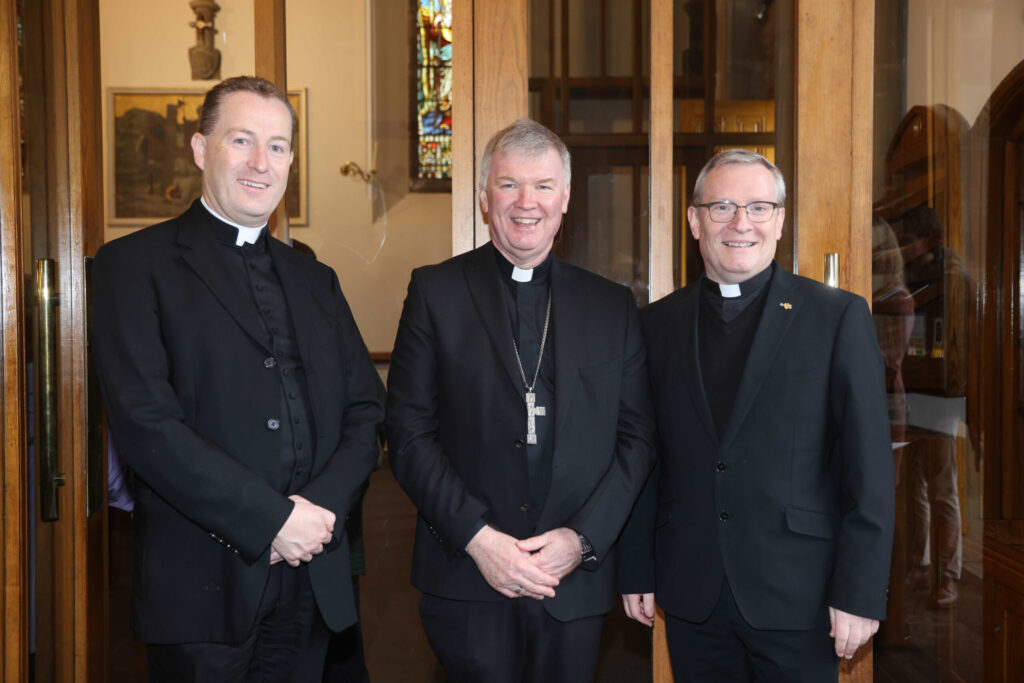
As a priest among priests I have always enjoyed the company of my brothers in ministry. If you look back at the photo from Ballymartin all those years ago and ask about the men who were present that day there is still much to say. They are all remembered by name, some were teachers and mentors and long since gone to God. Some are classmates and contemporaries, most are still alive, some happily married, others struggling with health issues, none are currently in jail, some are bishops and the remainder, like myself, carry on in ministry whereever we are sent, and just do the best we can. In that picture all the men are white, not a single brother priest from Africa, India or born overseas was present that day. In the unfortunate circumstances that my ‘big funeral’ were to occur in the near future that would be one of the biggest changes in the sanctuary. I’d imagine there would be priests from overseas among the concelebrants, certainly given that most of the young priests in Dublin now are born overseas, at least seven have worked with me in this appointment during the last six years, and they have been the greatest blessing imaginable. There are challenges managing the inculturation of these men into our ministry here, and it takes an effort for the people to play their part in making their ministry fruitful, but there is no doubt that we would be totally lost without them and we are blessed in so many ways by sharing in their exuberance, faith and fidelity to the Gospel. I listened to one of them introduce the liturgy at the main Sunday Mass on the Feast of the Presentation recently. In front of him a basket of candles to be blessed, a congregation more at a distance than up close. “At home” he said “our people gather with candles and dance in a procession to the church for this celebration.” My heart really went out to him, as he struggles to understand the Irish Catholic way of quietly marking religious moments with silent prayer, little animation and very few processions, how does he keep going with such energy and enthusiasm?
Now that we are few we have to take the hands and hearts of men and women of faith and carry on together”
When I was in London for a year after school, contemplating entering the seminary a friend gave me Graham Greene’s The Power and the Glory it’s a novel set in Mexico in the 1930’s when priests were being persecuted. The central character is a struggling priest, he had an illegitimate child, drinks heavily and is being pursued relentlessly. At a certain point in the novel he goes to the assistance of a parishioner in act of selfless love, knowing that he will likely be caught and killed. The novel explores themes of faith, redemption, and human imperfection, portraying the priest as both deeply flawed and, paradoxically, a vessel of grace. Reading Greene, and knowing my own human limitations and some of those of the priests around me I continue to believe in the ‘Power and Glory’ of God, his Son Jesus Christ and the Spirit that dwells in the hearts of the baptised. It’s clear to me that God calls shepherds to ministry, that the Lord walks with us and that only from the grace of the Holy Spirit are we able to serve, despite our limitations. When we were many priests I believed in the complimentary of gifts, that together we could meet most challenges in the world. Now that we are few we have to take the hands and hearts of men and women of faith and carry on together. For relentless ministry to subside a balance has to be worked out, one that asks the people of God to live out their baptismal calling with full, active and conscious participation in their church. We priests can then discern an activity level commensurate with age and energy, as we all travel on as pilgrims of hope bringing the joy of the Gospel to a world that hungers for truth.