Tetiana Metyk
Ukrainian refugees carry deep spiritual wounds that, with God’s help, need healing.
In the small chapel at Summerhill College in Sligo, around twenty parishioners are gathered for the Sunday Liturgy. Most are young or middle-aged, attending with their families. Little girls in bright dresses, fidgety boys occasionally dashing into the college corridor to play. Some wear traditional Ukrainian embroidered shirts. The vestments of the priest and the altar cloths are similarly embroidered. The liturgy is interwoven with gentle, melodic singing. A choir and several women standing beside the priest softly offer responses.
One of them is Alla Taranukha, a refugee from northern Ukraine, Chernihiv region—one of the fiercest battlegrounds at the onset of Russia’s full-scale invasion. She and her family endured true hell.
“It was terrifying from the very start,” she recalls. “Russian tanks were passing through our city for the first three days.”
Chernihiv
“We were cut off for a month and a half because all the bridges were destroyed. We ran out of food. Local farmers literally saved us by distributing milk.” On her 55th birthday, she baked a cake in a bomb shelter with second-grade flour previously intended for cattle. She was happy even with that—it was a dire situation. Not only was food scarce, but the blockade exhausted all medical supplies in pharmacies. Yet people united, helping one another as best they could.
Chernihiv, located on the road to Kyiv, was constantly shelled—and still is. “The explosions were so loud. Missiles flew above us, aimed at Chernihiv and Kyiv. I hid and slept in shelters with others. Nights were the most terrifying,” she says. Although Chernihiv was encircled by Russian forces, her children escaped by crossing a mined field and the Desna River, with help from volunteers.
After the full-scale invasion, he fled Ukraine with his wife and three children”
She remembers these events with tears, still deeply worried for family left behind in Ukraine. After the occupation ended and Russian forces withdrew from her region, Alla chose to relocate to a safe country, fearing for her life amidst ongoing shelling and terror from Russia.
“I cannot thank the Irish people enough,” she says. “ for their shelter and heartfelt kindness,” “When I arrived and learned there was a Ukrainian Greek Catholic Church in Sligo, I rejoiced—my soul needed it so much!”
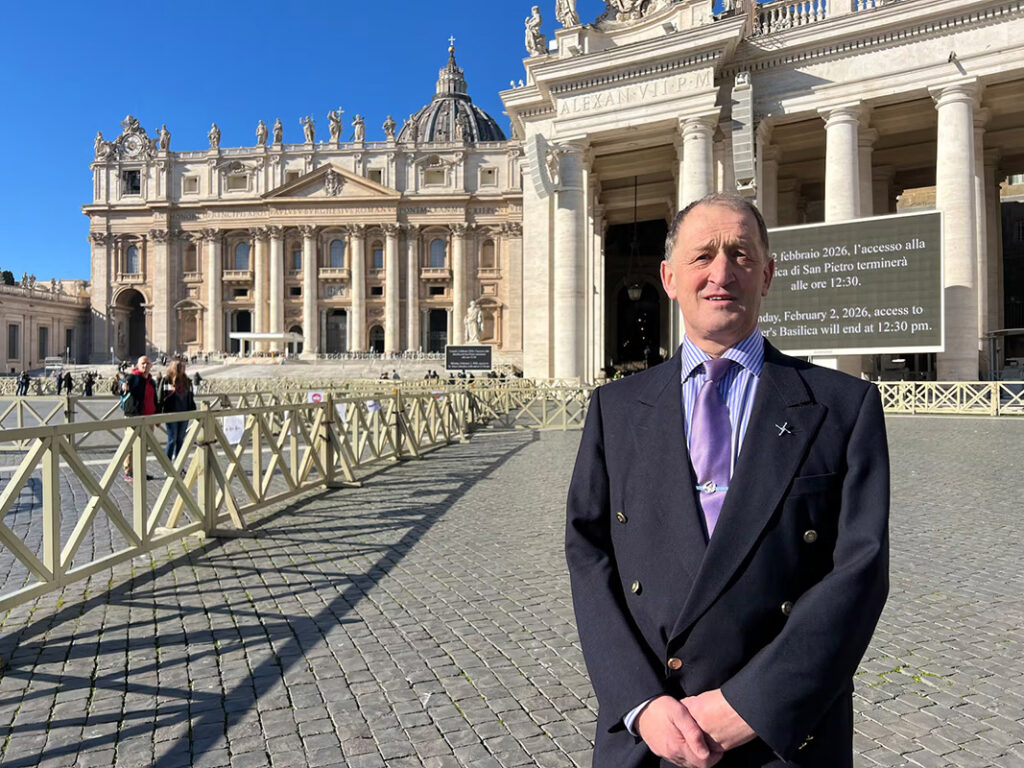
When Petro Chelyadyn first attended a Greek-Catholic church in Ireland and heard worship in his native language, he was deeply moved. He had longed for that. After the full-scale invasion, he fled Ukraine with his wife and three children, deeply concerned for their safety.
They were invited to Ireland by a relative of Ukrainian descent. His grandmother’s brother, Leon Dzera, moved to Great Britain after World War II. His son then relocated to Australia, and his grandson, James Dzera, married an Irish woman, Orla, and settled in Dublin.
“It was James and his wife who provided shelter for us,” he says. “We lived with them until I found a job. We no longer live together now, but we have a good relationship and see each other from time to time. We are very grateful to them and to all the Irish people.” The trauma has left its mark.
Fear
They are struck by fear even at the sound of a civilian airplane.
There are twenty-three Eastern Catholic Churches in the world. Of these, the Ukrainian Greek-Catholic Church(UGCC) is the largest Greek-rite Church in full communion with the Holy See. The UGCC endured severe persecution during Ukraine’s time under Soviet occupation. After World War II, churches were shuttered, and people were forbidden from worshipping, celebrating religious holidays, or baptising children. Soviet Russia executed or exiled Greek-Catholic priests, forcing them to renounce their beliefs and serve the regime. Many died as martyrs or survived torture and forced labour. One of the most renowned was Major Archbishop Cardinal Josyf Slipyj, arrested by Soviet authorities, who spent 18 years in Siberian and Mordovian camps including Dubravlag in Potma, Krasnoyarsk region. Even today, Russian occupying forces actively persecute the UGCC in controlled areas.
He began serving migrant workers in Dublin, conducting liturgies in both Greek and Irish”
The Ukrainian Greek-Catholic Church in Ukraine was forced underground during the Soviet era, specifically after the Lviv Council in 1946 and legalised in 1989. The establishment of the Ukrainian Greek-Catholic community in Ireland is credited to Archimandrite Serge Keleher, an American of Irish descent fluent in Ukrainian.
He began serving migrant workers in Dublin, conducting liturgies in both Greek and Irish. He translated the Divine Liturgy of Saint John Chrysostom (the Byzantine rite liturgy used most days of the liturgical year in Eastern Catholic and Orthodox churches) into Irish. “Even today, people writing doctoral dissertations in theology seek copies of our Irish language liturgy,” says Fr Vasyl Kornitsky, a priest licensed in both the Roman and Ukrainian Greek-Catholic rites who serves as assistant priest at Our Lady of Consolation in Dublin.
Compassion
Since Russia’s full-scale invasion in 2022, the Ukrainian parish in Dublin has tripled (or possibly quadrupled) in size. Additional priests have arrived and now serve in various counties. Today, there are six centers in Ireland: Dublin, Cork, Limerick, Waterford, Galway, Belfast, and Sligo. Greek-Catholic priests also travel to other Irish towns with Ukrainian residents. “The Irish truly understand our pain and what Ukraine is enduring. Hence, the Roman Catholic Church—laity, priests and bishops—are genuinely open to us. When we seek to celebrate our liturgy elsewhere in Ireland, they welcome us into their churches.” explains Fr Kornitsky.
According to him, Ukrainian communities are quite active, especially in cities. In more remote rural regions, attendance can be small, and this is attributable to several reasons.
Bishop Kevin Doran explains:
“Many of the first refugees, especially those coming from Eastern Ukraine, are Orthodox Christians. Although they would be very welcome, they possibly would not wish to join the Roman Catholic celebration. Many Ukrainian people seem happy to come to mass when it is celebrated in the Latin Rite. Some people, of course, struggle emotionally with being displaced from their homes and their familiar surroundings and, possibly, feel that God has abandoned them. I think God would understand their disappointment and frustration. Some of the refugees would possibly not have been practicing their faith even at home in Ukraine.”
It was heartbreaking. You can only imagine what they’ve endured”
Among other challenges faced by the UGCC in Ireland are the lack of dedicated church facilities and a shortage of Ukrainian priests—since male departures from Ukraine remain restricted due to the war.
Fr Kornitsky, who has ministered in Dublin since 2012, says “At the start of the full-scale war in Ukraine, I noticed how much my parish had changed. Many arrived with great fear in their eyes. Undoubtedly, those fleeing the war bear deep spiritual wounds that require, God’s help, healing.” Ukrainian refugees need mutual support, communication, and encouragement. Therefore, alongside liturgies, churches often organize communal tea gatherings, pilgrimages to holy sites, excursions, and catechesis for children preparing for First Holy Communion.
During one such excursion, Fr Vasyl was profoundly moved by an incident: “When Ukrainian children were at Dublin Zoo and a passenger plane flew overhead toward the airport, they started screaming and hiding. They were seized by unspeakable terror—it was heartbreaking. You can only imagine what they’ve endured.
“Many Ukrainian families in Ireland are separated, living in confusion and uncertainty about the future. But I tell my parishioners not to lose hope. Through our steadfastness, we show how strong we are in our faith and conviction that if God is with us, who can be against us?”
“Ukrainian liturgy is much more expressive”
It’s common for Irish people—especially those supporting Ukrainian families—to attend Greek-Catholic Liturgies in various cities. They often bring their Ukrainian friends and stay for the service.
“The first thing we did when we saw Irish people at Ukrainian services was to prepare an English-Ukrainian prayer book so they could better unite with us. Also, every Sunday in Dublin we celebrate part of the Liturgy in English,” emphasises Fr Vasyl.
Liturgy
At the Sunday Liturgy in the Summerhill College chapel in Sligo, you can often find Irish priest John Carroll with the Ukrainian parishioners. Despite not understanding Ukrainian, he prays with everyone and feels drawn to return. He gets along well with Ukrainian priest Taras Fedorenko, helps address practical issues, and willingly communicates in English.
“I don’t understand spoken Ukrainian, but I think I have some understanding of Ukrainian symbolic, ritual, and liturgical language — which is very, very visual and deeply meaningful. It’s evocative, evoking a sense of mystery even more important, perhaps, than the linguistic aspect itself. It’s a language of the spirit, of the heart, of imagination. It speaks through aesthetics,” says Fr John Carroll.
Fr Carroll loves to observe the involvement of young people and children”
“There are so many different ways in which faith in the Mystery of God is expressed. Ukrainian liturgy is much more expressive. Ours—by comparison—is very simplified, very Latin, in its color, sound, and ritual. In your tradition, I find a richness that touches all the senses.”
Fr Carroll loves to observe the involvement of young people and children in the Divine Liturgy.
“In the Ukrainian church, children can receive Holy Communion once they are baptised. In the Roman Catholic Church, liturgy is often celebrated in a formal, stylised manner—closely following the text. But the priest—pastor—is entrusted with the responsibility to adapt it to the understanding and needs of the people. Some priests hesitate, preferring rigidity.”
Fr Fedorenko explains:
“Although we belong to the Byzantine rite, we are fully Catholic, in complete communion with the Holy Fr and part of the worldwide Catholic Church. Many Irish, seeing us celebrating the Byzantine liturgy, assume we are Orthodox—but we are not. For example, in our tradition a married man can be ordained and remain a Catholic priest.