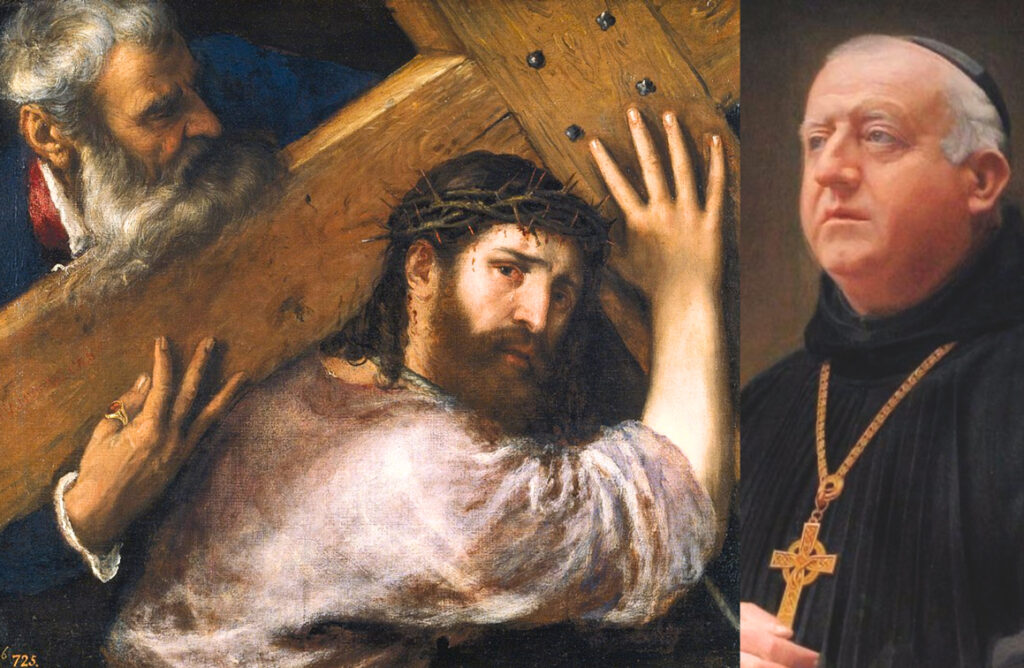
Although suffering is unavoidable, we can see in it an ultimate meaning and value, says Jason Conroy
Well, how has your Lent gone? Forgive me if I’m not surprised if your record isn’t exactly pristine. I’ve always noticed that by the time Good Friday comes around I’ve often been practically brought to my knees trying (and failing) to keep my resolutions – but perhaps this was the point all along, to realise how much we need saving.
We have only a few days left. We’re going to join our Lord tonight with a Dublin man for our guide, Blessed Columba Marmion.
Gethsemane
We find Our Lord sweating blood and praying in great fear over our sins in Gethsemane. “He foresees that for many men His blood will be shed in vain,” Marmion says, “and this sight raises the bitter suffering of His sacred soul to its highest pitch.”
“Yet, Father, let your will be done, not mine.” And so the Passion begins. Marmion gives us three ways we can participate in Christ’s Passion – except, why would we want to do that in the first place? Since we’ve just heard how terrible it was! – Because, inasmuch as we share his sufferings we also share his glories. ‘If we have died with Him, then we shall live with Him; if we suffer with Him, then we shall reign with Him.’ The principle holds true that in whatever extent we have solidarity with Jesus in His human lot, so He shares with us His divine lot, and the prizes of His victory.
We should do these three practices especially during Holy Week- but also all year round too, because Lent and Holy Week are supposed to push us to actually do all the things we mean to do but put off. Rather than just going ‘back to normal’ afterwards, we’re trying to make lasting progress, Lent after Lent, Passion after Passion, Easter after Easter, over the course of our whole life.
Passion
The first way is by thinking often about Christ during His Passion. In the years after the events of Holy Week, the mother of Jesus and the first Christians must have often retraced from memory that path Jesus walked to Calvary, and this is the origin of our Stations of the Cross today. Why is this important? Marmion explains:
When Christ lived on Earth, there emanated from His divine person an all-powerful strength which cured bodies, enlightened minds and gave life to souls… Something analogous happens when we put ourselves into contact with Jesus by faith. And when, in a spirit of faith, we follow Him from the Praetorium to Calvary and take our place at the foot of the cross, He gives us those same graces.’
Columba Marmion recommends taking time now and then throughout the day to pause, silence the soul, and accompany Jesus by making an interior stations of the Cross.
The best part is that you can do this anywhere – during your commute, for a few minutes during your working day, while you’re walking to lunch or stuck in traffic, or – dare I say it! – before you switch on to your preferred form of electronic screen for the evening. I call them Guerilla Stations because, just as guerilla fighters can fight anywhere and appear behind enemy lines, so in this way we can pray the stations anywhere, thereby making Christ’s passion present in the most unexpected times and places.
‘It is enough, in order to gather the precious fruits of this practice, that you pause at each Station of the Cross and there meditate on the Passion of the Saviour. No formula of prayer is prescribed, no form of meditation is imposed. Full liberty is left to the taste of each person and the inspiration of the Holy Spirit.’
Mass
The second way is by going to Mass! ‘To be present at this Holy Sacrifice or to offer it with Christ constitutes an intimate and very efficacious participation in the Passion of Christ….’
Many say, “Oh, if only I had been at Golgotha with the Virgin and St John and Mary Magdalene!” But faith puts us in the actual presence of Jesus immolating Himself on the altar.’
I call this practice “going to Mass at Golgotha”, because it sums up that we are already with Christ on the Cross at Mass – we just need to be conscious of it.
Finally, we can also associate ourselves with this mystery by bearing, for love of Christ, the sufferings and adversities that, in the designs of His providence, He gives us to undergo.’ The third practice is to see, by faith, that our little crosses in life are in fact His cross.
He unites our sufferings to His sorrow, and by that union He confers on them an inestimable value”
To us also God gives a cross to carry, and everyone thinks his own cross to be the heaviest. We ought to accept our cross without argument, without saying “God could have changed this or that circumstance of my life.”
Our Lord says to us: “Accept that part of my sufferings which, in my divine prescience, on the day of my Passion, I reserved for you.’
Doesn’t this turn our attitude to hardships upside down? Right there on the Cross, Christ pictured and reserved this cross for me – ‘This is the one I picked for you, not another.’
Marmion goes on: ‘He unites our sufferings to His sorrow, and by that union He confers on them an inestimable value.’ One of the things that sets us apart as Christians, is this fact, that though suffering is still unavoidable, we can see in it nonetheless an ultimate meaning and value. ‘We shall find there,’ in the Cross, not only strength, but also ‘that peace and that inner joy which knows how to smile in the midst of suffering: “I overflow with joy in all our troubles”, declares St Paul.
‘Indeed when He mounted to Calvary aided by the Simon of Cyrene, Christ Jesus, God-man, thought of all those who in the course of the centuries would help Him carry His cross by accepting their own.
Good Friday in song
Jesus was an only Son – so runs the opening line and title of Bruce Springsteen’s little-known song about the Passion of Christ, from Mary’s perspective, as she walks beside Him on the way to Calvary, and remembers the happier days in Nazareth when He was a child; but He comforts Her in the final line of the song with these mysterious words; ‘Mother, stay your tears, for remember the soul of the universe willed a world and it appeared’. It’s not a name we would use for God, but it does say something good: However bleak everything seems, just remember that someone unthinkably good set it all in motion from the start – so there must be some good purpose behind it all, despite appearances.
The famous ‘Stabat Mater’, one of the great latin hymns of the Middle Ages, also follows by Mary’s side, but my favourite version of it is the wild Corsican chant found in L’Arpegiatta’s album ‘Via Crucis’, a beautiful album which follows the life of Christ in jazzy-baroque-folk music.
Caoineadh na dTrí Muire or The Lament of the Three Marys, is also very touching – something about the perspective of the mother resonates particularly with Irish people I think. During the Triduum, the ‘Lamentatio Ieremiae Prophetae’ is sung at ‘Tenebre’ in St Saviours Dublin – also a very solemn and plaintiff tune. During Holy Week our Eastern brethren sing the lament of the Bridegroom over His Bride, for whom He will be crucified. Arvo Part’s ‘Passio’, which follows the Passion accordion to John, has an austere grandeur right until the moment of the Lord’s death, at which point the tone and atmosphere are totally changed to one of comfort, with the final triumphant, relieved lines: “You who suffered for us, have mercy on us. Amen!”
Finally, I must mention Sting’s legendary tongue-and-cheek, Newcastle sea shanty about the end times, The Last Ship, which opens with Mary Magdalene’s discovery of the empty tomb– but it’s too soon for that yet!