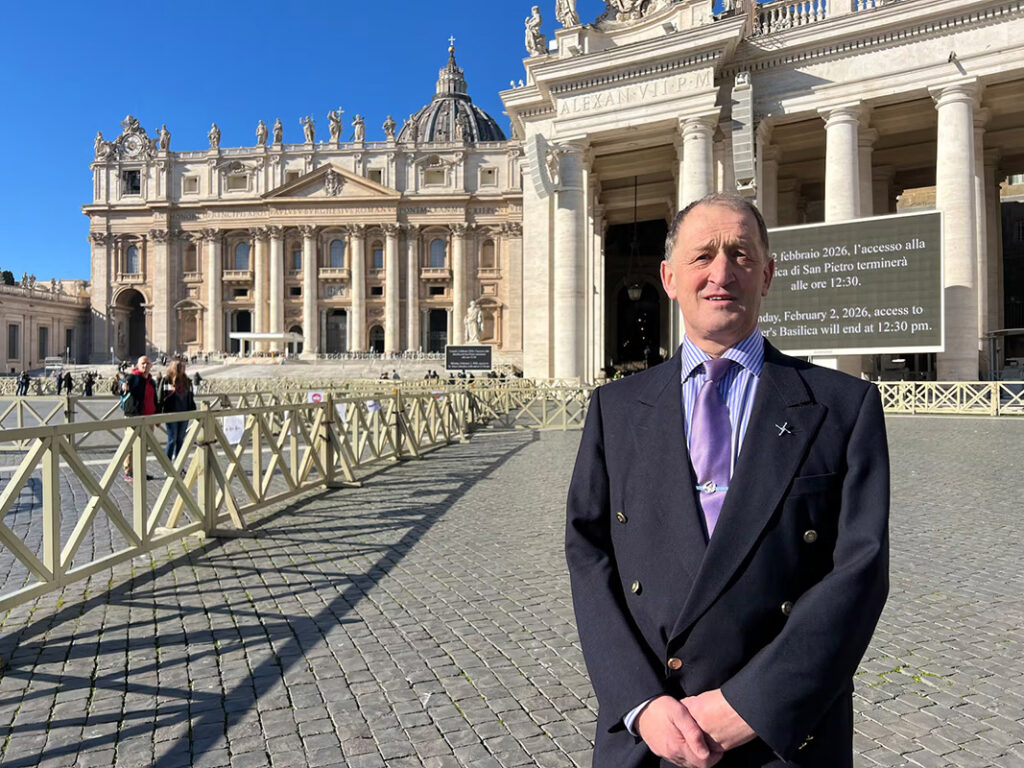
Fr Brian Lennon SJ
A friend of mine – let’s call her `Lorraine’ – worked as a hospital chaplain. In the course of this she came close to a woman with terminal cancer. But whenever her friend wanted the sacrament of the sick Lorraine could not give it to her because she was not ordained. Instead she had to call in a priest unknown to the woman.
Lorraine could not become a priest because she is a woman.
In the words of St John Paul II, “the Church has no authority whatsoever to confer priestly ordination on women and…this judgment is to be definitively held by all the Church’s faithful” (Ordinatio Sacerdotalis 22, 1994).
This statement does not meet the church’s bar for infallibility, and John Paul would have known this. Nonetheless it is the absolute thesis that bans women’s ordination. According to this, God in Christ has mandated that under no circumstances at any time now or in the future in any place in the world shall women be ordained priests in the Roman Catholic church. There are no exceptions, and the Church has no power to change this because God has mandated it.
Absolutes are difficult to defend because someone, somewhere, is likely to come up with an exception.
The ban has serious consequences. It excludes approximately 50 percent of church members from the priesthood.
Images
Different images are used to defend the thesis. One is the Old Testament idea that God is the bridegroom of Israel. In this image God is male, Israel is female. God is the husband of the people with whom he has made his Covenant, a Covenant modeled on marriage. Based on the same image Jesus in the New Testament is seen as the bridegroom of the Church. In this image the masculinity of Jesus is seen as of central importance. The argument is then made that women cannot be ordained because the priest represents Christ and therefore must be male.
There are problems with this argument. The image presents Christ as a bridegroom, but then a jump is made to the proposition that a priest must always represent Christ as bridegroom and therefore must be male. But are there not other ways that a priest can represent Christ? This argument is not addressed.
The absolute thesis about women’s ordination is at a much lower level in the hierarchy of truths, and it relies on a particular approach to gender”
In baptism lay people, men and women, are given the gift and the responsibility of representing Christ and his love for the Church. It is not suggested on this basis that baptism should be given only to males. Instead we are told that the ordained priesthood is different. Others argue that Christ’s masculinity was so central to his identity that anyone representing him has to be male.
Images are useful to explore many of our beliefs, for example, `God is Three’ and `God in Christ is fully human and fully divine’. But the absolute thesis about women’s ordination is at a much lower level in the hierarchy of truths, and it relies on a particular approach to gender. One would need extraordinarily strong arguments to be absolutely certain about it. Images are unlikely to do this.
There are other arguments such as those based on tradition: if Jesus wanted to ordain women he could have done so. But are these arguments so substantial that they give us the certainty needed to support an absolute thesis? We could for example respond that Jesus never formally condemned slavery, and that slavery is more important than the ordination of women.
God made us in his/her own image, as males and females. Why would God want to exclude persons made in his or her own image from any role in the Church which is his/her body?
What is it about women?
Physical
As part of the thesis women are distinguished from men on a physical basis. The criterion used is crude: the presence or absence of a wherewithal. This is the method normally used at birth to assign gender. It may be that as she grows into adulthood a woman with no wherewithal decides that she is a man in a woman’s body. This makes no difference: she is excluded from ordination.
The reverse is also the case: a person with a wherewithal might decide that he is in reality a woman. Nonetheless he could be considered for ordination.
This is not merely a speculative distinction. To be accepted in a seminary a person needs to show that he is a male. Archbishop Jerome Listecki of Milwaukee, then chairman of the bishops’ national canonical affairs committee, warned his fellow bishops in 2024 of multiple reports of women living under transgender identities being “unknowingly admitted” to US seminaries or formation houses (Arlington Catholic Herald, October 25 2024).
In the same report Fr Carter Griffin, Rector of the John Paul II Seminary in Washington DC, said “Among the many elements of an application for priestly formation, every seminarian receives a full physical examination…While historically such an examination would not have included testing for biological sex, increasingly dioceses are requiring just that”.
Conclusion
It would be good if there were a less crude way to discuss the absolute thesis. But there isn’t because the criterion used by the thesis is crude.
If the thesis were not absolute then the need for a complex discernment would arise. For example, a statement such as: `It seems to us that we cannot ordain women at this time because the tradition of the Church forbids it’, would call for deep theological thinking, reflection on scripture, a subtle discernment to find the form of the Church, new awareness of patriarchy and gender issues, a probing of culture in different parts of the world, and deep personal and communal prayer.
One can oppose the ordination of women, therefore, without accepting the crudity of the thesis outlined above. But it is the absolute thesis that is operative”
A different argument is that we should not focus on women’s ordination because doing so simply reinforces clericalism, and this further reduces the role of the laity. While all sorts of changes are needed to address the validity of this criticism, ignoring the issue of women’s ordination leaves in place a crude absolute thesis excluding women from a role simply on the basis of their gender.
One can oppose the ordination of women, therefore, without accepting the crudity of the thesis outlined above. But it is the absolute thesis that is operative. It is based on certainty, not the probing and always partially uncertain exploration that should take place in a good discernment.
Glimmers of hope?
There may be glimmers that the absolute thesis is under pressure. The Pettrocchi Commission, appointed by Pope Francis, while it agreed in February 2025 that the female diaconate “was not understood as the simple female equivalent of the male diaconate”, divided 50/50 on the idea that the masculinity of Jesus is an integral part of sacramental identity, and it called for further theological discussion of the issue.
In September 2025 Pope Leo XlV suggested – in relation to ordaining women as deacons – that the issue will not be closed down.
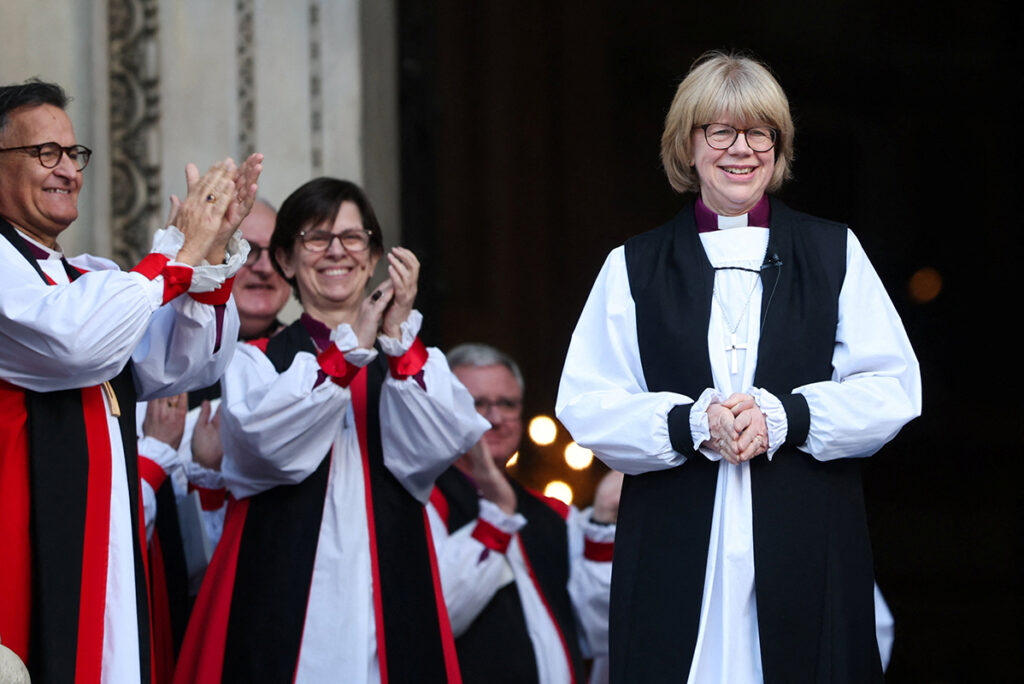
Ordaining women will not solve the problems of the church, the most important of which is arguably to help more people in today’s world see that the story of the incarnation is really incredibly good news for them. Women, if ordained, will in all likelihood make a mess of things, just as we men have done. But it will be their mess. Ordaining women will cause further divisions – the issue is deeply emotional for many. When women are ordained they will face opposition, as shown by the experience of many in our sister churches, and referred to recently by Sarah Mullally, newly appointed Archbishop of Canterbury.
Change
However, ordaining women will change some things for the better. It will remove the need to explain to 50 percent of church members why they are excluded from ordination on the sole basis of their gender. And it will change the current situation of women like Lorraine – all made in the image of God – being barred from giving their gifts to the community of the Church, the sacrament of the sick and in other ways.
Can we really be certain that God does not want them to do this?
Brian Lennon is a Jesuit living in Armagh, Northern Ireland. He coordinates projects on dialogue, bio-diversity, and support for ex-prisoners. His most recent book is: Magdalen and the Gardener: Women Leaders in the Church.