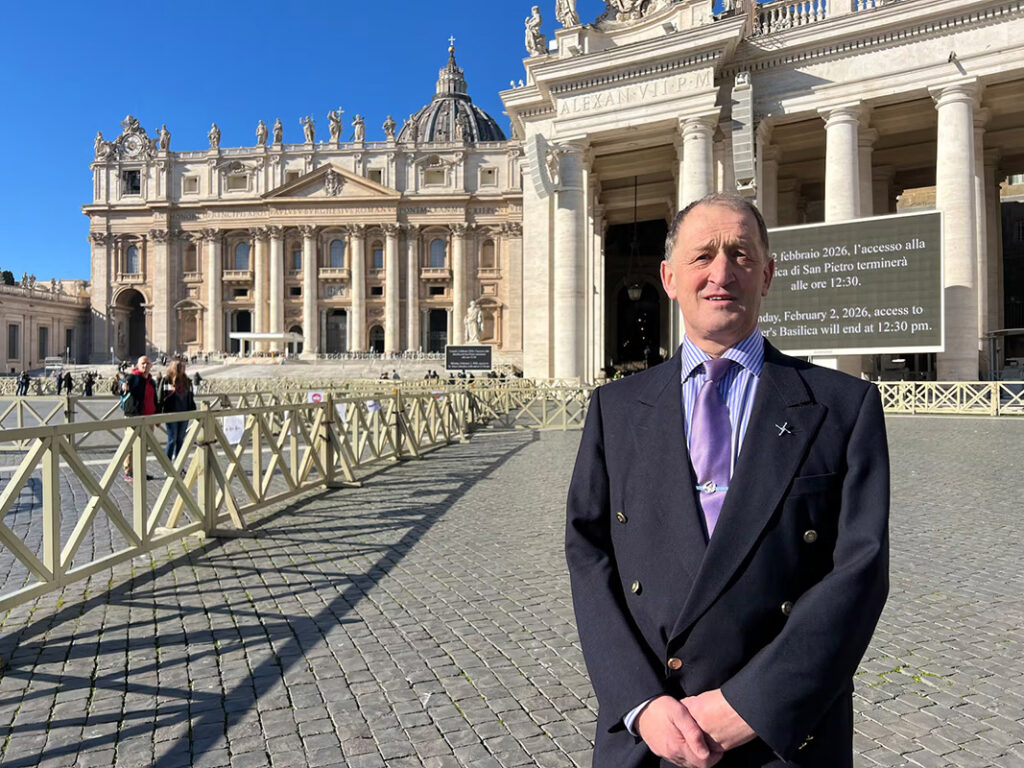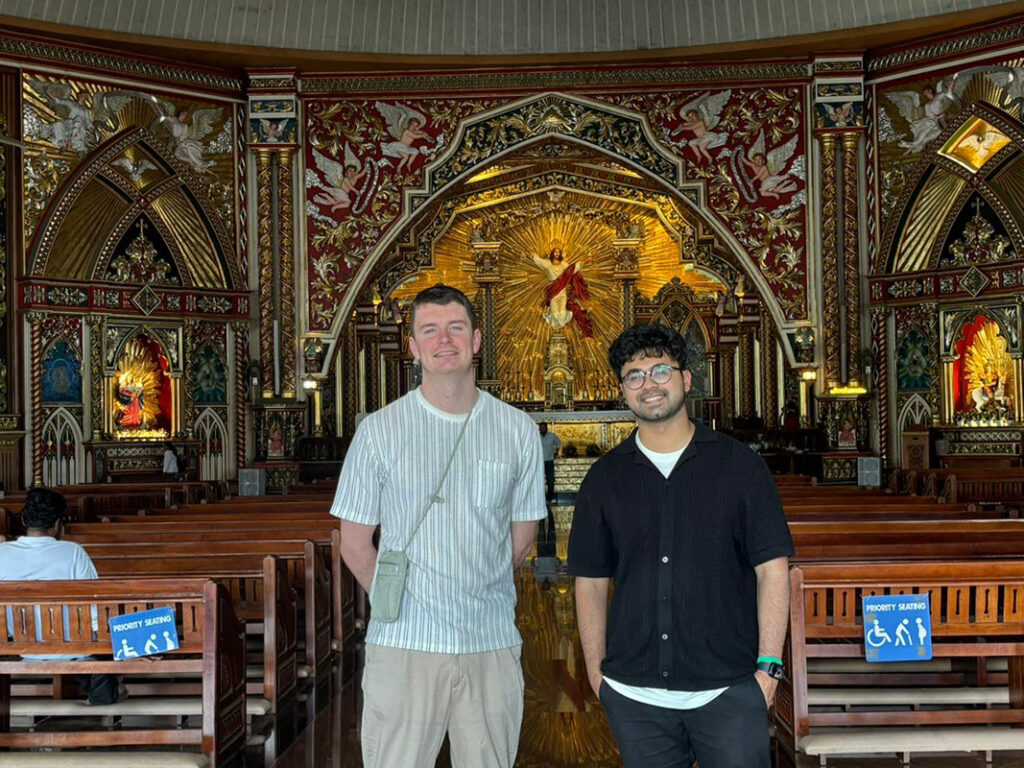
Three weeks ago, I flew across the European continent, across the Middle East, to my hometown of Kerala, a state that needs no introduction with fellow Catholics. It had been two years since I visited my state in India, and this time, I wasn’t alone. My close friend from the Rathmines Parish Young Adults group, Michael Varley, who often reads this paper, joined me on this quest to understand more about the ancient Christian history, which dates back to 52 AD with the first church built by Apostle Thomas.
I visited quite a few, and since working and writing for The Irish Catholic, my interest has only intensified, with an open eye to ask more and know more. There were many major churches that stood out to me during this trip.
To begin with, St George’s Church, which is now a thriving parish with the first church being built in 594 AD, and the new massive church, which holds around 5000 people, stands out to show its proud heritage and growing parish after all these many centuries. There is a church that was built in the middle of these two in 1080 AD. The new church has a risen Christ instead of the usual Crucifix, to show the new beginning for anyone who enters the building.
Kinattukara.
hold around 5000 people
Miracles
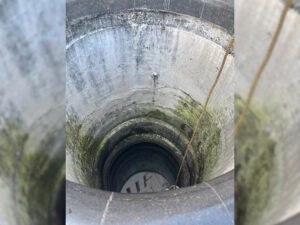
Many miracles have taken place here; one such is the well that has had many miracles in the past. The water in the well is always two meters, regardless of the season, and knowing Indian summers, there is no other explanation for why it is so. Many people bring back the water in bottles to use for their protection from snakes, as the faithful believe that St George protects people from snake bites. St George is a very famous saint among farmers, and since many of the locals were farmers, the popularity of this church rose from the start. The oldest church is now an adoration chapel, which is also quite packed.
George’s Church
Next was St Mary’s Forane Church in Kanjoor. Built in 1001 AD, it is originally called St Mary’s Forane Church. It is also famous for its miracles, which have been done by St Sebastian and is often referred to as St Sebastian Church. The church has a mixed architecture of Indian, Persian and Portuguese, while the original church had more of a temple structure that was quite common for all religious buildings. The Portuguese gave the church a more modern look. The church has many ancient manuscripts and artefacts that have been displayed across the building. The one that caught my eye, on the side of the church, was scripts written in granite.
The St Sebastian statue in the church has contributed to many miracles. The most notable one, the warrior Tipu Sultan, was on the verge of destroying all the built monuments, such as churches around the state, and was standing outside the gates of this great church, ready to attack; when he entered the church, he saw the statue and asked “If this clay statue has divine powers, let it speak to me”. He suddenly heard a voice that came from the statue of St Sebastian, who calmly asked, “Won’t you allow me to rest?”
Every time, including this year, there have been two eagles circling the procession, which marks the power of this historic church”

Sebastian’s Church), the very gates that Tipu Sultan tried
to enter
Another notable miracle from the famous church was when the local ruler Sakthan Thampuran visited the area during the annual St Sebastian festival. Annoyed with the celebrations, he demanded that the saluting mortars be thrown into the river. While doing so, the mortars shot back, and the surprised ruler realised his big mistake. He quickly went back to the statue, asking for forgiveness and donated an elephant lamp, which is made out of 5 alloys of metals.


Every January 19 and 20, there is a St Sebastian’s festival with a procession that has thousands joining in. And every time, including this year, there have been two eagles circling the procession, which marks the power of this historic church and its lifelong parishioners.
Thomas churches
Then there were the two St Thomas churches, in which the first is where St Thomas established the church, and the second is a shrine with his relic, a part of his arm. Both these churches were beautiful, one with a river view and the other with an old Kerala church architecture.
The first church built by St Thomas was believed to have been a temple, and that is where he performed the first miracle next to the temple pond. The pond has statues of the first people witnessing the miracle and asking to be baptised, and there is a statue of St Thomas blessing all of them. The church has a very strong spiritual presence, and many come to this church to get baptised and ask for blessings. There is also a bigger church which is built next to the old one, again, because there was no space to accommodate everyone during Mass.

Seeing the relic of St Thomas at the shrine on the last day of my trip gave me a sort of enlightenment and courage to know I am seeing the same hand that would touch Jesus’ wounds when he had doubts about his glorious resurrection. There was something humbling writing about this church, knowing that one of the 12 stood on those very grounds to proclaim the good news, and sacrificed his life for the betterment of our world.
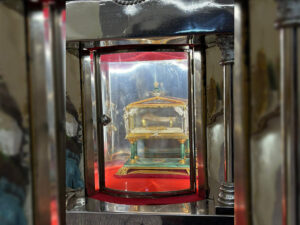
very hand that touched Jesus’ wounds.
The Egyptians, the Romans, and the Greeks were all trading here, with the largest amount of Roman coins found outside the Roman Empire”
It is believed that Jesus had come to St Thomas and asked him to visit India. It is also believed that the Holy Spirit had allowed St Thomas to speak the local language at the time, which allowed thousands to follow him. The shrine had a spectacular view of the backwaters and the sea merging, and there were few people who had stood next to the relic that felt a powerful and divine force that drove them emotionally.
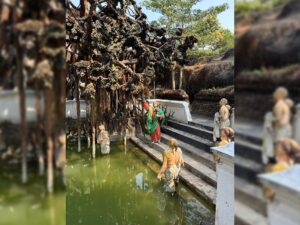
and baptising the first few people outside the first church
built by him in 52 AD.
Muziris (Kodungallur) was the port where Christianity would have started spreading, and I had visited the archaeological site. Muziris was the port that had been trading since early 1000 BC till almost 600 AD during the collapse of the Roman Empire. The Egyptians, the Romans, and the Greeks were all trading here, with the largest amount of Roman coins found outside the Roman Empire being in Muziris. It just shows the vast religious history the Kerala church has and the reason why it’s standing strong and growing even more.
People
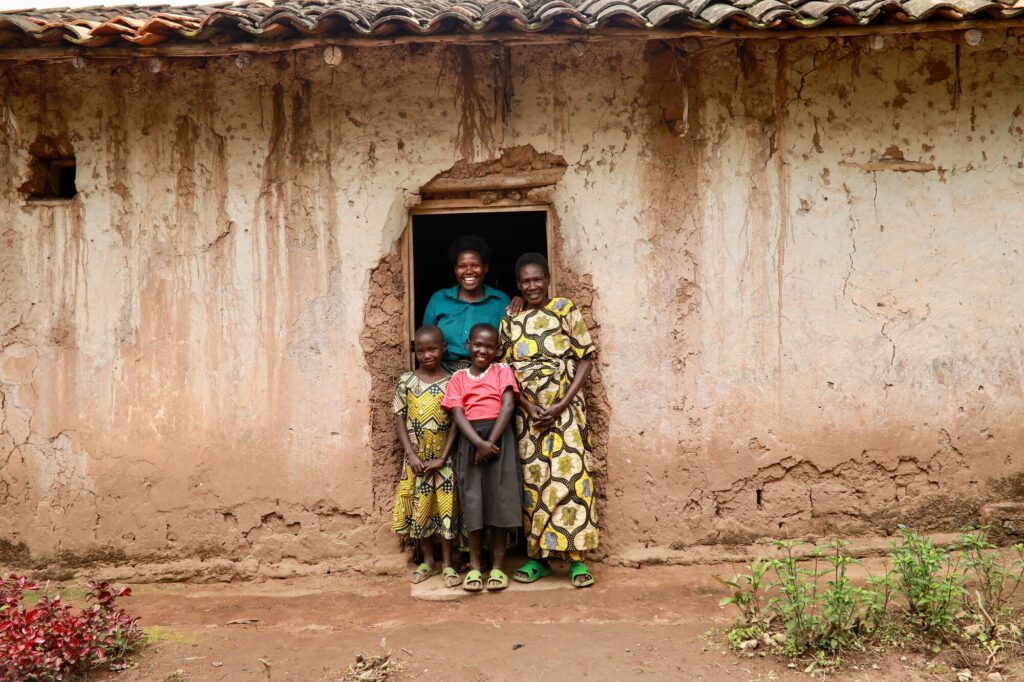
There was another eye-opening thing that Michael and I saw: the faith of people. Every single street we travelled had a statue or small figure dedicated to Holy figures. Even the remotest of places had a thriving parish, and kids, young adults, and the elderly were excited to go to church. For them it’s not a forced event, but more about seeking His guidance and always thanking God for the life they have.
Some can also say, the blessings of St Thomas are the reason the faith in this small state is not dying but only growing for centuries”
India is slowly seeing a rise in Christian hate, mainly in the North of India, with many churches, celebrations and priests being attacked during the last holiday season. Nothing has stopped or allowed to stop the faith in Kerala, and that is the beauty of this state. Religious harmony and freedom are at the forefront of its identity. Some can also say, the blessings of St Thomas are the reason the faith in this small state is not dying but only growing for centuries. Next time you see a person or a family from Kerala in your local parish, ask them their story of faith, and you will be amazed by the sheer passion they have for Christ, the Church, and
Catholicism.