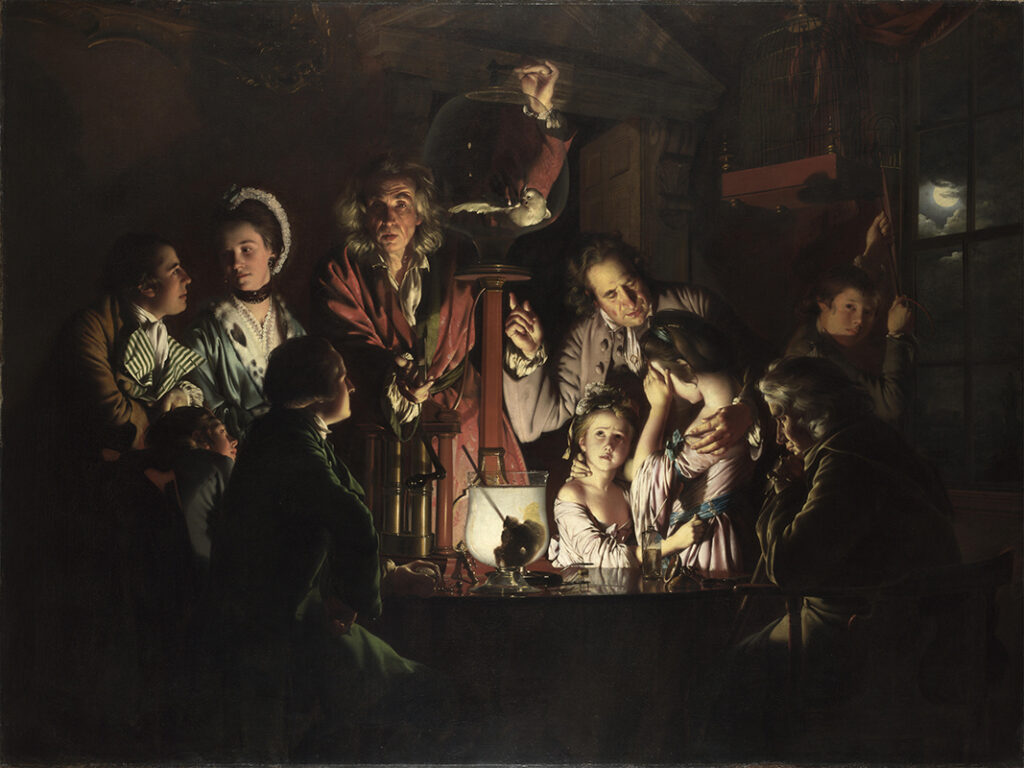
What thoughts, I wonder, are conjured up in your mind at the mention of the Enlightenment? If you are of a traditional bent you may be a bit like the 19th century French clergy who were inclined to blame everything they did not like on Voltaire and Rousseau, two characteristic adepts of the Enlightenment in France. “Tis the fault of Rousseau, ‘tis the fault of Voltaire” was their accusatory refrain. If, on the other hand, you are of a more revisionist vein, you may well think of the Enlightenment as one of the best and most hopeful episodes in the life of mankind.
Whatever the case may be, I feel sure we will all agree on one thing. That is, on the label ‘Enlightenment’ for the complex of ideas and achievements that developed and thrived in 18th century Europe. I mean, what individual and what movement in history would not love to be considered enlightened, throwing clarity, elucidation, and above all, rationality, on just about every subject under the sum? The name is a stroke of genius worthy of any so-called 21st century influencer. Saatchi & Saachi has never come up with anything even near!
In every language I know, the ideas of rational thought and inquiry predominate in its designation of this 18th century movement. Siècle des lumières – age of light (French), Aufklärung – clarification (German), Illuminismo – illumination (Italian). The Reformation, by contrast, has a somewhat pejorative connotation especially if you are Protestant, as it infers a real change in the deposit of faith coming down from the Apostles.
Movement of Ideas
The Enlightenment is not an event in history like, for instance, the French Revolution (1789) with which it is so closely associated in time and ideas. Liberty, Equality, Fraternity are Enlightenment ideas although it would be remiss of me not to point out that they are, at root, Christian ideas. But did Christians ever make optimal use of them as the revolutionaries did? A pertinent question indeed!
Be that as it may, rather than an event, the Enlightenment is a movement of the European mind, a movement of ideas. It has two tendencies: (i) from authority to autonomy and (ii) from metaphysics to physics.
Authority to autonomy
Eighteenth century people had developed the confidence, the brashness you might say, to move on from the great authorities of the ancient and medieval world and to rely a good bit more on their own genius. They did not, for the most part in any case, abandon the Greeks and Schoolmen, notably Plato and Aristotle, Augustine, Anselm, and Aquinas. No right-thinking scholar would do that!
After all, each one of us is from birth a Platonist or an Aristotelian. Neither did they abandon the Christian faith in any wholesale fashion. But they did want to speak sternly to the Church about equality, the rights of man, democracy, the anachronism of divine right. And why wouldn’t they, and why wouldn’t any thinking person who had read the New Testament with even a modicum of authenticity? These ideals are, after all, constitutive of the Gospel.
Metaphysics to physics
Of this tendency there is a certain inevitability considering the history of the previous 17th century. That century saw stunning achievements in our knowledge of the physical world and indeed of the cosmos. The beginning of science! Religion, theology, metaphysics, has now to share the limelight and even move over, and defer more than a little to this new zeitgeist. What an astounding cast of historical characters created this novel mindset!
Going back as far as Copernicus (1473-1543) with his heliocentric theory; on to Kepler (1571-1630) and the laws of planetary motion; on again to Galileo (1564-1642) who was totally captured by the physical laws of the world around him. Every maths and physics professor, right up to today, has a thing about Galileo’s law of falling bodies. I should know, I was that very mediocre soldier in the advanced mathematical trenches! With Newton (1642-1727) – note he was born the year Galileo died – the 17th century, the age of science, reached its remarkable apogee. The beauty of his laws of motion, once that is, you do not have to steal many an hour from the night trying to figure them out! It has been said that in 1600 the mental outlook was still largely medieval; by 1700 the modern world had arrived. The medieval gloom is ended. We see the red glow of the modern dawn.
The Enlightenment
That scant excursus into the rise of science in the 17th century, the appropriately named Age of Science, brings me back to the Enlightenment, the Age of Reason, in the 18th century. By now, men and women are confident enough not just to accept hook, line, and sinker the ancients and the medievals. They want to find out for themselves by observation, experiment, hypothesis. The scientific method! Beloved of the philosophes, those earnest and diligent scholars of the Enlightenment. Their great triumph is the Encyclopèdie, 35 volumes, replete with diagrams, and edited by two doyens of the French Enlightenment, Denis Diderot (1713-1784), and Jean D’Alembert (1717-1783). As all subsequent revolutions are inspired by the French Revolution, so all encyclopaedias are inspired by the Encyclopèdie.
The people of the Enlightenment have a bit of a swagger about them. Their time has come; they are in the ascendant. Medieval people, it is often said, had a love of learning and a desire for God. Enlightenment people have a love of a different kind of learning and a desire for man. No complaint about that as the glory of God is man and woman fully alive. They could be tough on religion, it is true. But was it not a debased, ancien règime, version of religion often without care for equality, right, justice? Such a religion deserves only to be toppled. Now as well as then.
Maurice Kiely is from Dungarvan Co. Waterford and is a retired civil servant