Dr Hugo Slim says humanitarian action must protect both people and the world they depend on
There is a painting by Francisco Goya entitled ‘Fight with Cudgels’. Two men furiously swing at each other in desperate concentration, locked in combat, yet they are unaware that they are both sinking into the same ground beneath them.

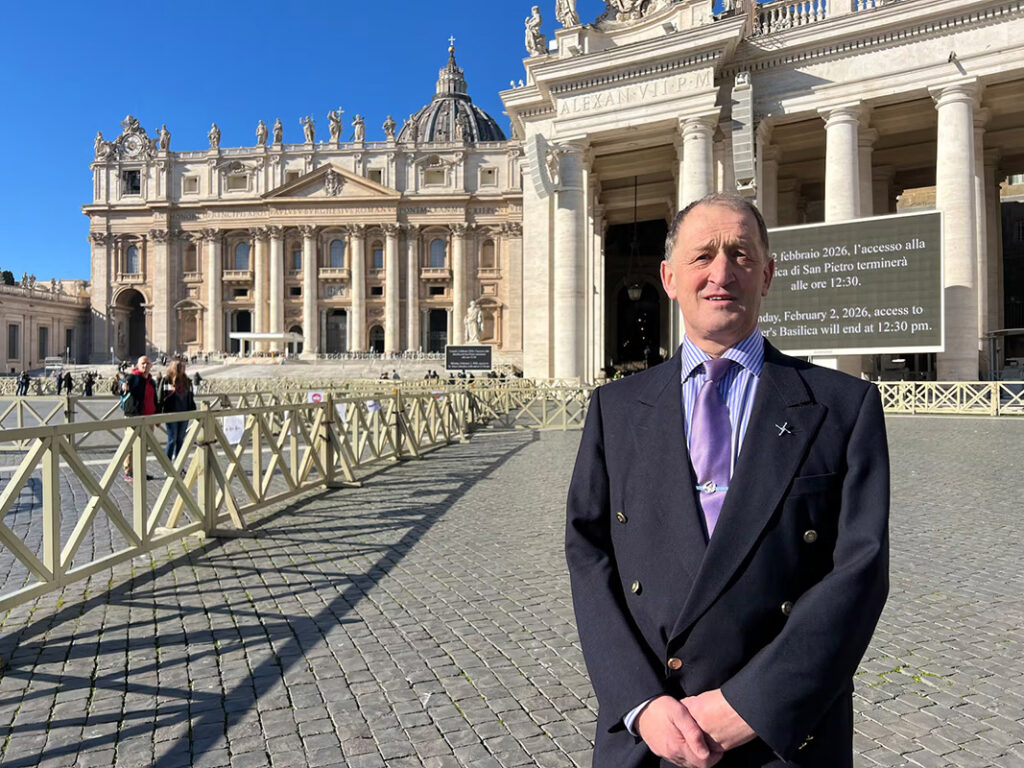
Speaking ahead of the Annual Trócaire Lent Lecture at St Patrick’s College Maynooth, Dr Hugo Slim – Director of the Las Casas Institute for Social Justice at Blackfriars Hall, University of Oxford – suggests that our current moment has something of this logic to it.
“We have this major earth emergency brought on by the climate emergency,” he says. “We’re facing a human crisis of survival in a warming earth that’s got more floods and heat and fire and everything happening. At the same time we’ve got biodiversity loss and major change in habitats. We’re being faced by this possibly unsurmountable challenge of rapid evolution and adaptation into a new climate.”
But attention is elsewhere, he argues. “War always distracts the short-term political view… and that’s a terrible diversion of attention from the really big earth challenge that we face as a universal society.”
For most of his life, Dr Slim has worked in what is called ‘war humanitarianism’. After studying theology at Oxford in the early 1980s, he joined Save the Children and worked in Sudan and Ethiopia during the civil war and famine. Later working during the First Intifada before moving into humanitarian ethics and diplomacy.
Three cries
It was there, he says, that he began to see how war dominated the attention without resolving deeper questions about the world people must continue to live in.
His lecture, entitled ‘Care for creation amidst the cries of war: working for peace in the earth community’, turns on various ‘cries’.
There is the cry for war: banging the drums of deterrence, retaliation, defence. There is the cry from war: that of civilians, prisoners, wounded, the victims and those who humanitarian workers aid.
But there is a third cry which is drowned out. “We need to listen to the cry of the earth as well,” he says. “The Church is committed to both peace and ecology at the same time.”
War is tragic and loud, and it can take all our attention while the ground beneath life continues to shift.
Dr Slim glimpsed this first hand during the Ethiopian famine in the 1980s. Working with Save the Children, their focus was on feeding the severely malnourished children arriving into their care and beyond. Nearby, however, a Swedish colleague was doing something different.
“There was this big, tall Swede, Lars is his name, completely obsessed with trees,” Dr Slim recalls. “He was terracing hillsides and building water catchments across a whole basin.”
At the time, the two efforts seemed unrelated – emergency feeding and long-term environmental work. “But looking back,” he says, “we were saving humans and nature together, even if we didn’t have the language for it.”
“When you really look at what constitutes a human life, you realise human life is nothing without other life. The best way you save a human being is by plugging them back into nature – water, food, shelter, a livelihood. If you ask someone in a drought or conflict how they are, they point to the landscape. The water is failing, the cattle are suffering, the crop is stunted.”
“People want jobs and cash, but they also need protection from floods and heat. An ecological problem becomes a social problem, and a social problem becomes an ecological problem,” said Dr Slim.
And he makes it clear that the relationship is reciprocal: “Nature protects us from storms, floods and heat. So we have to protect it if it is to protect us.”
Humanism 2.0
After years teaching humanitarian ethics and later working in Geneva with the Red Cross, Dr Slim found himself increasingly dissatisfied with a purely war-centred moral framework. “At the end of the day you’re always asking how many people can be killed and when,” he says. “It’s an ethical cul-de-sac.”
He had entered ethics almost accidentally during the humanitarian crises of the 1990s, when agencies dealing with the aftermath of Rwanda began asking him to help think through the dilemmas they faced. But over time he felt the field could not answer a larger question: what kind of world those saved lives would return to.
This would develop into what he calls ‘Humanitarianism 2.0’.
“We need a new sense of the earth community of all life as a basis of our global politics. It’s not enough just to save human beings. You have to save humans and nature together.”
Theology and ecology
Although his career has largely been in international relations and humanitarian policy, Dr Slim still considers theology his first discipline. He studied theology at Oxford and later became Catholic after encounters with the Dominicans at Blackfriars including regular conversations, as a student, with Fr Timothy Radcliffe OP. He describes Pope Francis’s Laudato Si’ as an important influence on his thinking, and says he has been shaped by Catholic ecological writers such as Thomas Berry and Teilhard de Chardin.
“The earth is sacred because God made it and said it is good,” he says. “Dealing with nature is a bit like dealing with the sacred. We can study a river scientifically, but we can’t really know its experience. There’s something mysterious, a kind of other-worldliness, in relating to other species.”
“We are blessed as well with science. Biologists and ecologists can tell us a lot about a river or an animal, and with the knowledge that we have, we can then transcend it and also try and understand how we need to live with them.”
For Dr Slim, the task is not choosing between crises but addressing them together. ‘You have to save humans and nature together’”
And this experience, he suggests, is widely shared: “Most human beings have a sort of sacred experience if they spend time in the natural world.”
If that is true, the problem may not be understanding but attention. In Goya’s painting, the fighters never notice they are sinking.
Dr Slim does not minimise war. Its suffering demands compassion and response, but he fears the urgency of conflict can narrow vision to the immediate struggle alone. Like the tall Swede in Ethiopia, different kinds of work are not opposed. Some respond to immediate suffering, others care for the ground people will still need once the crisis has passed. For Dr Slim, the task is not choosing between crises but addressing them together. “You have to save humans and nature together,” he says.
The challenge, then, is balance. A collaboration of efforts, even among organisations with different mandates, to protect both lives and the world those lives depend on.
The lecture takes place on Tuesday, March 3, 2026 at 7pm and will also be livestreamed. Admission is free, but registration is required. Link.