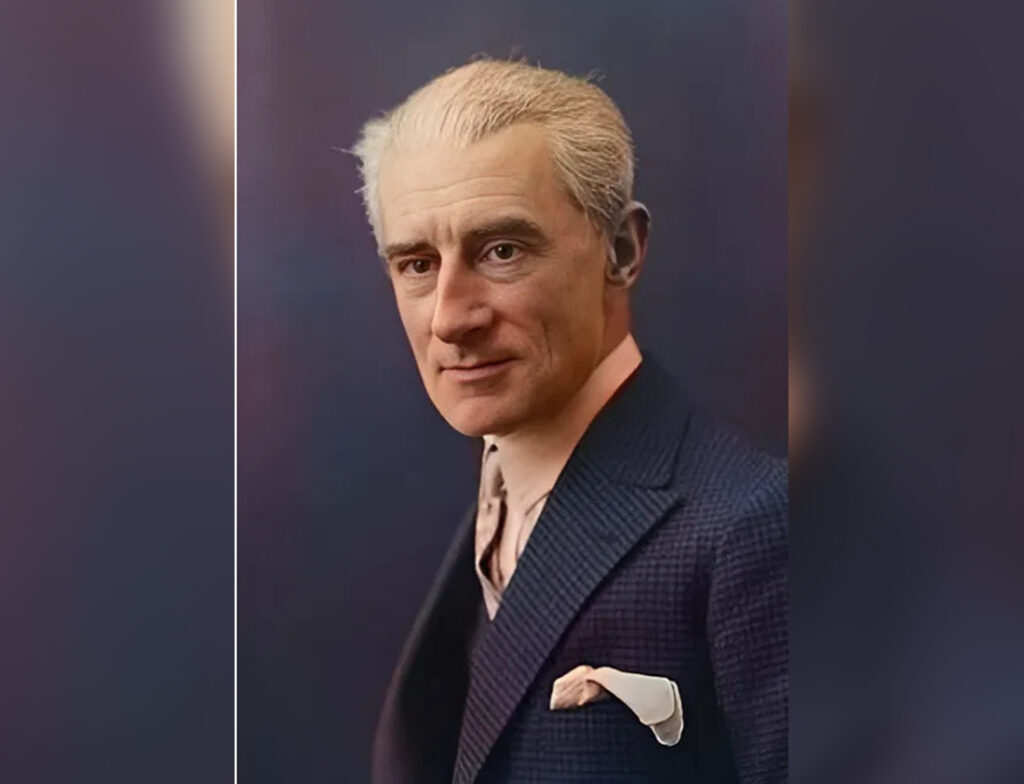
This year celebrates the 150th anniversary of the birth of French composer Maurice Ravel. Born in the Basque country very close to its border with Spain on March 7, 1875, Ravel died in Paris on December 28, 1937.
His mother was also Basque with his father coming from Switzerland. The family was culturally rich, with music playing an important role in the household. The boy Ravel studied piano at the Paris Conservatoire from the age of fourteen, having had lessons at home prior to that. At the Conservatoire, he was greatly influenced by Gabriel Fauré.
Ravel left the Conservatoire in 1895, as musicologist Dr Gabriela Mayer in the current edition of the music magazine Sound Post informs us, “to focus on his own way of writing music.” But Ravel returned to the Conservatoire in 1897 this time studying composition with Fauré. It took Ravel some time to establish himself, but his Pavane pour une Infante défunte of 1899 and Jeux d’eau, written in 1901, brought him a measure of fame. His String Quartet of 1903 secured his place in French music.
As Gabriela Mayer also tells us “controversy surrounded the competition for the coveted Prix de Rome composition award at the Conservatoire. Debussy had won it previously and Ravel entered the competition five times unsuccessfully. On the last occasion, in 1905, his piece was eliminated in the first round causing quite a scandal and referred to as L’Affaire Ravel.”
The finalists were students of a jury member, and the Director had to resign following outcries from the public as well as critics who might not even have been fans of Ravel’s music but who recognised the unfairness of the elimination.
At the Conservatoire Ravel was introduced to the Spanish pianist Ricardo Vines who promoted contemporary music as often as he could and was particularly helpful to Ravel. After WWI pianist Ravel extended his music-making activities to include conducting and undertook extended tours of Europe and the USA in that role.
Ravel’s compositions are relatively limited but among them the ballet Daphnis et Chloé, commissioned by Serge Diaghilev and completed in 1912, ranks among the pearls of his output. Ravel, who never composed what might be termed ‘a symphony’ in the classical sense, referred to Daphnis et Chloé as his ‘choreographic symphony’. His famous Bolero, where a single melody is constantly repeated in a crescendo of colour, was written in 1928 for the Ida Rubinstein ballet company.
Besides his String Quartet, Ravel wrote a small number of other chamber works not least two violin sonatas, a violin and cello sonata, a piano trio and his Introduction and Allegro for an ensemble comprising harp, flute, clarinet and string quartet. There are two short operas – L’Heure espagnole and L’Enfant et les sortilège where the range of musical styles is remarkable.
Again Dr Mayer reminds us that Ravel maintained a distance between his private and professional lives, preferring to keep the spotlight on his music. As he famously stated, “My only mistress is music.”