Genesis 12:1-4
2 Timothy 1:8-10
Matthew 17:1-9
There is always a certain tension between ideals and reality of life. Let us be honest about that. Only those who have flattened their ideals beyond recognition do not experience it. The rest of us live in that space between what we profess and what we manage to practise. And that, in itself, is not yet a tragedy. The tragedy begins when Christians start subtly adjusting the teaching of their Master to fit what we call ‘common sense’.
When the sharp edges of the Gospel are gently filed down so that nothing really hurts, nothing really demands, nothing really changes. When we nod politely at God — but without the slightest intention of allowing His word to rearrange our lives. The readings for the Second Sunday of Lent confront us with a simple yet unsettling command: Listen to God. Not casually. Not selectively. But in a way that requires decisions.
Abram: the beginning of trust
The first reading takes us to the twelfth chapter of the Book of Genesis. It is, in a sense, a beginning — not of the world, but of salvation history. The first eleven chapters of Genesis describe what we might call biblical prehistory: creation, the fall, Cain and Abel, the flood, Babel. They also tell a quieter story — God’s early attempts to heal the wound of sin. We sometimes ask, especially when confronted by the scale of evil in the world: Could God not simply eliminate it with one divine snap of His fingers? If He does not, perhaps He does not want to? And from there, it is a short step to suspecting God Himself. But the issue at stake is human freedom.
The flood was, in a sense, an attempt to deal with evil ‘our way’: remove the wicked, preserve the righteous. And yet evil returned. Why? Because original sin wounded human nature too deeply. Even the good carry within themselves a tendency towards darkness. And God refuses to coerce goodness. He created us free. He desires that good flow from free choice, not from divine compulsion. From this point onward, God changes His strategy. He begins not by erasing evil, but by rebuilding trust.
And so we hear: “The Lord said to Abram: Go from your country, your kindred, and your father’s house to the land that I will show you… and in you all the families of the earth shall be blessed.” In Eden, humanity heard: “Do not eat.” They did not trust. In Genesis 12, Abram hears: “Go.” And he trusts. He leaves security, familiarity, settled life. He walks into the unknown. Not because it is logical. Not because it is safe. But because God spoke. And this “yes” — repeated many times in Abram’s life — becomes the path of salvation. A path that will culminate in the supreme “yes” of the Son to the Father on the Cross.
The psalm responds beautifully: “Our soul waits for the Lord; He is our help and our shield.” Trust. Waiting. Confidence in goodness we do not yet fully see.
Timothy: courage without shame
The second reading, from the Second Letter to Timothy, echoes the same call. St Paul writes to his young collaborator: “Do not be ashamed of the testimony of our Lord… but share in suffering for the Gospel by the power of God.”
The Law reveals sin; it cannot heal it. Salvation comes through grace — a gift given in Christ Jesus before the ages began, now revealed in His victory over death”
Christianity has never been a romantic ideal. Proclaiming the Gospel was not easy in the first century, and it is not easy now. Paul speaks from prison. He knows the cost. Yet he writes with astonishing serenity: “I know whom I have believed.” That is the heart of it.
Paul reminds Timothy that salvation is not achieved by flawless moral performance. The Law reveals sin; it cannot heal it. Salvation comes through grace — a gift given in Christ Jesus before the ages began, now revealed in His victory over death. Christ has abolished death and brought life and immortality to light. There is hope. But hope does not eliminate difficulty. It gives meaning to it. “God has not given us a spirit of fear,” Paul writes, “but of power, love, and self-discipline.” The strength is there — given by God. We are asked to use it. Listen to God. Trust Him. Participate in His plan — even when it costs.
Tabor: light in the middle of the journey
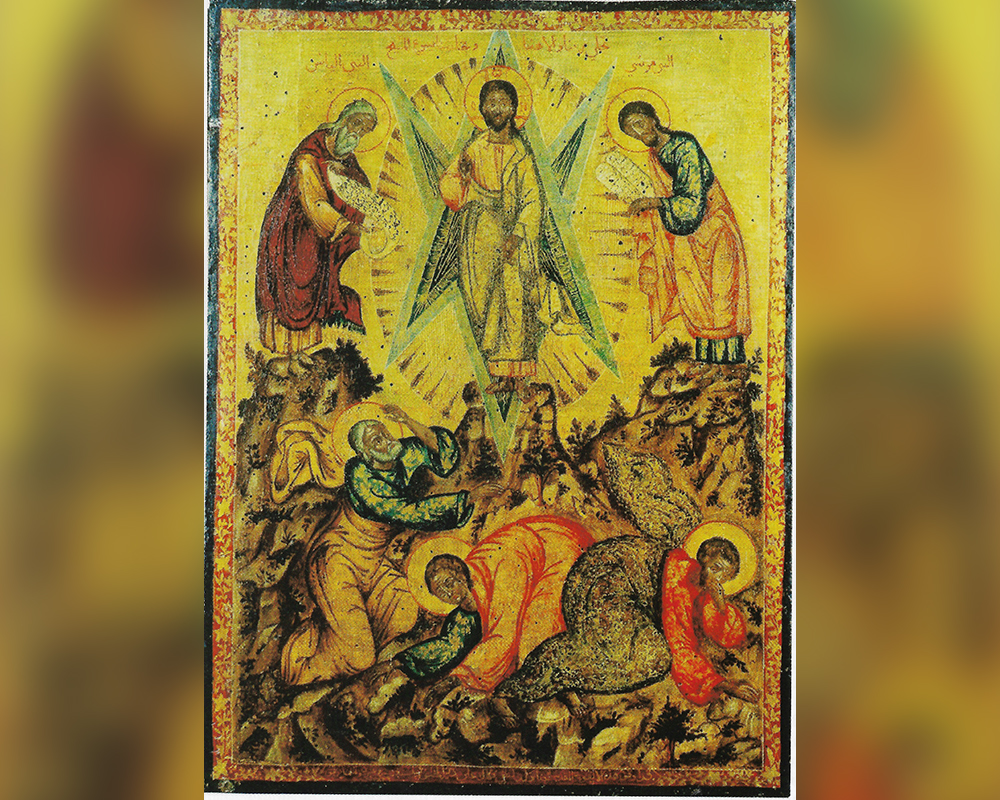
The Gospel brings us to the Transfiguration in St Matthew’s account. It occurs at a decisive moment. Peter has confessed Jesus as the Christ. Jesus has predicted His Passion. He has spoken about taking up the cross. The demands are becoming clear. The road ahead looks dark. And then — Tabor.
Jesus takes Peter, James and John up a high mountain. His face shines like the sun. His garments become white as light. Moses and Elijah appear. And from the cloud comes the voice: “This is my beloved Son… listen to Him.” It is a strange moment. A glimpse of glory placed between announcements of suffering. Why here?
Because discipleship will soon be tested. The Church — the community forming around Jesus — will face scandal, persecution, confusion. The Transfiguration is light given in advance. A memory to cling to when darkness descends.
St Matthew situates this event within his teaching about the Church. In effect, he is saying: Yes, the Church will ask much of you. Yes, you will encounter misunderstanding and even hostility. But you have seen something. You have glimpsed the glory. Do not forget.
We all, if we look honestly, have had our own Tabor moments. Moments of clarity. Of deep prayer. Of unexpected consolation. Of moral conviction burning brightly. They are not given to eliminate struggle, but to sustain us through it.
Listening – do we mean it?
So the readings converge on one imperative: Listen. Abram listened — and went. Timothy is urged to listen — and endure. The apostles are commanded to listen — and follow, even to Calvary.
The question is uncomfortable: What kind of listeners are we? If you are reading these reflections in the newspaper, you likely care about faith. You wish to deepen understanding. That is good. But the deeper question is not whether you know more. It is whether you intend to live differently. The tension between ideals and practice is natural. We all fall short. The real issue is not whether we succeed perfectly, but whether we genuinely desire to conform our lives to Christ.
It is possible, for instance, to speak eloquently about the Good Samaritan — about compassion for the wounded — and at the same time resist welcoming the injured stranger because “we have our own problems.” It is possible to preach love of neighbour while treating those who disagree with us with disdain. It is possible to confess faults publicly, yet make no effort to repair the harm caused — even continuing to benefit from it. We can applaud the Gospel — and quietly exempt ourselves from its inconvenient demands. That is not listening. That is curating.
Lent is precisely this season of honest examination. Not neurotic self-accusation, but serious questioning: Do I truly want Christ to shape my decisions?
To listen in the biblical sense is to allow the word to act. Abram did not hold a seminar on the theological implications of migration. He packed. Timothy was not invited to admire Paul’s courage. He was called to share in it. The apostles were not given a spiritual spectacle for entertainment, but a vision to sustain obedience.
Lent is precisely this season of honest examination. Not neurotic self-accusation, but serious questioning: Do I truly want Christ to shape my decisions? My politics? My finances? My speech? My treatment of those who irritate me? Less important is whether you have already achieved it. More important is whether you want to. Because only those without ideals experience no tension. The Father’s command on Tabor is short. No theological treatise. No complex programme: “Listen to Him.”
Not with one ear in and the other out. Not with a discreet wink. Not with selective obedience. Listen — and go. Listen — and endure. Listen — and trust. The One who calls is the One who conquered death. The One who shines in glory is the One who walks toward the Cross. The One who demands trust is the One who gives grace sufficient for your journey.
And so, dear reader, the question for this Second Sunday of Lent is simple and personal: Will you merely admire the light on the mountain? Or will you follow the voice that speaks from it? For in the end, everything depends on whether we truly listen.
Fr Dominik Domagala is the author of “The Social Sermon” blog on Facebook, Instagram and YouTube. Send your questions to: thesocialsermon@icloud.com