Two Middle-Aged Ladies in Andalusia,
by Penelope Chetwode
(Eland Publishing, £14.99 / €17.50)
This is the time of the year when we find so many people we wish to contact or speak to have “gone to Spain”. Indeed, the whole Irish people seems to have lost their hearts to Spain. But their Spain is as likely as not the touristy Spain, which some in that country now resent. Certainly, they have a point: Torremolinos is not “the real Spain”.
As a taste of the real Spain this book by Penelope Chetwode is very much an antidote. Penelope Chetwode, Lady Betjeman (1910–1986) was an English travel writer. She was the daughter of Field Marshal Lord Chetwode, and the wife of poet John Betjeman.
Journey
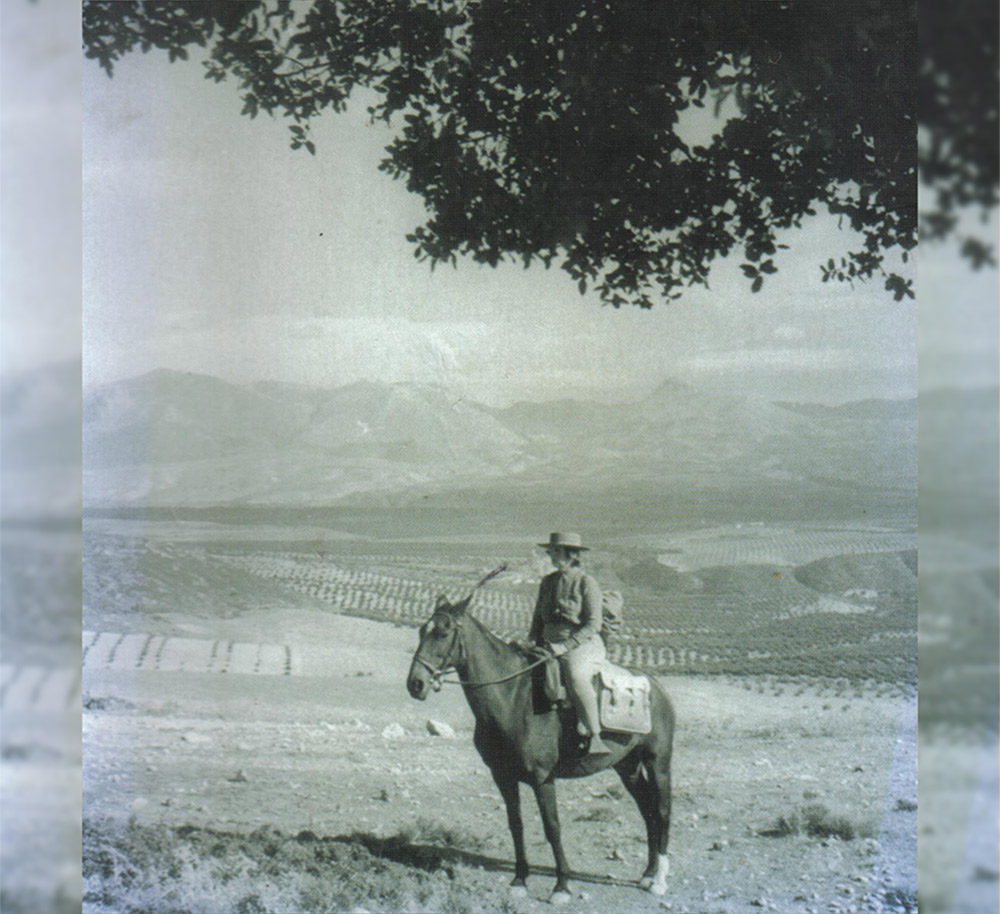
But she is far better known for this wonderful book, her account of travelling through southern Spain on horseback in the late autumn of 1961. She knew Italy well in person, but in reading about Spain she was in thrall to George Borrows’ The Bible in Spain (1843) and Zincali (1841), and to Richard Ford’s Gatherings from Spain (1846).
The people she loved and who loved her back, so it seems, were these country folk of one of the rough regions of Spain”
On this trek she constantly harks back to them and their observations on Spain and its people. She creates an impressionistic portrait of Spain which is lively, kind and warm, simply because she delighted in the local people she encountered and their religion. The key to her Spain was that she was a Catholic convert.
Hardly a day seems to pass without her hearing mass, and she constantly invokes St John of Cross in a quite casual way. Also, she is trying as she goes along to improve her grasp of Spanish by reading Don Quixote.
She observes that “St Thomas says you cannot love a horse because it cannot love you back. This statement proved a serious obstacle to my entering the Holy Roman Church in 1948. Then Evelyn Waugh pointed out that St Thomas was an Italian. …” He felt that if he had been British, he would have a truer understanding of horses. She reveals the truth of that matter in the last lines of the book.
The people she loved and who loved her back, so it seems, were these country folk of one of the rough regions of Spain. Everywhere she seemed to be received with kindness and consideration from people she knew had little enough for themselves. An encounter with two policemen who called one evening on the posada where she was staying turned out to be friendly when they caught sight of her black daily missal on a shelf.
Insight
She saw many aspects of daily life in rural Spain that tourists never see, including an annual pig killing, which provided the sausages and hams on which would feed the family for the year.
Highly praised when it appeared, this book is now a travel classic. While it may not take readers back to Ford or Barrow, it will certainly delight, entertain and inform all its readers.