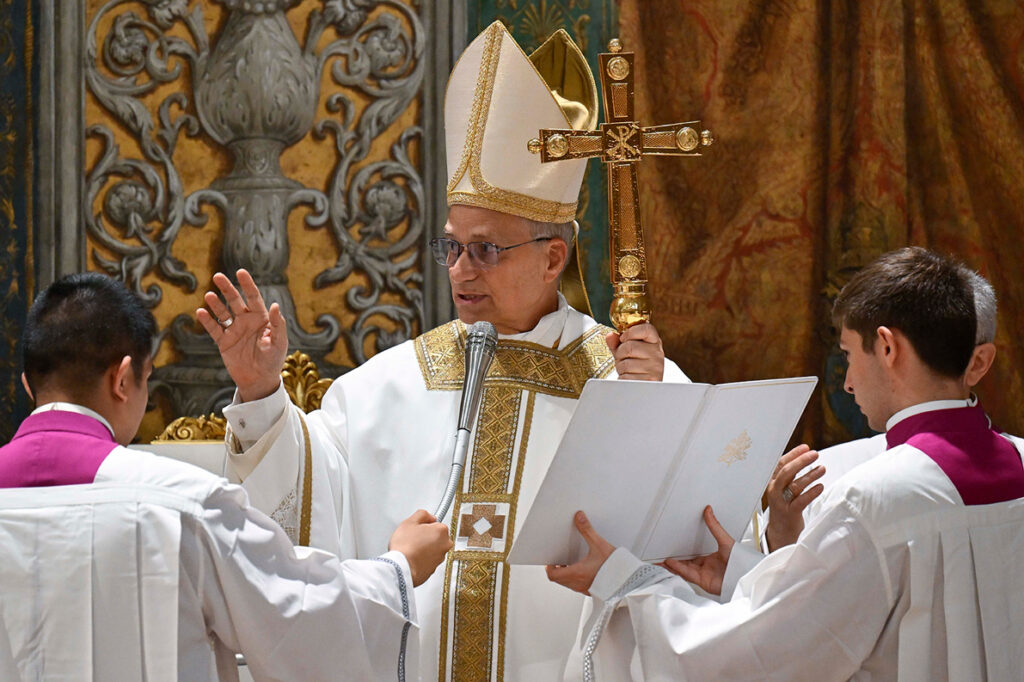
In his inaugural homily as Bishop of Rome and universal pastor of the Catholic Church, Pope Leo XIV called on the faithful to recommit to the mission of the Gospel with courage, humility, and trust in God’s grace. Preaching in St Peter’s Basilica before an international congregation of cardinals, clergy, and laity, the newly elected Pope reflected on the Church’s enduring identity and the challenges of modern discipleship.
“I will sing a new song to the Lord because he has done marvels,” Pope Leo began in English, quoting the responsorial psalm before continuing his homily in Italian. The moment marked a deliberate gesture of welcome to a global Church and set the tone for a reflection rooted both in Scripture and contemporary realities.
Drawing on the Gospel scene from Matthew 16, where Peter confesses Jesus as “the Christ, the Son of the living God,” the pope emphasized the dual responsibility of the Church: to guard the revealed truth and to live it out in a world that often misunderstands or rejects it.
Pope Leo compared his own succession to that of St Peter and described his new role as a “faithful administrator” of the Gospel, chosen not through merit but by divine grace and the trust of the College of Cardinals.
“God has called me by your election to succeed the Prince of the Apostles,” he said, “so that the Church may be ever more fully a city set on a hill… not through the grandeur of her buildings, but through the holiness of her members.”
He warned against two attitudes that persist in today’s society: one that considers Jesus irrelevant or bothersome, and another that admires Him only as a moral leader while denying His divinity. These views, he said, reduce faith to sentiment or social ethics and fail to grasp the full promise of salvation.
“Even today, there are many settings in which the Christian faith is considered absurd, meant for the weak and unintelligent,” he said. “Yet these are the very places where our missionary outreach is desperately needed.”
In continuity with the vision of Pope Francis, Pope Leo underscored the importance of evangelisation “from the margins,” the call to synodality, and a Church that listens and walks together. While his tone was more reserved and scholarly, he reaffirmed the Church’s commitment to proclaiming Christ in a secularised and wounded world.
Quoting the early Church Father St Ignatius of Antioch, the Pope called for leadership rooted in humility and self-effacement: “To move aside so that Christ may remain, to make oneself small so that he may be known and glorified.”
The homily concluded with an appeal for prayer and grace, invoking Mary, Mother of the Church, as the Pope begins a pontificate many believe will focus on governance, doctrinal clarity, and continuing the work of ecclesial reform – particularly in areas such as Canon Law, highlighted during the global synodal process.
As the bells of St Peter’s rang and the congregation applauded warmly, a new chapter began – not one of rupture, but of rooted renewal.