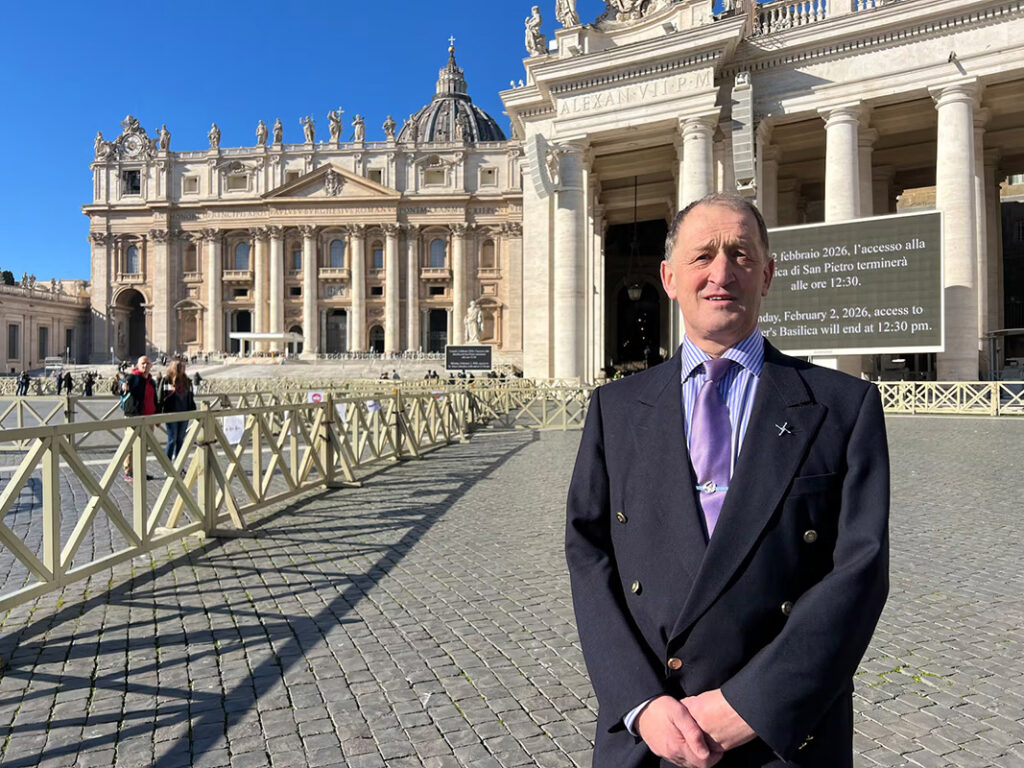
Head, neck, torso bent in a curve like the bend of a river. Grasping rail. I am looking up at the spectacular dome of St Peter’s Basilica. Awe-inspiring. Vertigo-inducing. No wonder Shakespeare said that human beings are little less than gods. The Bard may have exaggerated when it comes to the rest of us, but he was surely right about Michelangelo and his few equals in human history.
As well as wonder, I had another sensation while meditating on the great dome. Irony. If irony means a sense of incongruity then the great church with its dome certainly qualifies as ironic. Because the building of St Peter’s was the immediate cause of the Protestant Reformation. John Tetzel, Dominican friar, is preaching indulgences, with rather too much ardour, in the vicinity of Wittenberg. Martin Luther (1483-1546), Augustinian friar, fulminates and slaps up his 95 Theses. Sola fide, sola scriptura, justification, i.e. being made righteous in the sight of God, is by grace alone and not by works. The Reformation has begun. Gutenberg’s printing press is humming along. The revolt spreads rapidly. Luther has opened Pandora’s box.
The Reformation did not begin simply in anger, but in the moment when Christians were no longer meaning the same thing when they spoke about God, faith and the Church.
The bonfire set alight by the Wittenberg friar had been in preparation for the previous hundred years at least. Widespread abuse – grasping priests, bishoprics up for sale to the highest bidder, downright bad theology.
Scholars of the period constantly refer to the harvest of late medieval theology. They do not mean the rich, lush harvest produced by Aquinas with his joining of faith and reason. The medieval synthesis, as history calls it. They are thinking, on the contrary, of the poor, meagre harvest of Nominalism associated with the English Franciscan, William of Ockham (1287-1349). Here, God cannot be known by reason, faith is no longer seeking understanding, fides and ratio are split apart. Analogy between sense and spirit is gone. The divine will is felt an arbitrary tyranny. This is the hungry harvest of the late medieval Christian mind and therefore the inheritance of early modern theology. It is what the theologians of the 15th century, including the Reformers, learned in their schools.
G.R. Elton, one of the great historians of the 16th century, refers to “the stultified scholasticism of the dying medieval ages.”
Eck was too conservative, Luther too combative. Cajetan, despite his best efforts, was not able to understand the reformer”
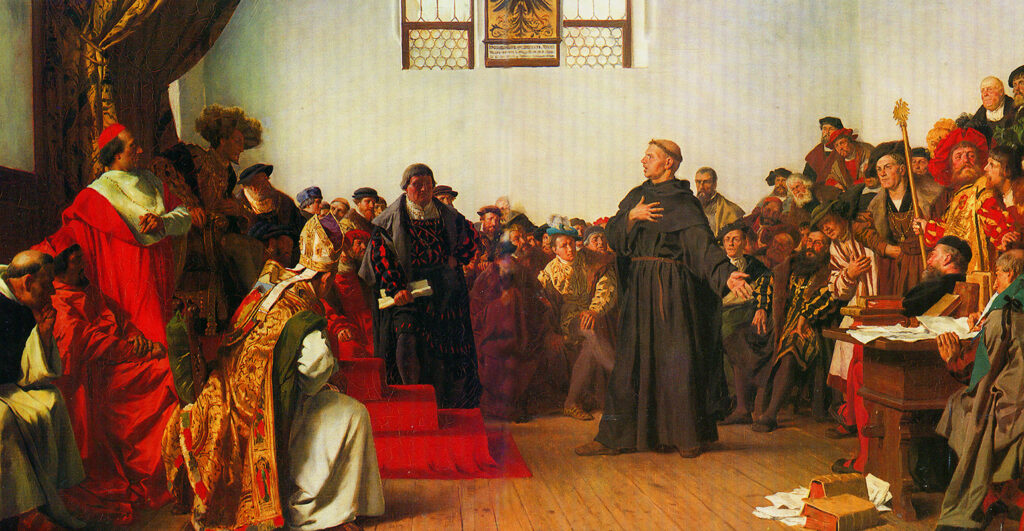
After Luther’s bombshell, there is vigorous Reformation controversy. At school we had many a joke about the famous Diet of Worms, January 1521, when Luther meets Hapsburg Emperor Charles V for the first and only time. No resolution. “Here I stand; I can do no other; God help me; Amen”, proclaimed the protestor.
On the Catholic side, the assault was led by Johann Eck (1486-1543), a German Dominican. A very influential theologian whose work was for centuries the main source for Catholics about the teachings of the Reformation. He followed up, like a lurcher, every argument of his adversaries. Faith and works, scripture, sacraments, images. Eck fields it all.
It would be impossible not to refer to the role of Thomas de Vio Cajetan (1469-1534), papal legate in Germany at the outbreak of the Reformation. He is known to history as Cardinal Cajetan, or just simply as Cajetan. Before his assignment to Germany he had been a professor, writing a great commentary on St Thomas’ Summa, and then Master General of the Dominicans. So he is a true-blue Scholastic. He studies the writings of Luther and in 1518, debates with the reformer on three occasions. Cajetan genuinely tries to understand Luther. Their conversations are quite peaceable but in the end, fruitless. No rapprochement!
We can see a clash of cultures in Reformation controversy. Eck was too conservative, Luther too combative. Cajetan, despite his best efforts, was not able to understand the reformer. Old scholastic versus young reformer! They lack a common universe of discourse.
At the Diet of Augsburg 1530 there is a distinct atmosphere of détente. The previous polemics are largely gone. Words matter. By this time Luther has been declared a heretic and is not allowed to attend the Diet. Philip Melanchthon (1497-1560) produces the Confession of Augsburg, a statement of Lutheran belief. It is from this point that we can begin to use the term Lutheranism. The Catholic reply to the Augsburg Confession is known as the Confutatio. Both Confessio and Confutatio are tolerant, conciliatory, carefully-phrased documents. Yet the schism continues. Old polemics, which did not play an important role in the negotiations at Augsburg, again intervene. Human history is the history of missed opportunities!
Melanchthon’s Confession of Augsburg gave to Lutheranism a theological and ecclesial identity. The Peace of Augsburg 1555 gave it a political reality. Its famous motto cuius regio, eius religio (the religion of the ruler is the religion of the subjects) grants the faith of Luther a political and legal right to exist. The first phase of the Reformation is over!
As a student I was assigned an essay on the mystical elements in the thought of Martin Luther. Apologies for the technical terminology, but I tried to explain the gemitus-raptus theme (anguish of standing before God-bliss of God’s presence) in Luther as best I could. I introduced Meister Eckhart, Johann Tauler and the Rhineland mystics. Jesuit professor is underwhelmed. Said I sold Luther short. Wending my way home to student cell and bowl of pasta, I ponder the puzzling ways of men. Jesuit sticking up for Luther. The times they truly are a-changing!