Confluences of Law and History. Irish Legal History Society Discourses and Other Papers, 2011-21, ed.
by Niamh Howlin & Felix M. Larkin
(Four Courts Press, €55.00 / £50.00)
Usually, edited collections of historical essays are thematic and derive from papers presented at a conference. However, the papers presented in this edited collection received their original airing at various meetings and events of the Irish Legal History Society over the past decade of centenaries of episodes, experiences and personalities that shaped Ireland’s emergence and development as a sovereign independent state.
This elegant tome published by Four Courts Press in association with The Irish Legal History Society is composed of sixteen essays contributed by luminaries from the disciplines of History and Law. Devoid of academic aridity, each essay sparkles with erudition, fascinating insight, clarity of expression and the occasional witty asides. The general reader will find it accessible and engaging, while the specialist will find it most useful.
The introductory essay by the editors, Niamh Howlin and Felix Larkin, provides an excellent historiographical survey concerning recent developments in the research, writing and publication of Irish legal history and its interaction with political, diplomatic, economic, social and cultural spheres.
Much of current Irish Law derives from the Common Law of England which was first introduced into Ireland in the 12th century. It was extended beyond the English Pale and corporate cities and towns between 1603 and 1607 in replacement of the indigenous Brehon Law.
Molyneaux’s achievements testify to the influence of Cicero’s six books on Rhetoric and Quintillian’s Institutio Oratoria”
Following the Cromwellian conquest (1649-’53), the Common Law was consolidated as the sole secular legal code of Ireland. Therefore, it is appropriate that this collection of essays leads with Jane Ohlmeyer’s examination of how the trial of Lord Dunboyne by his peers in Irish House of Lords in 1628, and the use of litigation and patronage networks served as effective instruments for the anglicisation process among society in Ireland during the 1600s.
This is followed by Patrick Hyde Kelly’s exposition of “the ambivalent patriot” William Molyneaux’s powerfully persuasive rhetorical devices in ‘The case of Ireland’s being bound by acts of parliament in England, stated’ (1698), to present his argument for Irish legislative independence. Molyneaux’s achievements testify to the influence of Cicero’s six books on Rhetoric and Quintillian’s Institutio Oratoria – compulsory reading for present-day aspirants to public speaking!
A chronological leap from the late 1690s to the early 1800s brings the reader to Kevin Costello’s analysis of the civil bill courts in Ireland between 1810 and 1848, which made incarceration for small debts more frequent than in England.
The following six essays reflect the perennially intricate relationship between land and law in Victorian Ireland. This is illustrated with three micro-studies into the operation of the law set in the general context of the struggle for land ownership.
Donnell Deeney provides an examination of the courts of petty sessions and of superior courts through the experiences of a controversial entrepreneur and pillar of Lurgan’s society.
Contested
The civil and criminal proceedings, as well as subaltern or subversive codes and activities, over the contested change of ownership of a rural Cavan townland is analysed by Robert D. Marshall. A vignette into how courts and judicial bodies operated in the pre-partitioned province of Ulster, is illustrated by the late Sir Anthony Hart’s study of the assizes of summer 1898.
These microstudies are complemented by L. P. Curtis Jr’s exploration of the political, social, economic, and even meteorological dimensions in the agitation of the land war (1879-90), in which the advantages of the adage, “knowledge is power” in obtaining legal and political changes is highlighted.
Paul Bew’s discourse on Charles Stewart Parnell’s strategic exploitation of the limits of the law in conjunction with the withholding of rent payments up until the last point before eviction could be enforced, rather than the “boycott”, unveils the real dynamics of the land war.
Patrick Geoghegan’s essay combines a critical evaluation of Robert Anderson’s memoirs as a historical source concerning Parnell with gruesome, but fascinating, insights into the attempt by the London Times to smear Parnell by association with Jack the Ripper!
Essays concerning the 1900s begin with Marion Röwekamp’s comparative and reflective study concerning the respective levels and qualities of suffrage for women in Germany, England and Ireland, and the subsequent dilutions, diminutions and disappointments despite their achievement of voting rights.
Transnational comparatives also pervade Thomas Mohr’s essay about the legal arguments regarding the removal of the oath of allegiance and repugnancy clause from the Irish Free State’s constitution.
It seems that the Irish comic tradition may be traced back to the ancient Gaelic Aoir – a formidable poetic satire of biting humour”
The theme of forensic oratory and historical or alleged historical precedents, as much as the impact of charismatic or compelling personalities in the interpretation, operation and transformation of law in periods of political and social transition may again be savoured in Daire Hogan’s study of the Unionist politician and lawyer, James Henry Mussen Campbell; in John Larkin’s reflection on the Irish Convention (1917-18), and in Bláthna Ruane’s analysis of how the Anglo-Irish peace settlement of 1921 was achieved through the legal mechanism of a treaty.
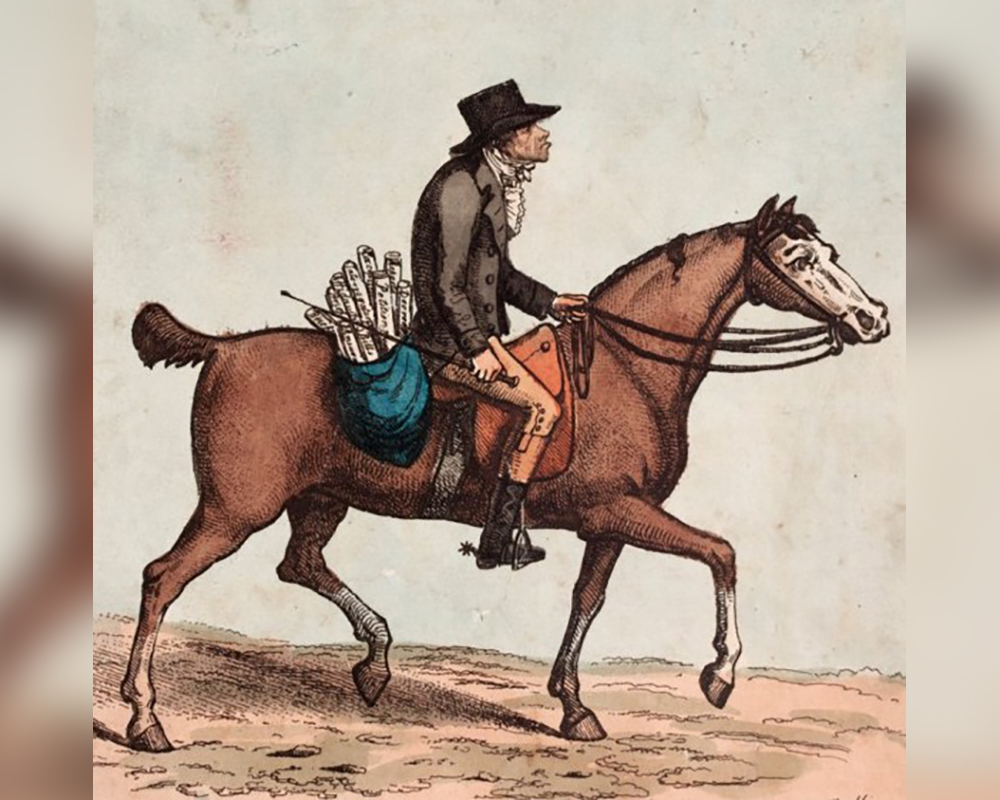
The collection concludes with an illustrated essay on Irish legal cartoons, erudite and entertaining in its composition by Felix Larkin. It seems that the Irish comic tradition may be traced back to the ancient Gaelic Aoir – a formidable poetic satire of biting humour.
While bereft of essays concerning the 18th-century, the book provides insights into the interesting interplay of law with politics, as much as the operation and interpretation of legal forms and processes, in the experience of Ireland from a kingdom in the 1600s to a semi-colonial status in the 1800s to an independent sovereign state in the 1900s.
Readers will appreciate this comprehensive collection and its extensive bibliography and excellent index. Both editors and contributors deserve recognition and praise for the honour they have rendered to Clio, Themis and Athena.
Declan M. Downey, UCD School of History, is the Co-Coordinator of the BCL Law with History Degree Programme at UCD.