Readings: Isaiah 2:1-5; Ps 122 (121); Romans 13:11-14; Matthew 24:37-44
Therefore you also must be ready, for the Son of Man is coming at an unexpected hour
Matt 24:37 [Jesus said] For as the days of Noah were, so will be the coming of the Son of Man.
Matt 24:38 For as in those days before the flood they were eating and drinking, marrying and giving in marriage, until the day Noah entered the ark,
Matt 24:39 and they knew nothing until the flood came and swept them all away, so too will be the coming of the Son of Man.
Matt 24:40 Then two will be in the field; one will be taken and one will be left.
Matt 24:41 Two women will be grinding meal together; one will be taken and one will be left
Matt 24:42 Keep awake therefore, for you do not know on what day your Lord is coming.
Matt 24:43 But understand this: if the owner of the house had known in what part of the night the thief was coming, he would have stayed awake and would not have let his house be broken into.
Matt 24:44 Therefore you also must be ready, for the Son of Man is coming at an unexpected hour.
Initial observations
Advent 1 dovetails with the themes which closed the previous liturgical year—the end of the world, judgement and preparation. Advent 2 and 3 take us to two moments in the career of John the Baptist, that iconic Advent figure—his proclamation (Advent 2) and his questions about Jesus’ identity (Advent 3). For Advent 4, we go backwards in time to the story of the conception of Jesus. Naturally, the theme of Matt 1:18-24 is most suitable on the Sunday nearest Christmas.
Kind of writing
This and similar passages belong to a category of hortatory texts (parenesis) in the New Testament. Our passage finds itself in Matthew 24-25, which is that gospel’s reception of Mark 13. Matthew includes many parables here—parables of watchfulness—and our passage is “incipiently parabolic”.
- a) The fig tree as a parable of the coming of the Son of Man
- b) As in the days of Noah
- c) As when a burglar comes
- d) As with a faithful servant when his master returns
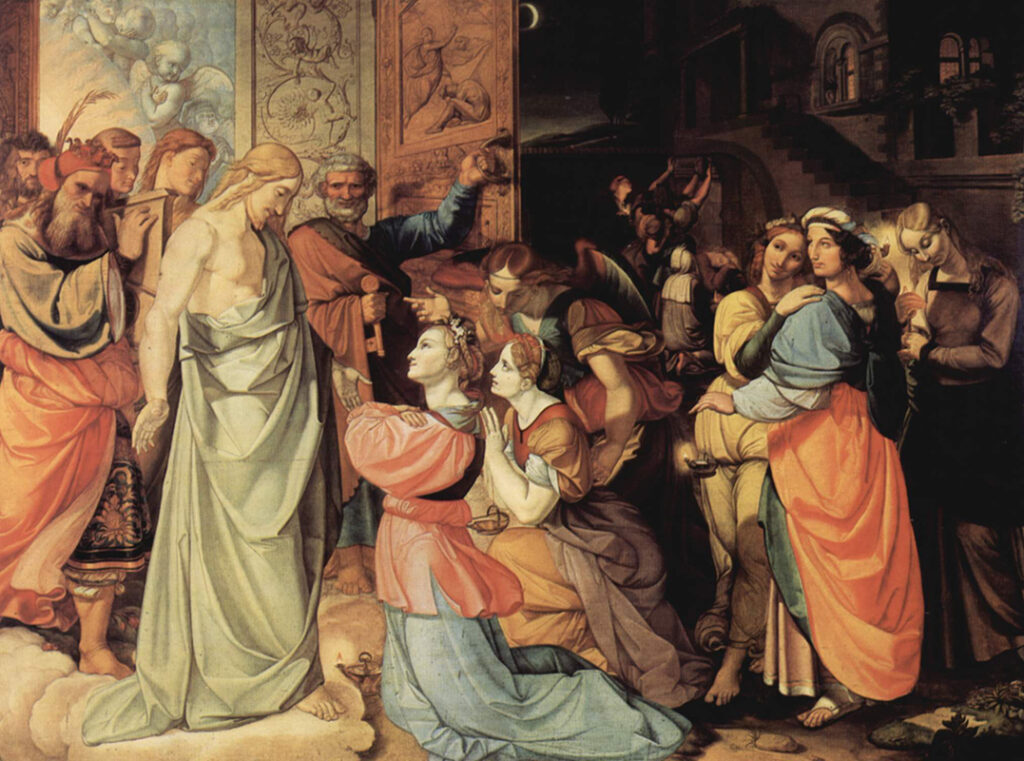
- e) As with bridesmaids awaiting the bridegroom
- f) As with talents given to servants to work with
- g) As with sheep and goats separated by the shepherd
Old Testament background
Son of Man
As the visions during the night continued, I saw coming with the clouds of heaven one like a son of man. When he reached the Ancient of Days and was presented before him, He received dominion, splendour, and kingship; all nations, peoples and tongues will serve him. His dominion is an everlasting dominion that shall not pass away, his kingship, one that shall not be destroyed. (Dan 7:13–14 NABRe)
Noah and the flood
Now the earth was corrupt in God’s sight, and the earth was filled with violence. And God saw that the earth was corrupt; for all flesh had corrupted its ways upon the earth. And God said to Noah, “I have determined to make an end of all flesh, for the earth is filled with violence because of them; now I am going to destroy them along with the earth. Make yourself an ark of cypress wood; make rooms in the ark, and cover it inside and out with pitch. This is how you are to make it: the length of the ark three hundred cubits, its width fifty cubits, and its height thirty cubits. Make a roof for the ark, and finish it to a cubit above; and put the door of the ark in its side; make it with lower, second, and third decks. For my part, I am going to bring a flood of waters on the earth, to destroy from under heaven all flesh in which is the breath of life; everything that is on the earth shall die. (Gen 6:11–17)
New Testament foreground
(i) Within Matthew 24-25, the themes arise as follows:
Watch therefore 24:42; 25:13
Unexpected returns or arrivals 24:37, 42-44, 50; 25:10,19
Delays in arrival 24:48; 25:5,19
Return of the Son of Man 24:27, 30, 37, 44; 25:31
Praises of faithful servants 24:46; 25:21, 23, 25, 34
The use of “Lord” 25:11, 24, 37, 44
Exclusions from the presence 24:51; 25:10, 30, 46
For our passage, Matthew may have in mind catastrophes which preceded the Jewish revolt of 66-70, which led to the destruction of Jerusalem.
(ii) The unexpected image of the thief is likewise found across the New Testament:
For you yourselves know very well that the day of the Lord will come like a thief in the night. (1 Thess 5:2)
But you, beloved, are not in darkness, for that day to surprise you like a thief. (1 Thess 5:4)
But the day of the Lord will come like a thief, and then the heavens will pass away with a loud noise, and the elements will be dissolved with fire, and the earth and everything that is done on it will be disclosed. (2 Pet 3:10)
Remember then what you received and heard; obey it, and repent. If you do not wake up, I will come like a thief, and you will not know at what hour I will come to you. (Rev 3:3)
See, I am coming like a thief! Blessed is the one who stays awake and is clothed, not going about naked and exposed to shame. (Rev 16:15)
St Paul
So then let us not fall asleep as others do, but let us keep awake and be sober; for those who sleep sleep at night, and those who are drunk get drunk at night. But since we belong to the day, let us be sober, and put on the breastplate of faith and love, and for a helmet the hope of salvation. (1 Thess 5:6–8)
Besides this, you know what time it is, how it is now the moment for you to wake from sleep. For salvation is nearer to us now than when we became believers; the night is far gone, the day is near. Let us then lay aside the works of darkness and put on the armour of light; let us live honourably as in the day, not in revelling and drunkenness, not in debauchery and licentiousness, not in quarrelling and jealousy. Instead, put on the Lord Jesus Christ, and make no provision for the flesh, to gratify its desires. (Rom 13:11–14)
Brief commentary
Verse 37 Something is lost by leaving out the preceding verse: “But about that day and hour no one knows, neither the angels of heaven, nor the Son, but only the Father.” (Matt 24:36) Noah is not much mentioned in the New Testament (Matt 24:37–38; Luke 3:36; 17:26–27; Heb 11:7; 1 Pet 3:20; 2 Pet 2:5). The present mention is to illustrate unawareness, the feeling of business as usual. Coming is lit. parousia, a technical used in the New Testament. Son of Man is Jesus’ self-designation and it has two meanings: a human being and an agent of end-time salvation (Daniel).
Verse 38 The point of comparison is the un-mindfulness of Noah’s contemporaries. The Greek word for flood is the evocative kataklysmos. The rhythmic description conveys the sleepy effect of the habitual and the usual.
Verse 39 The people did not know. Cf. 24:36, 39, 42, 43, 44, 48, 50; 25:13. The verb to know has no object, perhaps indicating a state of general unawareness.
Verse 40 “Taken” means to be gathered and to enter the community of the saved at the end, just as the animals were gathered into the ark. Now invisible, the second coming will make plain who is “in” and who is “out.”
Verse 41 The first pair of men is matched by a pair of women. Matthew is probably not thinking of gender balance. Rather, the repetition is a form of insistence or emphasis. As in the surrounding parables, the evangelist is saying that there will definitely be a time of sorting. Our choices now, therefore, will have an effect on our status then.
Verse 42 An exhortation, drawing out the consequences of the previous teaching. Keeping awake is frequent in Mark (6) and Matthew (6). It is, understandably, absent in John and infrequent in Luke (1) and the Acts (1). By the time of Luke-Acts, the tension of the imminent end had relaxed.
Verse 43 A second parabolic element is introduced. Householders are not normally informed beforehand (!), another way of underlining lack of information. However there is an implied a fortiori argument: if a householder had this much sense to protect himself and his home, how much more the believer…
Verse 44 A repetition of v. 36 thus forming a frame or inclusion. The theme of being ready is a feature of these parables in Matthew: Matt 22:4, 8; 24:44; 25:10. Unexpected renders a blunter, more direct expression in Greek: in the hour you do not know, the Son of Man is coming.
Pointers
for
prayer
- The ‘coming of the Son of Man’ can be applied to the end of the world, to the moment of death, or to any moment of grace. We are not given advance notice as to when any of these will happen, so the message is to be alert and ready. When have you found that your alertness meant that you were able to receive an unexpected grace (e.g. take an opportunity which presented itself, or respond to a hint from another person that you might easily have missed, etc.).
- One of the enemies of alert living is constant busyness. Have you ever found that being caught up in your own agenda makes you less sensitive to what is happening around you? Recall times when you paused in your relentless busyness and were rewarded by a significant interchange with another person, a moment of grace.
- You probably know the difference between being ready for a visitor and the unannounced caller who catches you unprepared. Let the memory of the discomfort of being caught off guard spur you on to a constant readiness for the coming of the Lord.
Prayer
God of majesty and power, amid the clamour of our violence your Word of truth resounds; upon a world made dark by sin the Sun of Justice casts his dawning rays.
Keep your household watchful and aware of the hour in which we live.
Hasten the advent of that day when the sounds of war will be for ever stilled, the darkness of evil scattered, and all your children gathered into one.
We ask this through him whose coming is certain, whose day draws near: your Son, our Lord Jesus Christ, who lives and reigns with you in the unity of the Holy Spirit, God for ever and ever. Amen.
===
Rom 13:11 And do this because we know the time, that it is already the hour for us to awake from sleep, for our salvation is now nearer than when we became believers.
Rom 13:12 The night has advanced toward dawn; the day is near. So then we must lay aside the works of darkness, and put on the weapons of light.
Rom 13:13 Let us live decently as in the daytime, not in carousing and drunkenness, not in sexual immorality and sensuality, not in discord and jealousy. 14 Instead, put on the Lord Jesus Christ, and make no provision for the flesh to arouse its desires.
Initial observations
Three times this Advent we hear from the letter to the Romans. Today’s excerpt is apocalyptic in tone and takes up the contrasting themes of light and darkness, vigilance and sleep.
Kind of writing
Very simply, these chapters are exhortations, in the genre of deliberative rhetoric. In the box underneath the different moments are identified. The lectionary excerpt is an integral unit from chapter 13. In effect, it constitutes a mini-conclusion, a more emotional exhortation in apocalyptic mode at the end of the foregoing instructions in 12:3-13:10.
Context in the community
The Letter to the Romans was written to (house) churches divided along Gentile/Jewish lines. Most of the letter is given over to the great theological arguments of Romans 1-11.
The practical consequences for both Jews and Gentiles of Paul’s “reading” of the Christ event are then offered in Romans 12:1-15:6. These are very fruitful, deeply pastoral chapters, perhaps unjustly obscured by the shadow cast by the preceding mighty arguments. And yet, the whole theological sweep of Romans is rendered practical in the final chapters: here is the goal of the whole project. The overall message at this point is the practice of love and the living of tolerance.
Related passages
Now on the topic of times and seasons, brothers and sisters, you have no need for anything to be written to you. For you know quite well that the day of the Lord will come in the same way as a thief in the night. Now when they are saying, “There is peace and security,” then sudden destruction comes on them, like labor pains on a pregnant woman, and they will surely not escape. But you, brothers and sisters, are not in the darkness for the day to overtake you like a thief would. For you all are sons of the light and sons of the day. We are not of the night nor of the darkness. So then we must not sleep as the rest, but must stay alert and sober. For those who sleep, sleep at night and those who get drunk are drunk at night. But since we are of the day, we must stay sober by putting on the breastplate of faith and love and as a helmet our hope for salvation. For God did not destine us for wrath but for gaining salvation through our Lord Jesus Christ. He died for us so that whether we are alert or asleep we will come to life together with him. Therefore encourage one another and build up each other, just as you are in fact doing. (1Thessalonians 5:1–11 NET)
Brief commentary
The choice of vocabulary here comes from Apocalyptic: time, hour, sleep, night, day, darkness, weapons, daytime, put on. Cf. 1 Thess 5:1-11 above.
Verse 11 The Pauline theme of the already/not yet. Cf. Mk 14:41. For everything made evident is light, and for this reason it says: “Awake, O sleeper! Rise from the dead, and Christ will shine on you!” (Eph 5:14)
Verse 12 The times demand behaviour consistent with our convictions. The adjective “nearer” from v. 11 becomes a verb here. The same verb is used by Jesus for his proclamation of the Kingdom: “The time is fulfilled, and the kingdom of God has come near.” (Mark 1:15) The imagery of weapons of defence fits the context of the final showdown.
Verse 13 “Let us live” is literally. “let us walk around,” using the usual Rabbinic image for morality. “Decently” as an adverb is a Pauline usage (Rom 13:13; 1 Cor 14:40; 1 Thess 4:12) in the New Testament. The general meaning of noble or eminent is narrowed to mean conduct which is respectable to outsiders. In that context of outsiders, cf. …but all things should be done decently and in order. (1 Corinthians 14:40) To the usual marks of nightlife excess, Paul pointedly adds discord and jealousy. Placing them on the same level is a sharp critique of the Christ-believers of both backgrounds in the Roman house churches.
Verse 14 The important verb “to put on” is resumed more explicitly. Cf. But since we are of the day, we must stay sober by putting on the breastplate of faith and love and as a helmet our hope for salvation. (1Thess 5:8) Thus values of the world are set aside in favour of the upside-down values of the Kingdom.
Pointers for prayer
- A wake-up call is almost always timely. Is there something in me or in my life in need of a fresh beginning?
- Putting on the Lord Jesus: what am I doing concretely to enable such a deep and personal transformation?
Prayer
Help us, life-affirming God, to put on Christ and so bear witness to you by how we live. Help us to let go of whatever stands in the way of our conversion. Through Christ our Lord. Amen.
===

Let us walk in the light of the Lord!
Isa 2:1 The word that Isaiah son of Amoz saw
concerning Judah and Jerusalem.
Isa 2:2 In days to come
the mountain of the Lord’s house
shall be established as the highest of the mountains,
and shall be raised above the hills;
all the nations shall stream to it.
Isa 2:3 Many peoples shall come and say,
“Come, let us go up to the mountain of the Lord,
to the house of the God of Jacob;
that he may teach us his ways
and that we may walk in his paths.”
For out of Zion shall go forth instruction,
and the word of the Lord from Jerusalem.
Isa 2:4 He shall judge between the nations,
and shall arbitrate for many peoples;
they shall beat their swords into ploughshares,
and their spears into pruning hooks;
nation shall not lift up sword against nation,
neither shall they learn war any more.
Isa 2:5 O house of Jacob,
come, let us walk
in the light of the Lord!
Initial observations
The liturgical year starts today and fittingly it begins with an invitation. The pilgrim people hears a renewed call to undertake the journey of faith, not to a particular mountain, but to God, that he may teach us his ways.
Origin of the reading
The book of Isaiah as it now stands is a result of a long, yet unified evolution. The unifying thread is threefold: national sin, disaster read as punishment, restoration. The agents of punishments noted in Isaiah are the Assyria, Babylon and Persia. There is no attempt to airbrush out the parts which belong to specific periods, such as our reading today. The book divides into three grand portions: 1-39, 40-55, 55-66.
In chapters 1-39, the presenting issues are social injustice and false worship. Our excerpt opens a section taking in chapters 2-4 or possibly 2-12. The opening line marks a new beginning.
Kind of writing
The writing is in typical biblical poetry. However, the parts are distinct. The parallelism is especially clear in 2bc, 3bc, 3de, 3fg, 4ab, 4cd, 4ef.
Related passages
Great is the Lord and greatly to be praised in the city of our God. His holy mountain, beautiful in elevation, is the joy of all the earth, Mount Zion, in the far north, the city of the great King. (Psalms 48:1–2) An almost identical reprise is found in Micah 4:1–3.
Brief commentary
Verse 1 The title is in contrast with an earlier title: Therefore says the Sovereign, the Lord of hosts, the Mighty One of Israel: Ah, I will pour out my wrath on my enemies, and avenge myself on my foes! (Isaiah 1:24) It may be that the ascription of the “word” to Isaiah son of Amoz in a counter blast to Micah’s use of the oracle which follows (see above). Although the time frame seems the same as in Isaiah 1:1, in verse 2, we are told this oracle was after these days.
Verse 2 The theme of the mountain of the Lord is typical of Is 1-37 and conversely absent in 38-55. Zion is to become the pilgrimage city not just for Israelites but for all the nations. Cf. These I will bring to my holy mountain, and make them joyful in my house of prayer; their burnt offerings and their sacrifices will be accepted on my altar; for my house shall be called a house of prayer for all peoples. Thus says the Lord God, who gathers the outcasts of Israel, I will gather others to them besides those already gathered. (Isaiah 56:7–8) Streaming is unique here to Isaiah (and Micah): it reverses nature because this flow is uphill!
Verse 3 The significance of the Temple is not sacrifice but instruction (= Torah here). Here the people are gathered to learn the ways of the Lord. The parallelism is itself instructive: not only to the mountain but also to the house; not only to be taught but also to walk; not only for Torah but also for the Word of the Lord. What is at stake is dynamic learning, so that we live what we have heard. It its final editing, in the time of Ezra and Nehemiah, Torah meant both instruction for the social order internationally and the teaching of the five books of Moses.
Verse 4 This tremendous vision informs all of Isaiah and is fully developed in chapter 41. YHWH will be sovereign over all peoples and war will no longer be necessary. Against the narrow nationalism of Ezra and Nehemiah, here it is God, not one nation, who rules. The unlearning of war puts words on a perennial human desire.
Verse 5 This verse, beginning with a different address and a different subject, really opens a distinct oracle which takes in vv. 5-22. This verse introduces a theme which will turn through all of Isaiah: the contrast between light and darkness. Contrast: Therefore justice is far from us, and righteousness does not reach us; we wait for light, and lo! there is darkness; and for brightness, but we walk in gloom. We grope like the blind along a wall, groping like those who have no eyes; we stumble at noon as in the twilight, among the vigorous as though we were dead. (Isaiah 59:9–10)
Pointers for prayer
- At the start of the liturgical year, the reading surely touches a chord in each of us to take up again with new vigour the pilgrimage of faith.
- The transformation in the reading is interior, neither will they learn war any more. In ways less dramatic but no less real, we all need to go within and look at our inner motivations and convictions. Conversion is never complete!
Prayer
God, loving and insistent, let us hear again your voice within. It is your word which guides us and we pray that in this season of Advent, your word may penetrate our hearts and change our lives. Through Christ our Lord. Amen.
| v. 1 | A superscription. |
| vv. 2-4 | An oracle for Jerusalem. |
| vv. 5-22 | An oracle against Jacob. |
Our salvation is now nearer than when we became believers
- Christian life as “reasonable worship” (12:1-2)
- What does Christian living require? (12:3-13:14)
- a) Your own gifts (12:3-8)
- b) Gift of love within the community (12:9-16)
- c) Love in action outside the community (12:17-21)
- d) How should we treat civil authorities? (13:1-7)
- e) Being indebted in love (13:8-10)
- f) “Knowing the time” (13:11-14)
iii. Living “inclusively” and in tolerance of each other (14:1-15:6)
- a) Tolerance is the call of everyone (14:1-12)
- b) Especially the strong should be tolerant of the weak (14:13-23)
- c) The example of Jesus, who was himself so patient (15:1-6)
| Advent 1 | Is 2:1-5 | Ps 122 | Rom 13:11-14 | Mt 24:37-44 | Wake up! |
| Advent 2 | Is 11:1-10 | Ps 72 | Rom 15:4-9 | Mat 3:1-12 | Convert! |
| Advent 3 | The Ark | Ps 144 | Ps 144 | Mt 11:2-11 | Rejoice! |
| Advent 4 | Prophecy for Nathan | Ps 24 | Rom 1:1-7 | Mt 1:18-24 | God-with-us |
Thought for the day
The liturgical cycle helps us not only by telling once more the story of salvation but also by underlining movements of the heart appropriate for each season. Thus, Lent invites us to conversion and Easter promotes joy in believing. What of Advent? The season encourages us and takes us back to our original longing and quest which brought us to God in the first place. Especially in the readings from the prophets, the lectionary explores again that restlessness of heart and helps us name our desire for the One who alone fills our hearts with his peace “which surpasses all understanding.”
Prayer
Stir up our hearts Lord, with a great longing for you in our lives. Let us feel again that deep restlessness of heart, the royal road to you. Amen.
===
Weekday introductions
We are going to hear a lot of Isaiah in the Advent daily readings. These are often highly poetic, so the “trick” will be to convert them into something which speaks to us today and not simply to fit them the grand scheme of biblical history.
It may be worth reminding people that the present book of Isaiah was written over a few centuries, reflecting differing contexts and concerns. In spite of that, the final edition is quite unified.
Monday 1December
Isaiah 4:2-6
The weekday readings of Advent open on a note of hope for healing and restoration. This reassuring reading invites us to acknowledge our need of bring washed clean, our need of the healing of the presence of the Lord.
Matthew 8:5-11
The faith of the centurion is indeed remarkable: “just give the word.” What “word” from the Lord do I need at this moment in my life?
Tuesday 2 December
Isaiah 11:1-10
The human hope for harmony is portrayed in this reading as a harmony in nature itself, even among the most unlikely animals.
Luke 10:21-24
Jesus pronounces a remarkable prayer in today’s gospel, a very encouraging prayer: we all stand before the mystery and the mercy of God, thank God!
Wednesday 3 December
St Francis Xavier, priest and religious
Isaiah 25:6-10
This reading is familiar from funerals; it offers a great vision of God and God’s gift of ultimate, comprehensive consolation. The idea that God will destroy death for ever was a hope at the time of writing; in our Christian faith we know that God has achieved this in Jesus.
Matthew 15:29-37
The compassion of Jesus is outstanding in this reading: it is he who names the need and supplies the food. What hunger does he identify in us today? How are we nourished by him?
Thursday 4 December
St John Damascene, priest and doctor
Isaiah 26:1-6
As you listen, you may notice all the words to do with protection: strong city, gates, rock, citadel, forming a great call to faith and trust in God.
Matthew 7:21,24-27
It is always tempting to think that once you’ve said your prayers, you’re done. The prophets regularly pillory such static complacency and so does Jesus. In addition, awareness of local geography adds over to his words. In the Judean desert, there are dry river beds called wadis, subject to flash floods. To build on such an exposed foundation is the very height of foolishness.
Friday 5 December
Isaiah 29:17-24
As often in the Bible, there are promises to the deaf, the blind and the poor. Each of us is precisely dead, blind and poor and so the message is for us all today, if only we would look. We hold fast to conviction that the Lord is our light and our help.
Matthew 9:27-31
Miracle stories, like today’s, are always meant to be taken at two levels. Rather than wonder about the past, we could ask in the present, how am I blind? What is my need of the gift of sight which comes with faith?
Saturday 3 December
St Nicholas of Bari, bishop
Isaiah 30:19-21,23-26
The prophet raises the hopes of his hearers with a grand vision of peace and prosperity, a gift of God himself. Such harmony and well being come from following the way offered by God. Their delight is in the law of the Lord, and on his law they meditate day and night. They are like trees planted by streams of water, which yield their fruit in its season, and their leaves do not wither. (Psalms 1:2–3)
Matthew 9:35-10:1,5,6-8
Again, it is the compassion of Jesus which is outstanding. He feels and he acts and he sends out. Our need for the word of compassion and the healing touch of God is great. Perhaps I too am being called to some ministry in the community of faith or in society at large?