When I was in college, back in the days when the earth’s crust was still warm, we saw Emily Brontë as the preserve of intellectuals. Charlotte, her sister, was for the middle-of-the-roaders. How we knew it all then.
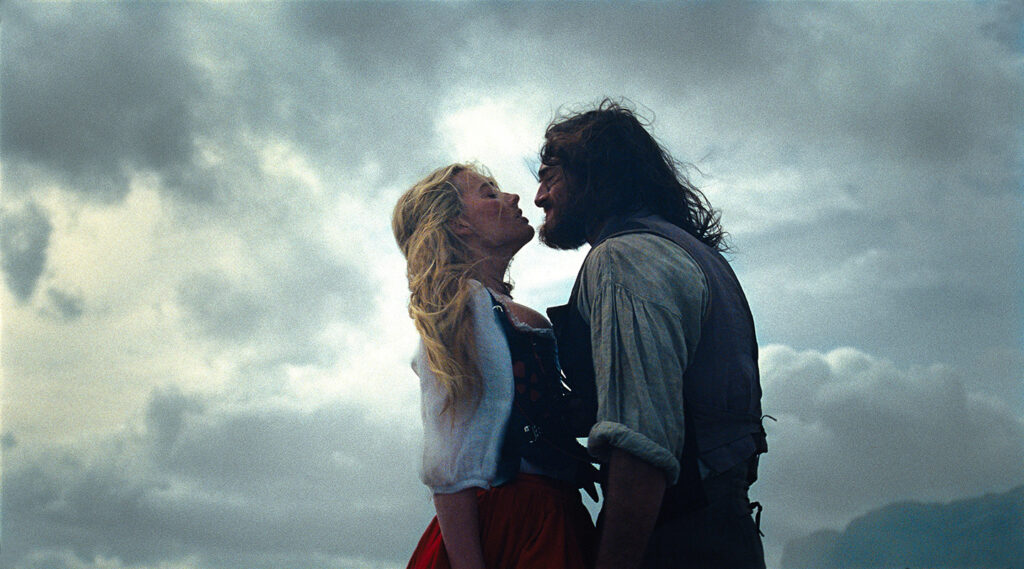
Wuthering Heights (15A) has been filmed over forty times. The latest version has Margot Robbie and Jacob Elordi as the star-crossed lovers, Cathy and Heathcliff.
“I am Heathcliff!” Cathy exclaims in one of the novel’s most famous lines. It indexed the commingling of their souls. Here, according to some critics, all we get is the commingling of bodies. They’re rubbishing the film as a bowdlerised adaptation, saying it’s more like Fifty Shades of Grey than a costume epic.
They’re half right. If you can put the sex to one side – a big ask considering there’s so much of it – Emerald Fennell’s film becomes an audio-visual extravaganza, a visceral Lady Chatterley’s Lover helmed by Stanley Kubrick.
We know the story. Our main interest, therefore, rests in how it’s told. Or should I say untold. Fennell strips Brontë’s text down to its essentials, giving us a bad marriage (Cathy and Edgar) begetting another bad one (Heathcliff and Isabella) as Heathcliff’s resentment of Cathy’s desertion of him for the posher Edgar festers into near-bestial demonstrations of bondage and sado-masochism with Isabella.
Everything is writ large with Fennell’s succulent textures: the expressions, the passions, the evocative Charli XCX soundtrack. An overheard early remark (“It would degrade me to marry Heathcliff!”) misses its follow-up (“I love him”) and sends him speeding across the moors in a blood-red sunset to his new life.
When he returns, he’s a man of means – beardless, more conniving, less rugged. Lawrentian assignations ensue. Emotions boil over in Fennell’s lush mansions and filthy hovels. Cathy’s Dickensian father (a brilliant Martin Clunes), who took Heathcliff in as a lad, decays.
Cathy breaks down. Her pregnancy becomes the stuff of melodrama. Fennell’s smorgasbord of secrets and lies reaches its nadir.
Despite being too old, at 36, for Cathy (she was just a teenager in the book), Robbie is the lynchpin of the film. In previous iterations, it was Heathcliff.
Laurence Olivier was too bland for him in 1939. So was Timothy Dalton in 1970. I had a grudging acceptance of Ian McShane in a 1967 TV version, if not Tom Hardy in a more recent one.
Ralph Fiennes portrayed him more as Brontë’s elemental force of nature in 1992. With Fennell’s post-modern memes, Elordi’s storm-tossed personality becomes compromised. At times, he seems more like the Terence Stamp of Far From the Madding Crowd than Brontë’s fearsome foundling.
Cork-born Alison Oliver conveys everything from fear to depravity as Isabella. Shazad Latif is a part-Pakistani Edgar. Hong Chau keeps us guessing about her manipulativeness as Nelly in Fennell’s stylised tableaus.
She directs with a painterly eye, providing a plethora of Bergmanesque chiaroscuros in her impressionistic symphony of desiccated lives. And, as Brontë put it in the book, “unquiet graves.”