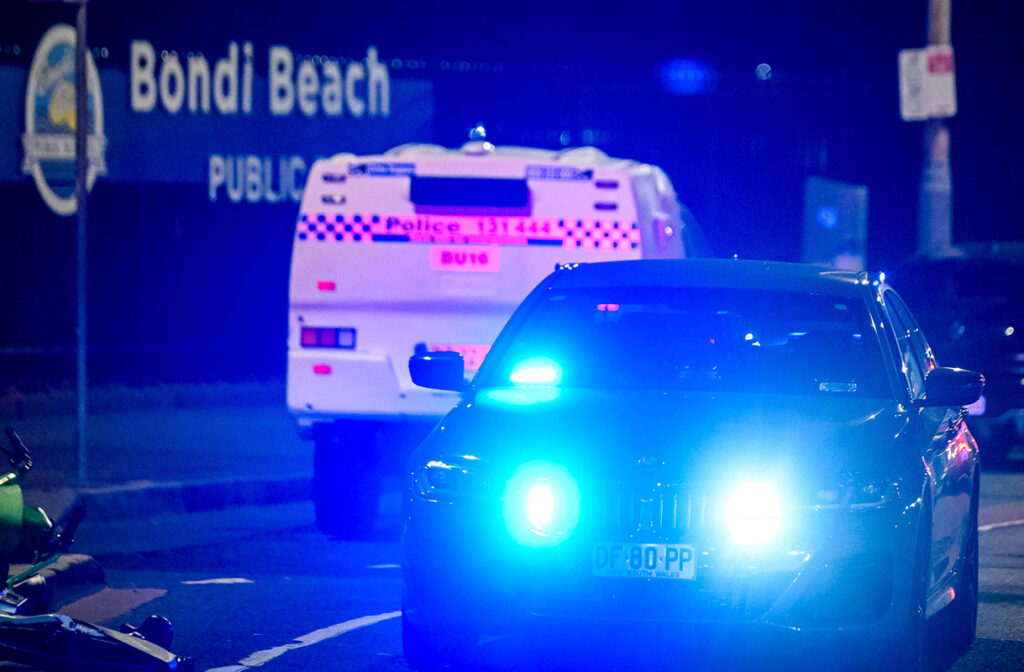
Listening to the news on Sunday about Jews murdered on Bondi Beach for being Jewish, one detail lingered. The newsreader reported that Israel’s president, Isaac Herzog, had condemned the attack, noting that it took place at a Jewish bar mitzvah.
Herzog.
The same name Dublin City Council recently sought to erase from a public park.
That decision was not a neutral administrative act. The name Herzog is not a political slogan or a provocation; it is a Jewish family name deeply associated with Ireland’s civic life, constitutional history, and public service. Yet DCC sought to remove it in pursuit of an ideologically driven gesture that quickly travelled beyond Dublin and became an international story.
History teaches us that the symbolic erasure of Jewish names and presence rarely remains symbolic. Those responsible may claim good intentions, but intentions do not determine consequences. Catholic moral teaching has long understood that actions must be judged not only by motive, but by their foreseeable effects on the dignity of others and the wider common good.
Do those involved ever consider how such gestures are read abroad — by extremists already convinced that Jewish identity can be erased with impunity? While Dublin was scrubbing a Jewish name from a park, others elsewhere were planning far more literal acts of erasure in Australia.
There has been little reflection or contrition from Dublin City Council or its allies on the radical left. Instead, there is a troubling tone-deafness to the way rhetoric and symbolism can give comfort, however unintentionally, to violent movements such as Hamas, backed and armed by Iran, whose objectives are not peace or justice but terror and annihilation of Jews.
Attention now needs to shift to Croke Park, where campaigners are demanding that the GAA “Drop Allianz”. Allianz plc, formerly Church and General Insurance of Ireland, is accused of complicity in Israel’s war because of alleged links within the wider Allianz Group.
This distinction matters. The GAA’s sponsor is Allianz plc, the Irish company — not Allianz Group globally. 700 Irish people and their families rely on their jobs in Allianz plc. The partnership is one of the longest commercial relationships in Irish business history, spanning more than 30 years and supporting both grassroots and central GAA activity.
To treat GAA funding as expendable collateral in an ideological campaign is to misunderstand its role in Irish society”
For the GAA, this is not merely a commercial arrangement. The Association is woven into parish life across Ireland. It sustains rural communities, supports youth development, reinforces social bonds, and for many parishes functions as one of the last remaining civic institutions holding communities together. To treat GAA funding as expendable collateral in an ideological campaign is to misunderstand its role in Irish society.
The catalyst for the campaign was a report published earlier this year by the UN Special Rapporteur on the Occupied Palestinian Territories, Francesca Albanese. Yet the report does not name Allianz plc or Allianz Ireland as investors in Israeli assets. Instead, it states that the rapporteur has a database of around 1,000 companies profiting from business in or with Israel, while explicitly naming about 45 — including Caterpillar, Microsoft, Google, Amazon, Axa, and PIMCO (a global Allianz Group subsidiary).
Given that breadth, the fixation on Allianz plc — an Irish operating company not named in the report — is difficult to justify. Why isolate the GAA and its sponsor, while ignoring countless others across sport, culture, and community life with comparable or greater global exposure?
Global holdings, not local decisions
Where the Albanese report does cite Allianz, it refers to Allianz Group globally, not Allianz plc, primarily through holdings by PIMCO in Israeli government bonds and shares in Elbit. These are global investment positions, common across international insurers and asset managers, and often embedded in pension funds relied upon by ordinary workers to fund their retirement.
Crucially, these are government treasury bonds, not “war bonds”. Every state uses such bonds to fund general expenditure — roads, schools, hospitals, and defence. While it is accurate that some state funds contribute to military activity, it is inaccurate to suggest these investments are illegal, unique, or covert.
Until September 2025, the prospectus for some Israeli bonds sold in the EU was approved by the Central Bank of Ireland. That approval has since moved to the Central Bank of Luxembourg, and the bonds remain legally available for investment across the EU. These are regulator-approved instruments operating within international financial norms.
The cost to parishes and communities
Much media coverage has repeated the campaigners’ narrative with little scrutiny. Allianz plc, like most companies named or implied in the Albanese report, has remained largely silent. The result is a debate stripped of context — and blind to consequences.
If Allianz plc is to be excluded from sponsoring the GAA because of indirect, global group investments, then consistency demands the same standard be applied everywhere: to other insurers and banks; to sponsors across rugby, soccer, racing, and the arts; to county boards and parish clubs whose sponsors may have similar supply-chain exposure.
The domino effect would be severe.
Ireland’s sponsorship market is estimated at close to €250 million. State spending on sport per capita is already below the EU average. Corporate funding is not optional; it is essential. According to the GAA’s Annual Report 2024, 82 cent of every euro generated is reinvested directly into clubs, schools, counties, and provinces. Independent analysis shows that every euro invested in Gaelic games returns between €2.30 and €3.96 in social value.
In Catholic social teaching, the principle of subsidiarity insists that decisions should be made at the most local level possible, and that higher-level political agendas should not undermine community institutions. Campaigns that threaten parish-based sport, youth engagement, and social cohesion violate that principle — while achieving no discernible impact on Israeli political or military decisions.
Where does it end?
Ireland has rightly spoken out for the dignity of Palestinian civilians and recognised Palestine as a state in the hope that a two-state solution might bring peace. That moral pressure must continue. But there are no EU sanctions against the Israeli state, and Israel remains integrated into the global economy.
In Ireland, as elsewhere, millions of people use goods and services with some Israeli connection — produce, mobile phone technology, investment flows, ownership structures. Drawing an arbitrary line around one Irish sponsor of the GAA is neither coherent nor just.
The deeper danger is this: in the pursuit of moral performance, we undermine institutions that sustain parish life, weaken the social fabric, and mistake symbolic destruction for ethical seriousness.
Ireland — and our social and community life — deserves better than politics that erase names, hollow out communities, and sacrifice the common good to ideological display.