Dr Mary McAleese’s Irish Times column recently argues [an argument that she has been making since at least 2018] that infant Baptism “denies babies their human rights” because it enrols them—without their consent—into lifelong Catholic membership with binding obligations and (in her view) a “no-exit policy.” She ridicules the language of “renewing baptismal promises” (since babies cannot promise anything), portrays Baptism as the Church’s primary “recruitment” mechanism, and frames the whole practice as incompatible with modern human-rights instruments such as the UDHR and the UN Convention on the Rights of the Child (UNCRC).
Catholics should read her carefully—because her piece trades on something real: the pain many people carry from coercive religious cultures, and the very modern suspicion that any inherited identity must be an imposition. But the argument she makes is ultimately a category mistake. And the moral posture it strikes—especially in today’s Ireland—invites a sharper question: whose rights are being defended, and at what cost?
Baptism is not a “contract.” It is a gift—and the child is not a captive
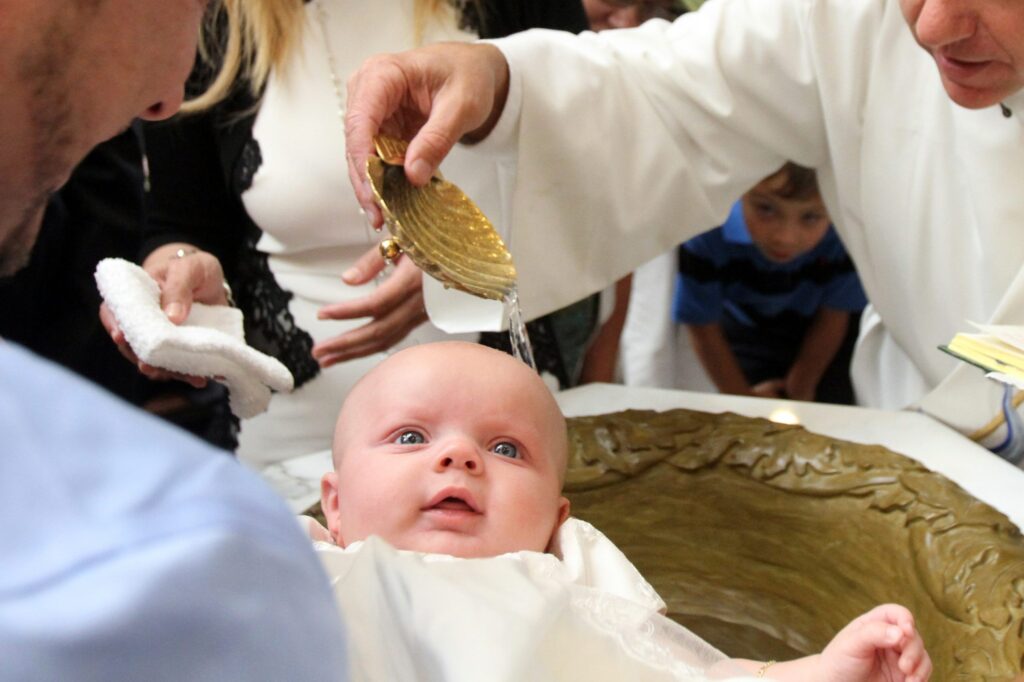
The Church teaches (and canon law reflects) that Baptism is “the gateway to the sacraments,” a saving gift that incorporates a person into Christ and His Church. That is not “recruitment” in the way a club recruits members; it is closer to what parents do when they give a child life, language, a surname, and a home. None of these are chosen by the baby. Yet no sane society calls them “human-rights violations.” They are the ordinary shape of love: adults taking responsibility for someone who cannot yet speak for herself or himself.
McAleese wants to treat Baptism as if it were primarily a juridical act—an administrative enrolment that locks the infant into an institution. But even on the Church’s own terms, the juridical aspect is secondary to the sacramental reality: grace is given, a spiritual seal is received, and a child is claimed for Christ. That is precisely why the Church has never understood Baptism as the kind of “consent-based transaction” McAleese demands. A baby cannot consent to life-saving medicine either; parents consent on the child’s behalf because the child’s good precedes the child’s choice.
“Children’s rights” language cuts both ways—especially in the UNCRC she appeals to
McAleese appeals to the UNCRC as if it were a charter against inherited religion. But the UNCRC repeatedly recognises that children exercise rights with the “direction and guidance” of parents, in keeping with the child’s “evolving capacities.” That is the key phrase she largely sidesteps: evolving capacities. The Convention does not imagine the newborn as an autonomous chooser floating free of family, tradition, or belief. It imagines a child growing into mature freedom—assisted, not abandoned, by parents who have duties as well as rights. And the UDHR itself explicitly affirms parental primacy in education: “Parents have a prior right to choose the kind of education that shall be given to their children.” So if we are going to speak the language of rights, we should speak it honestly: the Church’s practice of infant Baptism sits naturally inside a worldview where parents are expected to hand on what they believe is true and good—while gradually forming a child capable of freely embracing, refining, or rejecting it.
The “no-exit policy” claim is rhetorically powerful—and practically misleading.McAleese says canon law offers “no such right to change or exit religion,” and that even excommunication “leaves membership intact.” There is a sense in which that’s true: the Church believes Baptism leaves an indelible spiritual mark. But from the standpoint of human freedom in the real world, the claim is misleading. People leave the Church all the time—by conscience, by disbelief, by disgust, by indifference. The Church may lament that departure; she may say it wounds the person and the community. But she cannot physically compel belief, worship, or interior assent. And the Vatican has recently underlined something important that directly answers McAleese’s “life membership” framing: a baptismal register is not a membership roll certifying a person’s current beliefs; it records a historical fact (that a Baptism occurred). The note explicitly adds that such records “do not in any way limit the free will” of the faithful who choose to leave.
So yes: the Church believes something objective happened in Baptism. But no: she does not thereby abolish the grown person’s agency.
“Baptismal promises” aren’t a trick—they’re an adult responsibility
McAleese mocks “baptismal promises” because babies cannot make them. But in Catholic practice, the promises are made by adults—parents and godparents—who pledge to raise the child in faith. That is not “risible”; it is morally serious. What happens later is also crucial: the Church expects the maturing person to own the faith personally. In Confirmation, for example, Catholics do precisely what McAleese claims is impossible: they publicly ratify, as a conscious act, the faith first received as a gift. If Catholics have sometimes treated Confirmation as “graduation” or a social rite, that is a pastoral failure—not an argument against infant Baptism.
The corporal punishment aside illustrates the problem: polemic by insinuation
McAleese also claims that “despite sharp criticism” the Catechism “still encourages the use of corporal punishment.” The Catechism’s text on parenting emphasises tenderness, forgiveness, respect, and the formation of true freedom, while quoting a scriptural line about not “sparing the rod” in the course of discussing discipline. Reasonable people can debate how to interpret such biblical idioms, but presenting the Catechism as if it straightforwardly “encourages corporal punishment” is, at best, a tendentious reading. It’s emblematic of the wider argument: take the harshest possible interpretation, then prosecute the Church for the caricature.
A note on moral seriousness in Ireland: it is hard to scold the Church about “babies’ rights” while backing abortion liberalisation
Now we come to the point many ordinary Catholics will feel but hesitate to say aloud. Mary McAleese publicly said she voted Yes in Ireland’s 2018 abortion referendum and rejected the suggestion that such voters should go to confession. Ireland’s current law permits abortion on request up to 12 weeks, with later access in specified circumstances.
Whatever one’s view of that referendum, it is at least striking—indeed, jarring—to watch a prominent public figure appeal to “babies’ human rights” against Baptism, while supporting a legal regime under which the most fundamental right of the unborn child, the right to live, is explicitly unprotected in early pregnancy. If the charge is “no consent,” then we should be clear-eyed: abortion is not performed with the baby’s consent either—yet it ends the baby’s life. Baptism does not harm the child’s body; it proposes a destiny, offers grace, and situates the child in a community of faith. The comparison is not flattering to McAleese’s moral framing.
McAleese’s thesis rests on a modern assumption: that identity must be chosen to be valid, and that inheritance is oppression. Catholicism rests on an older and, frankly, more humane vision: that love gives before it is asked, that families hand on what they have received, and that freedom matures inside commitment—not outside it. Infant Baptism does not deny a child’s rights. It is an act of hope on the child’s behalf.
If Ireland wants to talk about “babies’ human rights,” let’s do so with moral seriousness and intellectual honesty. And let us not pretend that the Church’s pouring of water over a child’s head is the scandal—when our culture has grown accustomed to far graver violations, performed in cleaner rooms, with kinder language, and with the same conspicuous absence of consent.