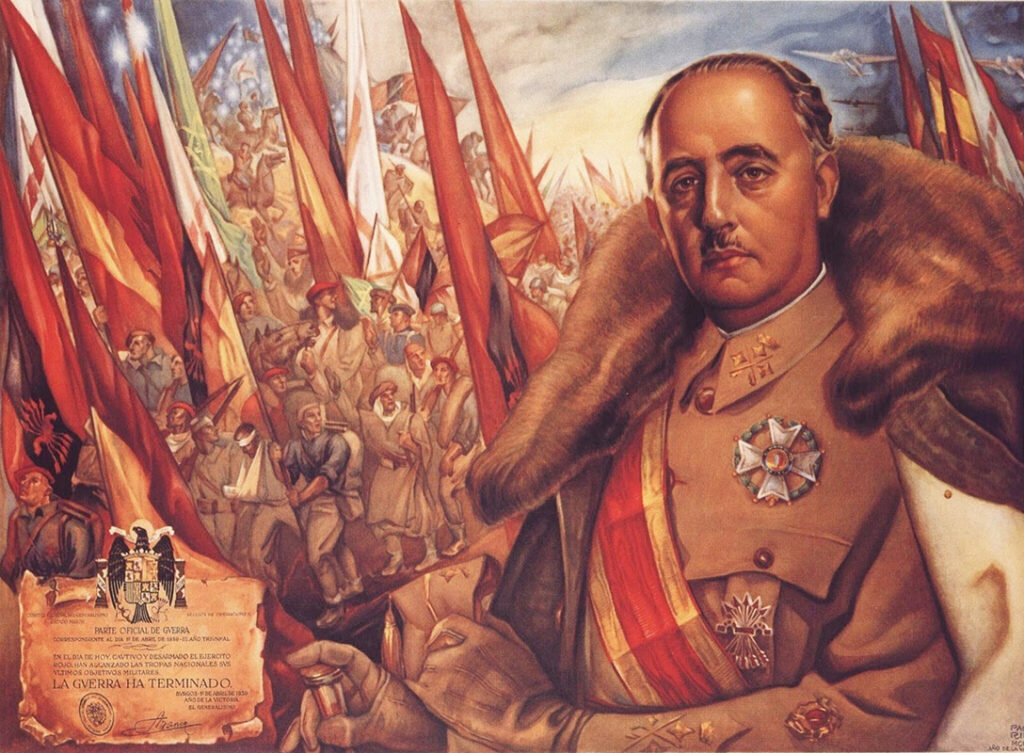
El Generalísimo Franco: Power, Violence and the Quest for Greatness,
by Giles Tremlett
(Bloomsbury, £30 / €35.00)
Giles Tremlett, who lives in Spain, has a deep understanding of that country’s past. He is the author of a remarkable account of the International Brigades in the Spanish Civil War. Here, however, moving on in time, he attempts to tell the events in the long life of Francisco Franco, as well as analyse the thoughts that lay behind his policies. This is difficult, because Franco is an elusive personality, who, despite his eminence, “kept himself to himself.”
Two European fascist leaders died in bed, rather than by violence. They were contemporaries, determined to control every aspect of life in their respective countries and both left societies that changed very rapidly after their deaths.
Antonio Salazar (1889-1970) and Francisco Franco (1898-1975) thought that they had preserved what they regarded as the traditions of Portugal and Spain.
The difference was that Salazar, who committed himself to the preservation of his country’s vast colonial empire, developed no cult of personality, had no interest in enriching his family, and was sincerely religious. Franco was short in stature, increasingly rotund and had a high voice, with a strong Galician accent. Unimpressive in appearance, he became the most powerful ruler in Spanish history.
Atmosphere
The Spanish-American War in 1898 – El Desastre del ‘98 – saw Spain lose the Philippines, Cuba and Puerto Rico, foreclosing on its empire save for some African enclaves, including part of Morocco. That too was the year when Franco was born, to an unhappily married couple, in El Ferrol, a small town in north-western Spain.
He grew up in a country where liberals and conservatives alternated in power, so sharing the spoils of state, and where too much authority was vested in the vain and limited Alfonso XIII, who had become king at his birth in 1886. There was appalling poverty and very little education in the countryside, social unrest in the developing cities and constant public debate about the future of the country.
Young Francisco Franco flourished. He was a successful military cadet and an even more successful army officer”
The Church was a conservative force in society, though most of the bishops came from very humble backgrounds. Priests and religious tried to educate the people and ameliorate their misery, but their efforts were hampered by very scarce resources.
In this atmosphere, young Francisco Franco flourished. He was a successful military cadet and an even more successful army officer, who fought a bloody campaign to retain Spain’s share of Morocco.
Franco was already well known and was regarded as lucky in most of his undertakings, including marriage. Carmen Polo was Franco’s only girlfriend. It was thought that she was marrying “beneath” her when they married in 1923. They had one daughter and, later, seven grandchildren.
War
His luck held when the Spanish Army rose in July 1936 against the socialist Second Republic, which had come into existence with the flight to Rome of Alphonso XIII in 1931. Generals who might have rivalled him died or were sidelined. German and Italian military assistance was invaluable.
The victorious Allies tried to isolate Spain, in the hope that people would rise in rebellion against Franco”
The anarchist murders of priests (about 7,000 and an uncounted number of laity) and destruction of church buildings in the Republican zone, ensured international Catholic support for the rebels. The Spanish Church declared that Nationalist rebellion was a Crusade.
When the Civil War ended in early April 1939, Franco was in complete control of a ruined and divided country. This might have been a time for reconciliation, but internal “enemies” were arrested, hundreds of thousands were imprisoned, and perhaps as many as 20,000 were executed.
Franco hoped that the Axis would win WWII, though his encounters with Hitler and Mussolini were unsatisfactory. By 1943, he saw that the Allies were prevailing and began to emphasise Spain’s neutrality.
Meanwhile, the Church became a close ally of the State, which promoted an ideology of National Catholicism. Spain was called “the spiritual reservoir of Europe.”
In 1946, the victorious Allies tried to isolate Spain, in the hope that people would rise in rebellion against Franco. The resulting poverty and hunger were appalling, but the government’s control was reinforced. As the Cold War intensified, American air bases were built, ports were opened to the American navy; isolation ended after 1953.
Power
Franco was prepared to change course, though claiming nothing had really changed. The monarchy was restored, but without an actual monarch as head of state. Franco behaved like a monarch, but he had no intention of founding a dynasty. Only one political party, the Movement, was permitted. Lay members of Opus Dei were very effective government ministers. Elected parliaments did as they were told. Censorship was very strict until the 1960s, when tourism became Spain’s major industry.
A Concordat had given Franco the power to appoint Catholic bishops, so it was with amazement, and to his growing anger, that his policies were criticised by priests and prelates, in the era of Pope John XXIII and the Second Vatican Council.
In the final decade of his life, with failing health, Franco clung to power”
It began when Cardinal Pla y Deniel, the Cardinal Primate of Toledo, expressed anger at the pressures put on Catholic workers by fascist groups. The Cardinal, a Catalan, came from a very rich family, unusual in the Spanish hierarchy. Once it became public, disagreement never stopped. Pope Paul VI later ensured that Catholicism ceased to be the State Church in Spain.
In the final decade of his life, with failing health, Franco clung to power. He hoped that Admiral Luis Carrero Blanco, as prime minister, would ensure continuity. On December 20, 1973, the prime minister was assassinated as he came out of morning Mass at the Jesuit church in Madrid. His death ended all hope of continuity, which made the transition to a constitutional monarchy under Juan Carlos much easier in 1975.
Tremlett is a superb writer, with a deep knowledge of printed sources. His biography is a summary of all contemporary research on Franco, who had widespread support as well as fervent opposition. Yet the man himself remains elusive.
Subsequent governments, particularly those of the Left, have tried to eradicate his legacy by changing the names of streets, by removing monuments, and even by having his family remove Franco’s body from the Valley of the Fallen to a family grave in Madrid.
What Spain now needs is not more polemics, but a shared and calm evaluation of Francisco Franco and his four decades of rule