Genesis 12:1-4; Psalm 33 (32); 2 Timothy 1:8-10; Matthew 17:1-9
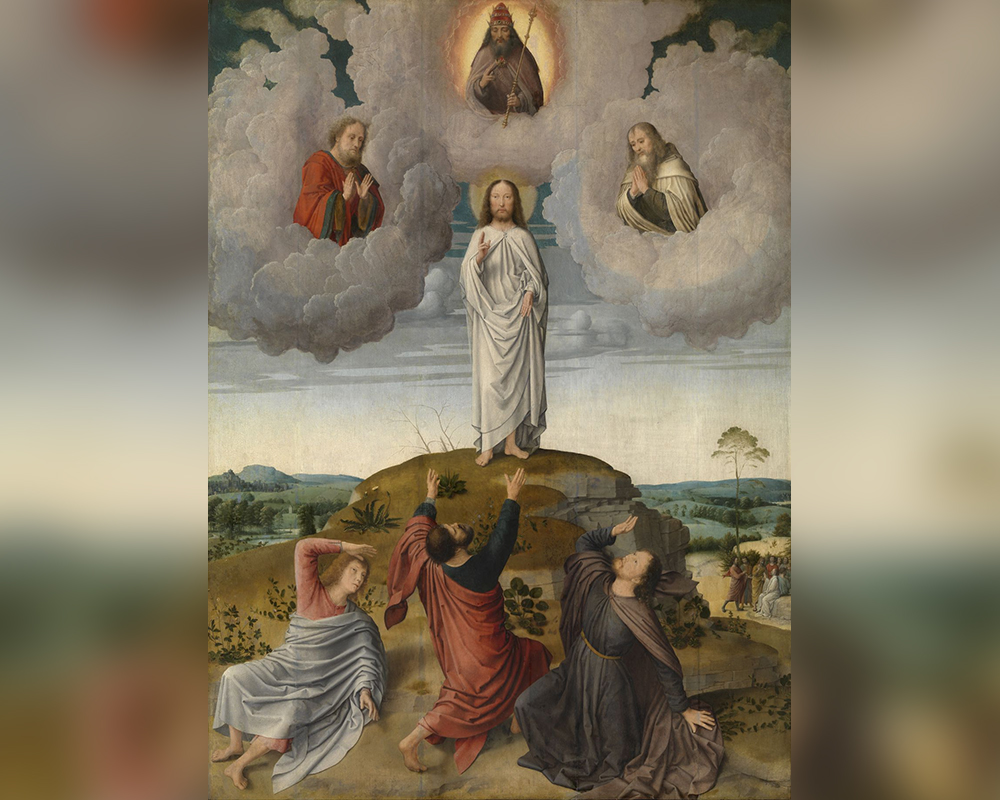
Matt 17:1 Six days later, Jesus took with him Peter and James and his brother John and led them up a high mountain, by themselves.
Matt 17:2 And he was transfigured before them, and his face shone like the sun, and his clothes became dazzling white.
Matt 17:3 Suddenly there appeared to them Moses and Elijah, talking with him.
Matt 17:4 Then Peter said to Jesus, “Lord, it is good for us to be here; if you wish, I will make three dwellings here, one for you, one for Moses, and one for Elijah.”
Matt 17:5 While he was still speaking, suddenly a bright cloud overshadowed them, and from the cloud a voice said, “This is my Son, the Beloved; with him I am well pleased; listen to him!”
Matt 17:6 When the disciples heard this, they fell to the ground and were overcome by fear.
Matt 17:7 But Jesus came and touched them, saying, “Get up and do not be afraid.”
Matt 17:8 And when they looked up, they saw no one except Jesus himself alone.
Matt 17:9 As they were coming down the mountain, Jesus ordered them, “Tell no one about the vision until after the Son of Man has been raised from the dead.”
Initial observations
The account of the Transfiguration can be found in Mark 9:2-8, Luke 9:28-36 and here in Matthew. It is also mentioned in 2 Peter 1:16-18. The Transfiguration account recalls the Baptism of Jesus and, in a way, looks forward to the prayer in Gethsemane. In this Gospel, Peter has just made a profound confession of faith (16:16) and so, he is “on the right track.” Nevertheless, the place of suffering in the identity of Jesus as Messiah still continues to elude him. The continuation of the story in vv. 10-23 is essential for our appreciation of what Matthew is trying to teach here.
Kind of writing
This is an “epiphany”, an appearance or revelation of a divine person. Matthew, Mark and Luke tell the same basic story, which is one of transformation in prayer, a mystical moment, in which some of the disciples are involved. It bridges the time between the Baptism and the Resurrection.
After that basic account, each writer shapes the story for his own particular goals. In Mark, it is to encourage the disciples on the way of the Cross. In Luke, it is a moment of prayer, marking the departure of Moses and Elijah.
Our Gospel, Matthew, invests the story with apocalyptic language (transfigured, face shone like the sun, dazzling white, touched), thus letting the reader know that Jesus is of ultimate significance in God’s plan for human history and so also for us.
Matthew recounts the Transfiguration as an apocalyptic vision, one of those “moments” of transcendence and transformation, never to be forgotten. The concentric pattern tells us that the centre is v. 5, that the divine voice is given a central role.
- Narrative introduction (v. 1)
- Jesus is transfigured (vv. 2-3)
- Peter’s response (v. 4)
- The divine voice (v. 5)
c*. The disciples’ response (v. 6)
b*. Jesus speaks (v. 7)
a*. Narrative conclusion (v. 8)
- Postlude (v. 9)
Old Testament background
There are four Old Testament texts to keep in mind. Deuteronomy 18:15 promises a prophet like Moses at the end. Malachi 4:5 predicts that Elijah will have a role ushering in the end of time. Most important are the passages from Exodus and the prophet Daniel.
- Then Moses went up on the mountain, and the cloud covered the mountain. The glory of the Lord settled on Mount Sinai, and the cloud covered it for six days; on the seventh day he called to Moses out of the cloud. Now the appearance of the glory of the Lord was like a devouring fire on the top of the mountain in the sight of the people of Israel. Moses entered the cloud, and went up on the mountain. Moses was on the mountain for forty days and forty nights. (Exodus 24:15–18)
- Moses came down from Mount Sinai. As he came down from the mountain with the two tablets of the covenant in his hand, Moses did not know that the skin of his face shone because he had been talking with God. When Aaron and all the Israelites saw Moses, the skin of his face was shining, and they were afraid to come near him. (Exodus 34:29–30)
iii. So he came near where I stood; and when he came, I became frightened and fell prostrate. But he said to me, “Understand, O mortal, that the vision is for the time of the end.” As he was speaking to me, I fell into a trance, face to the ground; then he touched me and set me on my feet. (Daniel 8:17–18)
- I, Daniel, alone saw the vision; the people who were with me did not see the vision, though a great trembling fell upon them, and they fled and hid themselves. So I was left alone to see this great vision. My strength left me, and my complexion grew deathly pale, and I retained no strength. Then I heard the sound of his words; and when I heard the sound of his words, I fell into a trance, face to the ground. But then a hand touched me and roused me to my hands and knees. (Daniel 10:7–10)
New Testament foreground
This story echoes in the ministry the Baptism of Jesus and marks some kind of appropriation of what happened then. The Resurrection is in our minds as well, because of the dazzling white garments and the explicit mention at the end. Also, Matthew wrote for a Jewish-Christian community and portrays Jesus as a Moses-type figure (in this Gospel, John the Baptist is identified as the latter-day Elijah). Jesus has just been talking about his death and Peter has quite spontaneously rejected the cross.
St Paul
It is necessary to boast; nothing is to be gained by it, but I will go on to visions and revelations of the Lord. I know a person in Christ who fourteen years ago was caught up to the third heaven—whether in the body or out of the body I do not know; God knows. And I know that such a person was caught up into Paradise and heard things that are not to be told, that no mortal is permitted to repeat. On behalf of such a one I will boast, but on my own behalf I will not boast, except of my weaknesses. But if I wish to boast, I will not be a fool, for I will be speaking the truth. But I refrain from it, so that no one may think better of me than what is seen in me or heard from me, even considering the exceptional character of the revelations. (2 Corinthians 12:1–7)
Brief commentary
Verse 1 The number “six” comes from Exodus account above; Peter, James and John feature together in the Gospels (call, Transfiguration, discipleship dispute, Gethsemane). No purpose is given for the journey (unlike in Luke). The mountain is the symbolic place of encounter with God, especially in the Mosaic traditions.
Verse 2 “Transfigured”: this is difficult to interpret – some kind of glimpse of the future, Risen Lord. “Like the sun”: cf. Rev 1:16 and Mt 13:43. “Dazzling white”: see Mt 28:3. These symbolic details tell us Jesus entered the transcendent world of God. And all of us, with unveiled faces, seeing the glory of the Lord as though reflected in a mirror, are being transformed into the same image from one degree of glory to another; for this comes from the Lord, the Spirit. (2 Cor 3:18)
Verse 3 Moses and Elijah represent the Law and the Prophets, and thus are symbolic of continuity and fulfilment. In Jewish tradition, the end of time was to be marked by their return.
Verse 4 Jesus is called “Lord” not “rabbi” as in Mark, because Peter believes. The experience is wonderful and Peter wishes to hold on to it. “Tents” hints at the feast of Succoth / Tabernacles. Peter apparently thinks the figures are equal, a misunderstanding corrected in 5.
Verse 5 Bright cloud: a kind of oxymoron, expressing mystery and transcendence (that is, God is present). The words are identical to the Baptism (Matthew 3:17), with the addition “Listen to him!”. They hint at other OT resonances: Messiah (Psalm 2:7), beloved son (Isaac, Genesis 22:2) and the Suffering Servant (Isaiah 42:1; 44:2).
Verse 6 Not psychological fear, but existential dread or awe before the mystery.
Verse 7 Everybody who is anybody in the Bible is told not to be afraid! Jesus touches them — a detail only in Matthew and reminding us of Daniel’s visions.
Verse 8 Suddenly, the experience is over. The real, lasting glory of Jesus follows on the cross and Resurrection.
Verse 9 Matthew alone calls it a “vision”. This verse makes the important connection with the Resurrection.
Pointers for prayer
- The transfiguration experience was one that, for Jesus, clarified his relationship with his Father and strengthened him for the future. What have been the experiences, the moments of insight, that have clarified your sense of who you are, and what is your relationship with God?
- On the mountain the disciples saw Jesus in a new way. Sometimes in friendship there are moments of sharing in which we get to know a friend in a new and deeper way. Have you had that experience in human friendship, or in your relationship with Jesus and God. Recall when that happened, and what it was like for you.
- The clear vision of Jesus with Moses and Elijah was followed by a frightening experience of being in a cloud and it was in the midst of the cloud that the disciples were instructed “This is my Son, my Chosen; listen to him”. Have you had the experience of learning the truth about life and about your relationship with God from moments of confusion as well as from times of special joy?
- After their special experience the disciples came down the mountain again. We cannot live each day at the level of special spiritual experiences, but the memory of them can strengthen us in difficult times. What memories encourage you in time of trouble??
Prayer
Holy God, from the dazzling cloud you revealed Jesus in glory as your beloved Son.During these forty days, enlighten your Church with the bright glory of your presence.
Inspire us by your word, and so transform us into the image of the risen Lord, who lives and reigns with you in the unity of the Holy Spirit, holy and mighty God for ever and ever. Amen.
Thought for the day
Every so often, we catch a glimpse of the “something more” that God has in store for us. These fleeting experiences are to be treasured: the birth of my first child, falling in love, a sense of “being held” by God’s presence. Such experiences may help us approach the Transfiguration. Like all transcendent experiences, it is fleeting and yet it etches a memory and leaves a longing. What should we do? Practice listening to him. Be not afraid. We cannot always be “on the mountain” and yet what happens on the heights can help us on the lowlands of the everyday.
Prayer
Lord, listening sounds so easy and yet is such hard work! Guide us as we listen to your Son, whose word is alive, who is himself the way, the truth and the life.
Jesus brought life and immortality to light through the gospel!
Tim 1:3 I am thankful to God, whom I have served with a clear conscience as my ancestors did, when I remember you in my prayers as I do constantly night and day.
2 Tim 1:4 As I remember your tears, I long to see you, so that I may be filled with joy.
2 Tim 1:5 I recall your sincere faith that was alive first in your grandmother Lois and in your mother Eunice, and I am sure is in you.
2 Tim 1:6 Because of this I remind you to rekindle God’s gift that you possess through the laying on of my hands.
2 Tim 1:7 For God did not give us a Spirit of fear but of power and love and self-control.
2 Tim 1:8 So do not be ashamed of the testimony about our Lord or of me, a prisoner for his sake, but by God’s power accept your share of suffering for the gospel.
2 Tim 1:9 He is the one who saved us and called us with a holy calling, not based on our works but on his own purpose and grace, granted to us in Christ Jesus before time began,
2 Tim 1:10 but now made visible through the appearing (epiphaneia) of our Saviour Christ Jesus. He has broken the power of death and brought life and immortality to light through the gospel!
Initial observations
Our reading from 2 Timothy is chosen for three reasons: (i) the word appearing (epiphaneia) makes a link with the Transfiguration; (ii) suffering reminds us of Lent and the passion of Jesus; (iii) the resurrection is richly proclaimed.
Kind of writing
Like 1 Timothy, 2 Timothy is most likely written in the name of Paul to a later, probably third, generation of believers. Within the letter, Paul is portrayed as an old man in prison and the letter is in the genre of the last will and testament, a genre of writing familiar from the period. Compare: Genesis 49 (Jacob); Deuteronomy 31 (Moses); Joshua 24 (Joshua), John 14-16 (Jesus); Acts 20:18-38 (Paul).
Our reading is the central section of the thanksgiving. Vv. 9-10 are in poetic, balanced, antithetical form.
Origin of the reading
The issue behind 2 Timothy is a frequent one in intentional communities: how to manage after the departure of the founder/mentor/genius. Accordingly, the letter has a valedictory tone. At the same time, there is a message of consolidation for the present moment.
Related passages
Share in suffering like a good soldier of Christ Jesus. No one serving in the army gets entangled in everyday affairs; the soldier’s aim is to please the enlisting officer. And in the case of an athlete, no one is crowned without competing according to the rules. It is the farmer who does the work who ought to have the first share of the crops. (2 Tim 2:3–6)
I solemnly charge you before God and Christ Jesus, who is going to judge the living and the dead, and by his appearing (epiphaneia) and his kingdom: Preach the message, be ready whether it is convenient or not, reprove, rebuke, exhort with complete patience and instruction. (2 Tim 4:1–2)
Finally the crown of righteousness is reserved for me. The Lord, the righteous Judge, will award it to me in that day—and not to me only, but also to all who have set their affection on his appearing (epiphaneia). (2 Tim 4:8)
The lofty–minded youth, a true son of Abraham, did not groan, but as though transformed in the fire into immortality, he nobly endured the torments. (4 9:21–22)
Victory meant incorruptibility in long–lasting life. (4 Macc 17:12)
Brief commentary
Verse 8 The rekindling of charism takes in the capacity to suffer for the Gospel, after the example of Paul. Only here in the Pastorals is Paul called a prisoner (cf. Eph 3:1; 4:1; Phlm 1, 9). “To suffer with” is distinctive of 2 Timothy. See 2 Tim 2:3, 11-12. Conflict with the culture is to be expected, if the proclamation is genuine. “Not to be ashamed” reminds us that the cross was of course shameful and scandalous.
Verse 9 The next two verses offer a rich summary of the Gospel proclamation. God, in the Pastorals, offers to all of humanity the gift of salvation. See 1 Tim 2:4, 6:12. Those who believe are called by God’s election, echoing the prophetic calls of old. The Pastorals often urge the readers to do good works, with many practical examples. Nevertheless, such effort is not the source of salvation but rather a living out of the grace already received. It is all God’s work, as his purpose and grace are disclosed (2 Cor 5:18). All of this has a cosmic dimension, being prepared before time began. Owing everything to God’s grace/favour is very strong in the Pastorals as a whole: 1 Tim 1:2, 12, 14; 6:21; 2 Tim 1:2-3, 9; 2:1; 4:22; Titus 1:4; 2:11; 3:7, 15.
Verse 10 Made visible is a good translation, because the appearance points to the historical Jesus’ mission. Thus, while the emphasis in the pastorals is on Jesus’ saving death and resurrection, the incarnation and ministry are not overlooked. In plain language, Jesus has broken the power of death. Cf. the Pauline teaching in 1 Cor 15:26 and 54. Life here is really life in the new creation at the end of time, that is eschatological life. The writer adds the expression “immortality” (lit. imperishability) which is not a Hebrew concept but one taken from the surrounding culture. But see Wis 2:23, 6:19 and 4 Macc 9:22 and 17:12 (these latter two cited above for convenience). This offer of salvation is made to all through the proclamation of the Good News.
Pointers for prayer
- Any generation could feel ashamed of the Gospel — perhaps today a special risk. When have I borne witness?
- Our riches in Christ: what does it mean to me to be saved and called through the Gospel?
- The sense of grace and gift is strong here. Recall your own sense of being favoured and unexpectedly graced.
Prayer
As we remember in these days the great events that gave us new life in Christ, renew of faith in him, who broke the power of death and brought us life and immortality. He lives for ever and ever!
I will make of you a great nation, and I will bless you, and make your name great, so that you will be a blessing.
Gen 11:27 Now these are the descendants of Terah. Terah was the father of Abram, Nahor, and Haran; and Haran was the father of Lot.
Gen 11:28 Haran died before his father Terah in the land of his birth, in Ur of the Chaldeans.
Gen 11:29 Abram and Nahor took wives; the name of Abram’s wife was Sarai, and the name of Nahor’s wife was Milcah. She was the daughter of Haran, the father of Milcah and Iscah.
Gen 11:30 Now Sarai was barren; she had no child.
Gen 11:31 Terah took his son Abram and his grandson Lot son of Haran, and his daughter-in-law Sarai, his son Abram’s wife, and they went out together from Ur of the Chaldeans to go into the land of Canaan; but when they came to Haran, they settled there.
Gen 11:32 The days of Terah were two hundred five years; and Terah died in Haran.
Gen 12:1 Now the Lord said to Abram, “Go from your country and your kindred and your father’s house to the land that I will show you.
Gen 12:2 I will make of you a great nation, and I will bless you, and make your name great, so that you will be a blessing.
Gen 12:3 I will bless those who bless you, and the one who curses you I will curse; and in you all the families of the earth shall be blessed.”
Gen 12:4 So Abram went, as the Lord had told him; and Lot went with him. Abram was seventy-five years old when he departed from Haran.
Initial observations
As noted last week, in Lent we have a large story arc from Adam to the Exile; this Sunday introduces the truly foundational figure of Abraham. The excerpt in the lectionary is necessarily brief and the full context of before and after is given above for ease of understanding.
Kind of writing
Gen 11:27-30 form the introduction to the whole Abraham cycle. The telling is highly compressed—135 years, no less!—so what is selected is important: Sarai is barren. As a result what follows is a totally unexpected new beginning, the call of Abraham.
Genesis 12:1-9 is the beginning a journey. This is one of the most common plots in traditional heroic literature. What is characteristic of this journey is the initial situation, full of uncertainties. Abram’s goal remains largely in the dark and he will have to discover it little by little.
Origin of the reading
The book of Genesis divides into four great cycles: Gen 1-11, the primeval history; Gen 12-25, the Abraham cycle; Gen 25-36, the Jacob cycle and Gen 37-50, the Joseph cycle (there is no Isaac cycle).
In Rabbinic tradition, the departure of Abraham is the first of ten testings of Abraham (the tenth is the sacrifice of Isaac).
The Abraham cycle is prolix (almost prodigal!) in the repeated offering of blessings. Our story is the first of seven promises / bestowals of blessing.
Related passages
Outside of Genesis, Abraham is rarely mentioned without the full troika of Abraham, Isaac and Jacob.
Then Joshua gathered all the tribes of Israel to Shechem, and summoned the elders, the heads, the judges, and the officers of Israel; and they presented themselves before God. And Joshua said to all the people, “Thus says the Lord, the God of Israel: Long ago your ancestors—Terah and his sons Abraham and Nahor—lived beyond the Euphrates and served other gods. Then I took your father Abraham from beyond the River and led him through all the land of Canaan and made his offspring many. I gave him Isaac; and to Isaac I gave Jacob and Esau. I gave Esau the hill country of Seir to possess, but Jacob and his children went down to Egypt. (Josh 24:1–4)
Wisdom also, when the nations in wicked agreement had been put to confusion, recognised the righteous man and preserved him blameless before God, and kept him strong in the face of his compassion for his child. (Wis 10:5)
Brief commentary
Verse 1 There is no preparation for this in-breaking of the Lord’s voice. Rabbinic tradition notices threefold command: country, kindred and house. In the tenth testing there is also a threefold, impossibly poignant comment (Gen 22:2). The link to the sacrifice of Isaac is confirmed in an unusual imperative: lek leka, which returns in that later verse: He said, “Take your son, your only son Isaac, whom you love, and go (lek leka) to the land of Moriah, (Gen 22:2).
Verses 2-3 The seven-fold blessing starts here. What does it mean to say “shall be blessed”? In Hebrew, the verb could be passive (as in the NSRV) or reflexive, “shall bless themselves.” The reflexive is closer to Jewish piety: may we be as blessed was Abraham.
Verse 4 Abraham’s obedience is profiled by omitting all personal, psychological and practical consequences.
Seventy-five seems old to us but not in the Bible: Abraham lives until the exceedingly ripe old age of one hundred and seventy-five. There’s a bit to go yet! He has his first child at one hundred.
Pointers for prayer
- Inevitably, the reading takes us to our own journey of faith, the call to trust and capacity to set out without knowing the goal. How has that been for me? What events in my life have been affected by it?
- The leaving of family—a common theme in Genesis—is known to us all. It involves both the pain of parting and the joy of embracing my own journey and identity. Again, how has that been for me in the course of my life?
Prayer (Camino de Santiago)
O God, who brought your servant Abraham out of the land of the Chaldeans, protecting him in his wanderings, who guided the Hebrew people across the desert, we ask that you watch over us, your servants, as we walk in the love of your name to Santiago de Compostela.
Be for us our companion on the walk, our guide at the crossroads, our breath in our weariness, our protection in danger, our albergue on the Camino, our shade in the heat, our light in the darkness, our consolation in our discouragements, and our strength in our intentions.
So that with your guidance we may arrive safe and sound at the end of the Road and enriched with grace and virtue we return safely to our homes filled with joy.
The Liturgy
Themes across the readings
In Jewish and Christian tradition, Abraham is “our father in faith.” His trust is extraordinary and, in the true sense, radical. No other ancient biblical figure combines in equal measure so many testings and so many blessings.
In Latin (and in Greek), to obey is based on the verb to hear, ob-audire. The central teaching of Matthew’s version of the Transfiguration is the voice: ‘This is my Son, the Beloved; he enjoys my favour. Listen to him.‘ How to practice this deep listening and obedience from the heart is our challenge. In the language of our time, we would speak of discernment, conversion and discipleship.
In some way bridging these two readings, the passage from 2 Timothy invites us, like Abraham, to rely on the power of God who has saved us and called us to be holy.
Lent, too, is a pilgrimage of faith, the Christian life in miniature, as we move from conversion (Lent 1) and faith (Lent 2) to the celebration of the great events which give us new life in Christ. In the words of 2 Timothy, this grace [has] already been granted to us, in Christ Jesus.
The responsorial Psalm
In effect, Psalm 30 (31) places us in the situation of Abraham, our father in faith. The response captures it all: May your love be upon us, O Lord, as we place all our hope in you.
Sunday introductions
First reading
Genesis 12:1-4
For both Jews and Christians, Abraham is the father in faith. You can see why from this startling reading.
Second reading
2 Timothy 1:8-10
The call and gift of faith are unexpected and unpredictable. This short reading reminds us that it is all God’s initiative and work. We really are graced.
Gospel
Matthew 17:1-9
The Transfiguration is traditional on the second Sunday of Lent. At the heart of Matthew’s version stands a great invitation, as powerful today as never before: ‘This is my Son, the Beloved; he enjoys my favour. Listen to him.’
Weekday introductions
Monday 2 March
Daniel 9:4-10
Daniel prays a great prayer which we could make our own today. The Psalm takes up the same theme of forgiveness.
Luke 6:36-38
Pardon is free from God — but it is truly “ours” only when we pardon in return.
Tuesday 3 March
Isaiah 1:10, 16-20
Following an opening command to wash and make ourselves clean, no fewer than seven imperatives help us to think practically of changes in our lives.
Matthew 23:1-12
Matthew is aware that religious leaders can “lose the run of themselves,”. This is true in our Gospel of the Pharisees, but the Gospel goes on to issue a warning also to Christian leaders: they are not to be called rabbi or father or teacher. Why is that the case?
Wednesday 4 March
St Casimir, patron saint of Poland
Jeremiah 18:18-20
Jeremiah, an unwilling prophet, had a tough time fulfilling his ministry, with many threats and even landing in jail. His story anticipates the passion of Jesus.
Matthew 20:17-28
The sons of Zebedee have overstepped the mark, but it’s a bit rich of the others to be indignant because they are really no different. Christian leadership simply must be service and nothing else.
Thursday 5 March
St Kieran, bishop
Jeremiah 17:5-10
As often in the Bible, a choice is placed before us. As the last paragraph is aware, the human heart can be (very!) perverse.
Luke 16:19-31
The story of the rich man (Dives in Latin) and the poor man, Lazarus, is unique to this Gospel. The point is pretty clear and it would be hard to miss the message. The exploration of the parable in the last paragraph, however, is larded with irony…are we among those who would not be convinced even if someone (who?) should rise from the dead?
Friday 6 March
Genesis 37:3-4, 12-13, 17-28
The story of the rejection of Joseph by his brothers is interesting and significant of itself. Joseph, the rejected one became the saviour when there was a famine in the land of Canaan. The rejected Jesus became a saviour to the human race.
Matthew 21:33-43, 45-46
In the Old Testament, there are passages which talk about Israel as God’s vineyard, a metaphor which undergirds today’s parable. The parable on the lips of Jesus may have been simpler. The version we have in the Gospel reflects the context of Matthew’s community and the later application of Psalms to Jesus’ own death and resurrection.
Saturday 7 March
Sts Perpetua and Felicity, martyrs
Micah 7:14-15,18-20
Today we hear a great prayer for forgiveness, a confident prayer because the Lord is our shepherd. It would make a terrific reflection on God’s mercy and compassion. It does prepare us to hear with fresh ears the parable of the prodigal son.
Luke 15:1-3, 11-32
As often, it can be hard to hear what is so familiar so that we are addressed again, so a special effort is needed. It might be good to focus on the stay-at-home brother and his resentments. Do I find such flinty resistance in myself? In my community? In our society? Even as we find this in ourselves, it is good to recall that the parable ends without resolution, open-ended, so that forgiveness and compassion are always possible.