Bloody Summer: A New History of the 1798 Rebellion, by James Quinn
(UCD Press, €30.00 / £25.00)
Though the events of 1798, variously a “rebellion” for some, but for others a proto-revolution, have never been forgotten, their meaning at the time and their present-day significance today are still debated, often with heated exchanges.
The events of that year have been the subject of two major Irish best sellers, The Year of Liberty (1969) by Anglo-Irish historian Thomas Pakenham, and The Year of the French (1979), by Irish-American academic Thomas Flanagan, which one can take it that every literate person in Ireland will have read or at least heard of. James Quinn discusses these in contexts, but his aims are very different.
He is widely known as an authority of 18th and 19th century Ireland, and was for many years involved with the continuing edition of Dictionary of Irish Biography, for which he provided many of the biographical entries relating to 1798.
The decade of chapters that follows deal turn by turn with the influence of the American and French revolutions, with their very different aims and consequences”
His aim in this book is to provide a clear cut yet detailed overview of the whole involved and controversial subject, rather than to take sides in an attempt to revise people’s long held ideas.
He begins, for instance, with an overview running from 1791 to 1800, in which each event is placed in its strict chronological order. This alone reveals the disparity of action and reaction in Ulster, Mayo and Connaught, showing those impossibilities of communication and the confusions of ambition between the determined rulers and the equally determined rebels.
The decade of chapters that follows deal turn by turn with the influence of the American and French revolutions, with their very different aims and consequences (with which both the United States and France are still living). The influence of these was universal, affecting much of Europe aside from these islands. The fascination to some minds of conspiracy as a form of political activity, with its oaths and passwords, came into view, again across Europe as a whole. As ever, the events in Ireland have to be seen in this European context to make full sense.
He then narrates in a crisp detail what happened in Leinster, Ulster and Connaught (as the western province was then called – he uses the term Connacht – in itself a political choice in preference to the contemporary term), running from May through September 1798.
Aftermath
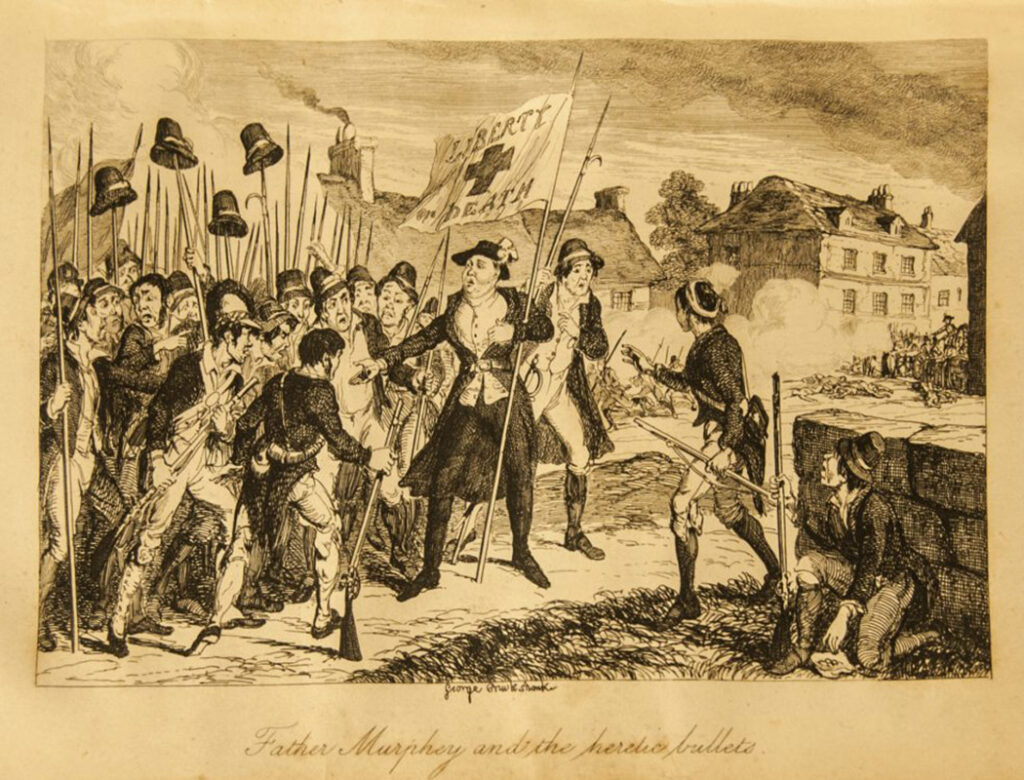
He notes that more than 10,000 people were killed, often in circumstances of great brutality, in struggle that unbleached barbarities on all sides which for some (echoed the historic events of 1641), for other were an effort to overthrow a polity that had provided a peaceful prosperous Georgian era for some, for many others a crowded life of poverty and neglect, which also saw the emergence of agriculture as a scientific industry in a country where so many lived off what was little more than gardening on a small haggard. The aftermath, leading as it did to the Act of Union, was an attempt to impose yet another form of government not from Dublin but from London, that would be continually challenged by many through the Victorian era, and into more recent days.
The year 1798 saw the emergence of a republican movement based on the majority”
For many readers though in this sweep of most enlightening chapters will be the last three, dealing with the causes, the consequences and, most importantly, going back to Pakenham and Flanagan as well as many other writers, later representation. What people thought had happened was quite as vital a matter as what had really passed.
The year 1798 saw the emergence of a republican movement based on the majority (as against the previous monarchist movements led by Irish traditional leaders) that became of increasing importance and well as the opposing move of unionism, summed up in the United Irishmen and the Orange Order, the early spirits of which are still with us, as the news stories in any one week will illustrate.
Quinn’s summary, so concise and compact, will clearly be of immense service, not only to students of history at all levels, but also to those still seeking to find an understanding that contents them of Ireland’s history. It deals too with the unhappy consequences of religious conflict, thankfully much reduced, but not fully done away with, today turned again through action and reaction, into new political movements, based on an imagined past to build an elusive future.
“Who fear to speak of Ninety Eight”: the balladeers sang around the streets the words of Trinity College scientist and positivist John Kells Ingram (whose true historical significance is one of the many matters that Quinn has to pass over in silence).
The various views of 1798 that were developed greatly depended, not so much on the events in Ireland, but on events elsewhere in 1775, 1789, 1832, 1848 and 1870, 1917 – the fear and admiration of revolutions elsewhere.
The answer must be maybe more people than one might imagine in the so very changed circumstances of present-day Ireland, where once again events in North America and across Europe are likely to shape the futures of our children and grandchildren.