Tracing Ireland’s forgotten desert saint
The antiquity of the Irish church is a historic curiosity. We truly know very little about how and when Christianity arrived on the shores of Ireland. But arrive it did, and we are left with a few highly stylised legends about how this came to be.
One of our earliest surviving pieces of written evidence about the provenance of the Irish church comes from the late Roman Empire. In his Chronicon, Prosper of Aquitaine records that Pope Celestine “ordained St Palladius and sent him as the first bishop to the Irish believing in Christ.” The particularity of the phrasing is crucial to our understanding. St Palladius was not dispatched to Meath to convert pagans, but to minister to those who were already credentes, ‘believers in Christ’. This terse reference from the continent tells us that in the early 5th century, Christian communities had already taken root among the Irish nation. But we don’t know who originally brought the faith to the North Atlantic. While St Patrick is famously credited with the task, the historic Patrick was likely a missionary of the late 5th century and was largely relegated to Ulster in the area around Armagh. The aforementioned St Palladius, who is frequently merged with St Patrick in the ancient annals, actually slightly predated him. St Finbarr, the princely missionary to Cork allegedly arrived even later, in the 6th century. So even with the knowledge we have of these early saints, the original foundations of the Irish church remain mysterious to us.
Enigmatic
Among the many enigmatic figures who populate the early Irish church, few are as intriguing, or as seemingly forgotten, as the man known as St Olan the Egyptian. His name appears in scattered traditions across southern Munster, particularly in the parish of Aghabullogue, Co. Cork, where the ruined church of Temple Olan and the famous Stone of St Olan still mark the verdant pastoral landscape. Little is known of the site itself though this is not unusual for Irish church ruins. However, what makes the site of Temple Olan different from most of these ruins is the ethnic origins of its alleged progenitor; unlike most early foreign missionaries to Ireland, St Olan is said to be Egyptian, and not from the more familiar points of origin like Wales, Cornwall, and Brittany. That of course begs the question: If St Olan was truly an Egyptian, when and how did this monk find his way across the known world?
In the Vita Sancti Finbar, St Finbarr is described as having studied under monks who had trained in the famous Scetis monastery in Egypt”
No hagiography or early synod survives to clarify his story. What remains are the folk whisperings of a truly remarkable, but altogether unprovable, legend. St Olan was said to be the companion of St Finbarr of Cork, meeting him during the founding of the monastery at Gougane Barra. In some oral accounts of the legend, he is regarded as the equal of St Finbarr; in others he served as his bell-ringer. In the Vita Sancti Finbar, St Finbarr is described as having studied under monks who had trained in the famous Scetis monastery in Egypt. The dating for the lifetime of St Olan is therefore dependent on the chronology of St Finbarr, which is highly contested amongst historians. Some place St Finbarr in the 6th century, in a time where the church had been already firmly planted in the eastern shore. Alternatively, the archaeological evidence from the city of Cork suggests a missionary presence in the 5th century, which would make St Finbarr, and thus St Olan, contemporaries of Sts Patrick and Palladius.
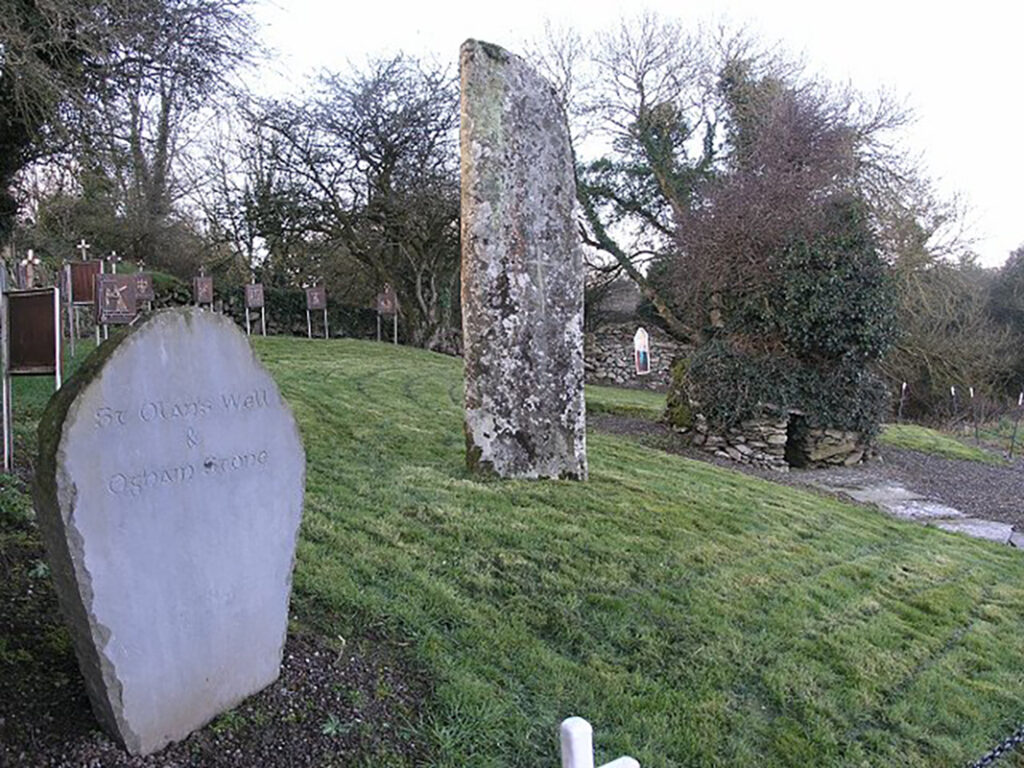
St Olan’s standing stone near Aghabullogue, one of the few pieces of material evidence of his life, is known locally as the ‘Stone of Olan’ and has long been believed to possess healing powers. Traditionally, locals would circle it while praying for deliverance from various illnesses which haunted rural Ireland in the familiar past. There is an ancient inscription on the stone, written in the Ogham alphabet, which suggests that it predates the 7th century, though the exact reading of this inscription is disputed. Other written tradition grants some reasonable, albeit limited, insight into Olan’s folk legend in the Irish church. His name is found in Martyrology of Donegal, rendered in various ways: Eolang, Eulang, or Eulogius. The final rendering of his name is the most tantalising, as we know that this was a name used by Copts in the 5th and 6th centuries, as the bishop of Alexandria at the time also bears this name.
Connection
Beyond these very terse references, nothing else is known of St Olan, or of his foregone connection to Egyptian monasticism. However, the ancient character of the Celtic church is curious and sui generis because of its peculiar character. It does not, in its earliest form, mimic the more familiar Latin church found in Britain or on the continent at this time, which were traditionally built around episcopal authorities and the metropolitan governance of the church. Rather, the Irish Church modelled itself after the Egyptian model of monasticism.
The Martyrology notes the existence of ‘seven monks of Egypt’ who reside in that locale”
There are a couple sources to support this connection. One is the writings of the Gallic monk St John Cassian, who visited Wadi el-Natrun in Egypt in antiquity. Another is a certain place known as ‘Disert Uilaig’, found in the 8th century Martyrology of Oengus the Culdee. Very little is distinctive about the place, as it likely stood among the hundreds of Irish hermitages of the Dark Ages. What is more, there is no clear agreement on where this Disert Uilaig was located geographically. However, the Martyrology notes the existence of ‘seven monks of Egypt’ who reside in that locale. Additionally, a century prior, in the Antiphonary of Bangor, another monastic author makes notes of “a house full of delight. Built on the rock, and indeed, a true vine transplanted from Egypt”. While the latter could be interpreted allegorically, the former is unequivocal: there was an Egyptian monastic presence in Ireland deep in antiquity that has largely been washed away by time. Therefore, we should note that the case of St Olan – specifically, his Egyptian-ness – does not stand alone in the annals of the Irish church.
The historical personality of St Olan remains elusive. What is of note is that the origins of the Irish church are far richer and more mysterious than the abridged, but highly celebrated, narrative of a uniform conversion. If we cannot fully reconstruct Olan’s life, or confirm the precise nature of his Egyptian heritage, the enduring traces of his memory, his stone and shire, and the hagiographical whispers of his memory all attest to his world, in which Ireland was not isolated from the burgeoning Christendom of antiquity, but quietly connected to the wider currents of monasticism.
Dr D.P. Curtin is a Psychologist and Translator. He has published articles with Catholic
Exchange, Where Peter Is, Catholic Stand, and Public Orthodoxy, as well as a large number of works from the early and medieval Church.