Doctor of the Church: An Introduction to Saint John Henry Newman, by Michael Rear, preface by His Majesty King Charles III (Gracewing, £12.99 / €15.00)
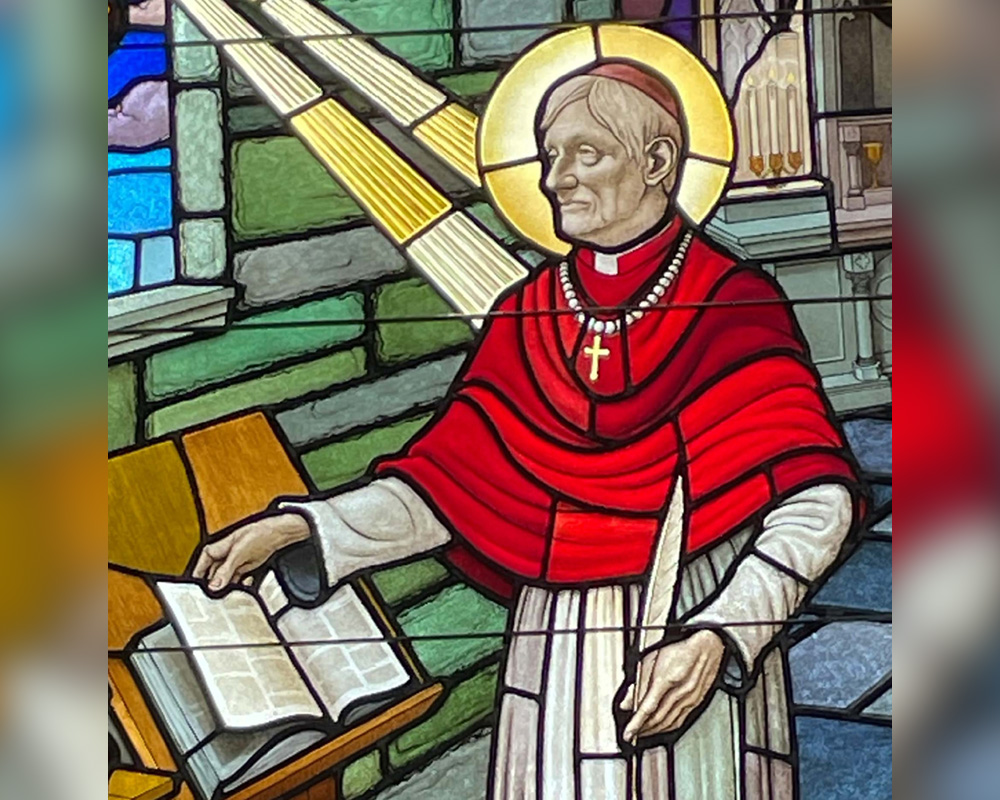
On the feast of All Saints, November 1, 2025, Pope Leo XIV conferred the title of Doctor of the Church on St John Henry Newman, thus ranking him with thirty-seven other luminaries of the faith, such as Thomas Aquinas, St John of the Cross, and Teresa of Avila.
This book is issued to mark the final elevation of an already admired man of the nineteenth century. It is intended for those who wish to inform themselves about Newman, but hesitate to take up the existing biographies, which often make a long and complicated read for many. Michael Rear, a Catholic priest who lives in retirement at Walsingham, the much visited shrine of Our Lady in North Norfolk.
The book carries as a preface a most interesting contribution by King Charles, in the form of a lecture ‘The Harmony of Difference’”
In these pages he provides what might be called the heart of Newman’s life and teaching in a form which is at once valuable and complete enough to grasp all that is essential in the saint’s life.
The book carries as a preface a most interesting contribution by King Charles, in the form of a lecture “The Harmony of Difference” which he gave in Rome on the eve of Newman’s canonisation on October 12, 2019.
This is of particular interest as the king’s comments attempt to point up the essential continuity of Newman’s search for the truth at the heart of his religion that he followed from his Anglian years into his old age as a revered, if sometimes controversial, figure in the Catholic Church
He deals with Newman’s development as a Christian in some eight stages of his life and achievement from his devout childhood to being recognised as a doctor of the Church. In addition, he provides samples of Newman’s hymns and prayers for daily use.
Newman, of course, is of great interest to many in Ireland because of his involvement not only with our island but with Irish people in England. Rear notes that in Newman’s early years Catholicism was of minority concern, being effectively reduced to the few families, mainly in the north of England, who had retained their religious beliefs through long years of persecution and rejection.
Influx
What changed Catholicism to a certain extent in England by the end of Newman’s life was the influx of Catholics from Ireland after the Famine, and later of Italians and Germans, fleeing from the political and social upheavals of their native countries.
On Newman’s time in Ireland, Rear is not perhaps as explicit as he might have been about the difficulties Newman faced dealing with the Irish bishops. When they thought about “a Catholic university for Ireland” they had in mind something like Louvain, that main purpose would be the training of the clergy rather than tertiary education for the laity. When Newman spoke about university education he on the other hand had in mind what his beloved Oxford had provided for originally, educated Catholics who would change the world by their beliefs as laymen.
Ireland was an unhappy experience for Newman. But he faced many such challenges in his life. There was his crisis of faith that took him from the Tractarian or High Church movement, into the Catholic Circuit.
Then there was that great moment of his treatment by Charles Kingsley, “a muscular Christian” of a particular kind who distrusted celibacy in the Church.
The importance of the need for the individual Christian to follow his conscience, albeit an informed conscience, at all times, that was perhaps Newman’s greatest insight”
Their differences lead to the writing of the Apologia Pro Vita Sua. It is often overlooked that this book is a classic of Victorian literature not just Catholic apologetic. Certainly, it was classed along with the works of Mathew Arnold and John Ruskin in the courses I took at my American university.
Michael Rear gives in a clear and well-balanced narrative everything one would want to know about Newman and his influential ideas, discussing the difficulties he had not only with his own conscience, but with English bishops and the authorities in Rome. But it was the importance of the need for the individual Christian to follow his conscience, albeit an informed conscience, at all times, that was perhaps Newman’s greatest insight into the essence of religious faith, a fact that was recognised at the time of Vatican II. It remains today as important as ever when efforts are made to recruit faith to secular causes in denial of individual conscience.