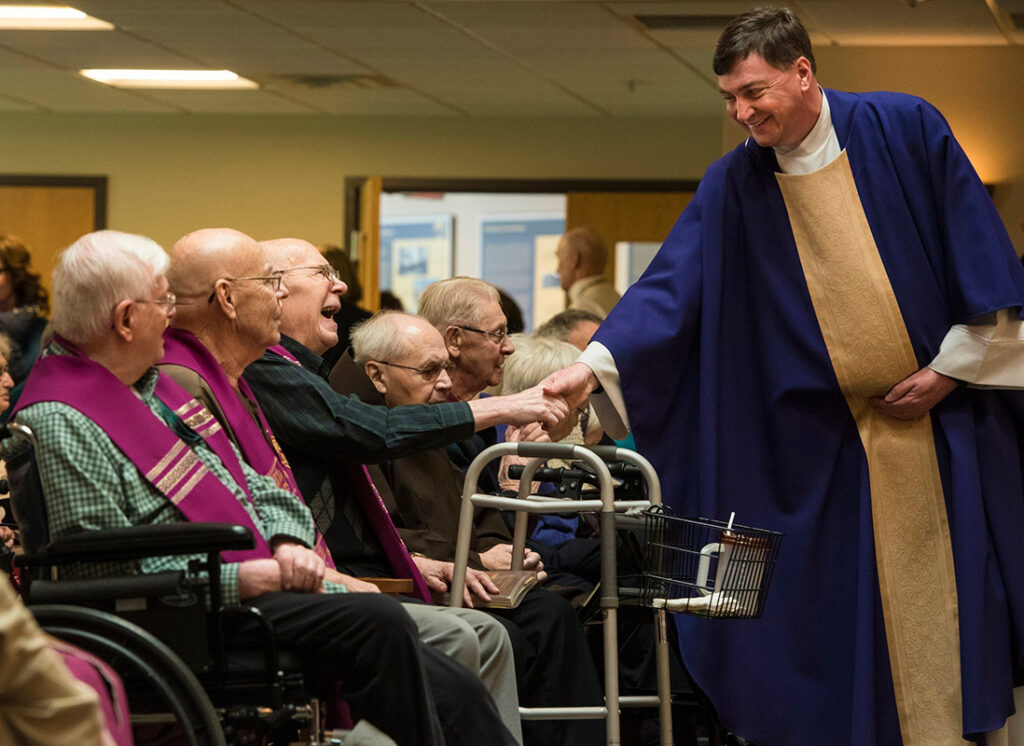
A parochial response to combating loneliness in nursing homes
The new year provides a unique opportunity to reflect upon who our neighbours might include. Those living around us immediately spring to mind, while those living in nursing homes are rarely considered unless they are family members or close friends. Yet loneliness is one of the biggest challenges facing nursing home residents.
Once a person enters long-term care, their links to friends, social outlets and the wider community are quickly severed. One might ask how could residents be lonely when they have staff and other residents to keep them company? In reality it can be difficult sometimes to form new relationships and while staff are constantly interacting with residents to address their care needs, they may not have the time to sit and chat for extended periods.
As a befriender and advocate with the Friends of the Elderly and Alone, I know how befriending residents on a regular basis can break through the isolation and lead to the development of enriching relationships for both the residents and the befriender. I often remark upon my good fortune to have so many wise and caring friends. The problem is there will never be enough volunteers available through the established agencies to befriend residents in nursing homes.
I believe that parishes throughout the length and breadth of Ireland are uniquely placed to fill this void. A framework to achieve this goal may include the following:
Step 1: Awareness
The first stage is to be aware of the nursing homes in the parish’s catchment area. The bed complement, type of accommodation and ownership are useful characteristics to know. For example, the residents in transitional or step-down facilities will typically be transient and harder to build befriending relationships unlike residents in long-term care facilities or the traditional nursing home model as we know it. That said, a quick “hello” is always appreciated by residents convalescing.
Approximately 80% of nursing homes are privately owned while the remainder are owned by the HSE. The buck stops with the Person In Charge (or PIC) -sometimes referred to as the director of nursing who has overall responsibility for the home and is accountable to the Health Information and Quality Authority (HIQA), the regulator. Beyond this person, the management hierarchy is different in private homes to that in the HSE. This distinction is good to know should engagement prove challenging.
Step 2: Leadership/co-ordination
The parish’s pastoral council is probably the most appropriate forum to guide the nursing home befriending project. Perhaps a subgroup could be formed or members identified who would formally contact the nursing home’s PIC to discuss the befriending needs of residents.
In an ideal world, it is the residents in these homes who should be consulted initially but this may not be possible because of General Data Protection Regulation (GDPR), security, or other constraints. In any event the chairperson of the residents committee and the chairperson of the relatives council (most homes have one or the other or both or should have!) will be key players in co-ordinating feedback from residents. Also, if parishioners have loved ones in the relevant homes, they could also act as befriending champions.
Step 3: Challenges & mitigation
While most homes will welcome community engagement, their overriding priority will be to protect residents. The biggest stumbling block is going to be garda vetting/security screening which is a mandatory requirement for staff and long-term visitors. If there is buy-in from the home and a befriending partnership agreed with the parish, the home could assist with garda vetting. Nursing Homes Ireland (NHI), the representative body for the private and voluntary nursing home operators coordinates garda vetting for its members and may be amenable to extending this facility to befriending volunteers. The diocese also has arrangements in place for screening other volunteers which could be extended to befrienders.
Bear in mind also that even with the best will in the world problems are inevitable”
Other challenges include relationship building and consistency in scheduling visits. As people in the older age group, we are driven by the rigors of routine. If somebody is telling us they are going to call in for a chat every Wednesday around three and don’t turn up or call at eleven instead, relationships become quickly strained. Letting the person or the home know of any changes in advance is always the best policy.
Bear in mind also that even with the best will in the world problems are inevitable. I don’t know how many times I’ve navigated the M50 in the thick of traffic to find the person I’m visiting is at the hospital or not up to chatting. Befrienders have to be patient and thick skinned.
Step 4: Quick wins
There are quick wins that can be achieved with very little effort. Finding out how many former parishioners are now living in local nursing homes or how many parishioners have loved ones in nursing homes and the type of supports they need is relatively easy to ascertain.
For those of us who are in local clubs and associations it is important to make sure that when a member enters long term care, we continue to visit them, ensure they receive updates and newsletters and include them in outings where feasible. A bridge club for example might decide to hold a session in the local nursing home of one of its members on the odd occasion. Ensuring that residents are prayed for regularly in parish services also helps to maintain links and provide a sense of belonging particularly through parish web cam and other services. It is also a welcoming gesture for residents who may not be parishioners.
Step 5: Other considerations
An alternative approach to a parish led befriending initiative would be for parishioners to join organisations such as Friends of the Elderly or Alone and volunteer through them. They also provide training and ongoing support for volunteers which are vital. The downside is that not all organisations providing befriending services have national reach or may focus their resources on befriending in the community rather than in nursing homes. There can also be significant delays in completing the recruitment process. That said every effort should be made to investigate, collaborate, and utilise complementary services already in existence where possible. The compilation of a local services guide would also be helpful if not already available.
In the final analysis however a parish led befriending initiative may be a more flexible and agile arrangement, driven by a desire to fulfil the second greatest commandant: love of neighbour.
Tony Carroll is an advocate and befriender. His book Cold Porridge, Broken Promises and a Missing Dog – Notes from nursing home advocacy can be ordered at https://www.buythebook.ie and selected bookshops. It is also available as an eBook on Amazon Kindle. All profits are being donated to Alone.