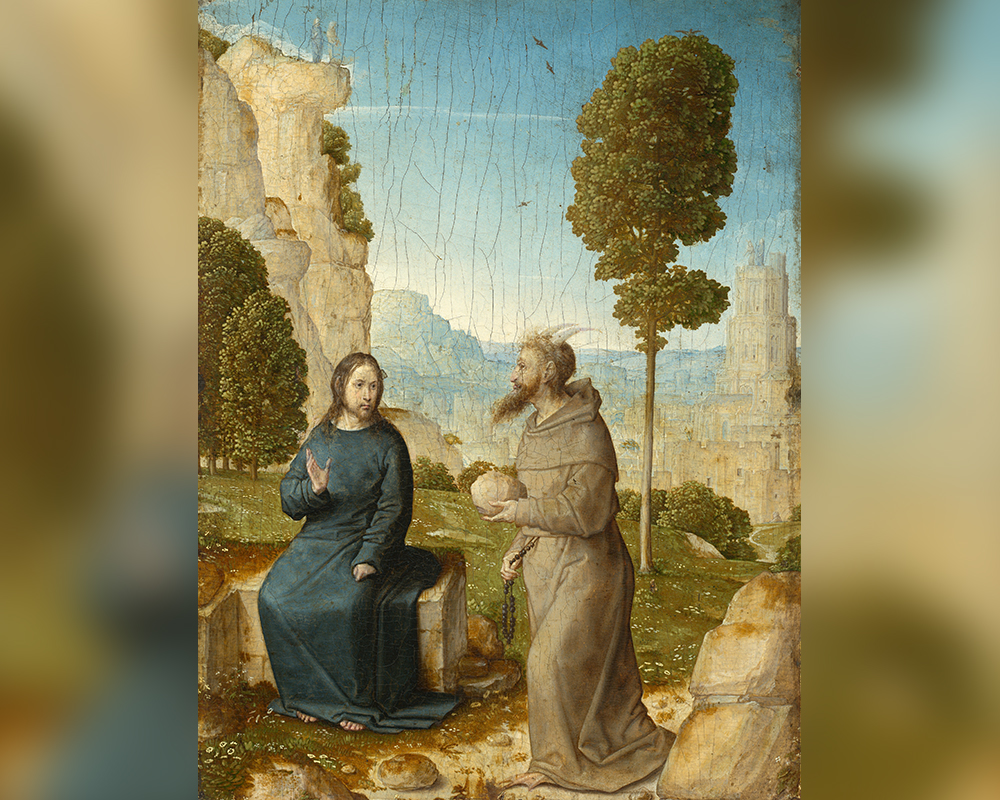
Jesus was led up by the Spirit into the wilderness to be tempted by the devil
Matt. 4:1 Then Jesus was led up by the Spirit into the wilderness to be tempted by the devil.
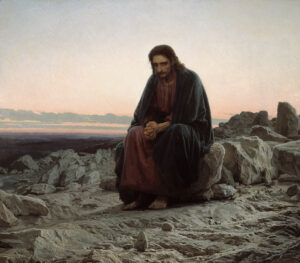
Matt. 4:2 He fasted forty days and forty nights, and afterwards he was famished.
Matt. 4:3 The tempter came and said to him, “If you are the Son of God, command these stones to become loaves of bread.”
Matt. 4:4 But he answered, “It is written, ‘One does not live by bread alone, but by every word that comes from the mouth of God.’”
Matt. 4:5 Then the devil took him to the holy city and placed him on the pinnacle of the temple,
Matt. 4:6 saying to him, “If you are the Son of God, throw yourself down; for it is written, ‘He will command his angels concerning you,’ and ‘On their hands they will bear you up, so that you will not dash your foot against a stone.’”
Matt. 4:7 Jesus said to him, “Again it is written, ‘Do not put the Lord your God to the test.’”
Matt. 4:8 Again, the devil took him to a very high mountain and showed him all the kingdoms of the world and their splendour;
Matt. 4:9 and he said to him, “All these I will give you, if you will fall down and worship me.”
Matt. 4:10 Jesus said to him, “Away with you, Satan! for it is written, ‘Worship the Lord your God, and serve only him.’”
Matt. 4:11 Then the devil left him, and suddenly angels came and waited on him.
Initial observations
The “Temptation of the Son of God” is found in four documents in the New Testament: in the Synoptic Gospels (Mark 1:12-13, Matthew 4:1-11, Luke 4:1-13) and in Hebrews 2:10-18 and 4:15-16. Mark’s account is quite minimal. Matthew and Luke are very alike, although Luke has a different order (bread, mountain, Temple). The temptations are a literary anticipation of the final disputes between Jesus and the Jewish leadership (21:23-22:46). The hidden conflict is really God versus Satan. What is at stake throughout is Jesus’ vision of the Kingdom of God.
Kind of writing
(i) Commonly in ancient accounts, the “hero” is tested in some fashion, before undertaking his heroic role. The test usually foreshadows realities to follow. It is not, therefore, a story about temptation to this or that moral deviation, but rather a testing of identity and role. Given that Jesus is the Son of God, what kind of Son of God will he be?
(ii) Our story resembles the typical manner of “robust” dispute among rabbis of the period. These often argued by firing texts from Scripture at each other.
(iii) It is a symbolic tale, with a deep, non-literal meaning. (This helps us deal with the impossibility of seeing all of the kingdoms from one mountain and with the mild absurdity of Satan “whisking” Jesus hither and thither.)
Old Testament background
Often in the New Testament (and especially in Matthew’s Gospel), it is helpful to keep an eye on any possible Old Testament background to a particular story or scene. “The Temptation of the Son of God” is a good example of this. The biblical citations in the story all come from Deuteronomy 6-8. They thus come from that part of the Pentateuch (the first five Books of the Old Testament) where the people of Israel are about to enter the promised land after forty years in the desert and Moses reflects on their experience of temptation and failure during that very period.
Even the words used in Matthew reflect Deuteronomy: “led”, “forty”, “wilderness”, “son of God” (meaning Israel), and “test”. There is an implied comparison: historical Israel fails the test in the desert and emerges as unfaithful to the covenant, whereas Jesus, the Son of God, comes through successfully and models the fidelity God desires from us. The second background in the Hebrew Bible is, of course, Psalm 90.
Jesus also recapitulates the temptations of Israel in the desert: hunger (Exodus 16); testing God (Exodus 17) and idolatry (Exodus 32).
They tested God in their heart by demanding the food they craved. They spoke against God, saying, “Can God spread a table in the wilderness? Even though he struck the rock so that water gushed out and torrents overflowed, can he also give bread, or provide meat for his people?” (Psalm 78:18–20)
New Testament foreground
The testing recounted in this Gospel exemplifies challenges faced by Jesus in his ministry. It also anticipates the final testing around the cross. The question of “what kind of Son of God?” comes back vociferously at the crucifixion.
Then two bandits were crucified with him, one on his right and one on his left. Those who passed by derided him, shaking their heads and saying, “You who would destroy the temple and build it in three days, save yourself! If you are the Son of God, come down from the cross.” In the same way the chief priests also, along with the scribes and elders, were mocking him, saying, “He saved others; he cannot save himself. He is the King of Israel; let him come down from the cross now, and we will believe in him. He trusts in God; let God deliver him now, if he wants to; for he said, ‘I am God’s Son.’” The bandits who were crucified with him also taunted him in the same way. (Matthew 27:38-44)
Finally, the sequence in Matthew (different from Luke’s) may anticipate a future pattern in this Gospel:
(i) the multiplication of the breads (Matthew 14:13-21 “bread”).
(ii) the story of the transfiguration (Matthew 17:1-13 “temple”).
(iii) the end of the Gospel, on a mountain (Matthew 28:16-20 “mountain).
Public domain.
St Paul
So let the one who thinks he is standing be careful that he does not fall. No trial has overtaken you that is not faced by others. And God is faithful: He will not let you be tried beyond what you are able to bear, but with the trial will also provide a way out so that you may be able to endure it. (1 Corinthians 10:12–13)
Guard against self-deception, each of you. If someone among you thinks he is wise in this age, let him become foolish so that he can become wise. For the wisdom of this age is foolishness with God. (1 Corinthians 3:18–19)
Brief commentary
Verse 1 The desert is more a biblical motif than geography exactly (Deuteronomy 8:2). Being tested was part of Israel’s relationship with God—in reality a testing of their fidelity. The wilderness evokes Israel’s experience in the wilderness.
Verse 2 Forty is an evident echo of the years in the desert (Deuteronomy 8:2) and also of the “heroic” fasts of Moses (Deuteronomy 9:18) and Elijah (1 Kings 19:8). Fasting, as such, was a practice in Matthew’s community in Antioch—see 6:16-18 and 9:14-15.
Verse 3 The devil is here called the “tester”. Thus, ironically the purposes of the Holy Spirit are being fulfilled. “Son of God” echoes a title of Israel, as a whole, in the Old Testament. The further background here is the story of the manna in the desert. Compare Psalm 78:18-20 above. Will this Son of God come through the testing? Some Jewish expectations identified the Messiah with a repetition of manna in the desert.
Verse 4 The quotation comes from Deuteronomy 8:3, where it gives the reason for the manna in the desert. Providing bread for the hungry is also a teaching in Matthew: 6:11; 14:13-21; 15:32-39; 25:31-46.
Verse 5 The “holy city” is a rare reference, with messianic overtones. The architectural element is called a “wing” in Greek, perhaps providing a link with the citation from Psalm 91:4.
Verse 6 The quotation comes from Psalm 91:11-12. The tempter learns quickly to use Scripture against someone for whom it is the Word of God. The launching of textual “missiles” would have been familiar from rabbinic debates.
Verse 7 Jesus’ response comes from Deuteronomy 6:16. Again, in the background lies Israel’s (failed) testing in the desert. Cf. Matthew 26:36-53.
Verse 8 “To a very high mountain” is added by Matthew and underlines the link with Moses. Again, although some echo of Moses’ panoramic view of the Holy Land may be intended (Deuteronomy 34:1-4), it is not geography which counts. For the real mountain of authority, see Matthew 28:18.
Verse 9 “Homage” to Jesus himself frames this whole Gospel, from the Magi to the disciples on the mountain in chapter 28.
Verse 10 Away with you, Satan! A very interesting phrase, which Matthew alone places here, thus making a dramatic link with the same phrase (Matthew 16:23), when Peter misunderstands radically the kind of Messiah Jesus intended to be: (lit.) Away with you, behind me, Satan!
Verse 11 “Angels” indicate obliquely that some experience of the transcendent took place. Cf. Matthew 28:2.
Pointers for prayer
- In today’s gospel Jesus is enticed to gratify his own needs, or to perform some spectacular act in public. He rejects the temptation because he chooses commitment to his mission and dependence on his Father over any immediate gratification. We can all be tempted to go for some immediate satisfaction…but is that where true happiness lies? Have you found that sometimes it can be more life-giving to say “no” to your immediate desires for the sake of some long-term goal? What are the goals, aims, values, which inspire you in this way?
- One way of looking at this gospel is to say that Jesus went into the desert to face his demons. We all have demons we need to face—compulsions, fears, prejudices, anger, and urges that lurk within. It is in facing our demons that we find a way to live a fuller life. Can you recall a time when you grew through facing a ‘demon’ in this way?
Prayer
Lord our God, in every age you call a people to hear your word and to do your will.
Renew us in these Lenten days: washed clean of sin, sealed with the Spirit and sustained by your living bread, may we remain true to our calling and, with the elect, serve you alone.
We make our prayer through our Lord Jesus Christ, who lives and reigns with you in the unity of the Holy Spirit, God for ever and ever. Amen.
Crosiers.
Thought for the day
The temptations of Jesus are not at all temptations to this or that sin but rather fundamental options which matter for the direction of his life. Jesus was tempted in the course of his ministry to choose other ways of being God’s prophet, the Messiah or anointed one. In a less obvious way, we too can be attracted by choices which can shape the way our life unfolds. We ask ourselves, what do I live on? What’s my true goal? Where is my nourishment? The human, no less than the Kingdom, is more than food and drink. Only the Word of God truly nourishes and illuminates.
Prayer
Lord, in you we live and move and have our being and we thank you. Help us to place you and your Word at the heart of all we do and, even more, at the core of who we are.
Through the obedience of one man many will be made righteous
Rom 5:12 So then, just as sin entered the world through one man and death through sin, and so death spread to all people because all sinned–
Rom 5:13 for before the law was given, sin was in the world, but there is no accounting for sin when there is no law.
Rom 5:14 Yet death reigned from Adam until Moses even over those who did not sin in the same way that Adam (who is a type of the coming one) transgressed.
Rom 5:15 But the gracious gift is not like the transgression. For if the many died through the transgression of the one man, how much more did the grace of God and the gift by the grace of the one man Jesus Christ multiply to the many!
Rom 5:16 And the gift is not like the one who sinned. For judgment, resulting from the one transgression, led to condemnation, but the gracious gift from the many failures led to justification.
Rom 5:17 For if, by the transgression of the one man, death reigned through the one, how much more will those who receive the abundance of grace and of the gift of righteousness reign in life through the one, Jesus Christ!
Rom 5:18 Consequently, just as condemnation for all people came through one transgression, so too through the one righteous act came righteousness leading to life for all people.
Rom 5:19 For just as through the disobedience of the one man many were made sinners, so also through the obedience of one man many will be made righteous.
Initial observations
Our reading, though challenging, is quite appropriate for the start of Lent and especially in the light of the first reading from Genesis.
Context in the community
The letter to the Romans is big in every sense. Nevertheless, the persuasive outline is relatively clear. The context is division in the Roman house churches between disciples of Jewish and Gentile backgrounds. The issue at stake resembles the issue in Galatians: how much of the Jewish Law should be retained and followed? It is evident from the letter, that the community itself is divided into the “weak” and the “strong.” Who these are becomes clear only in the final section, 12:1-15:6. However, in 1:16-4:23 and in chapters 9-11, it is evident that each side looks down upon the other (the word despise is used). Such a division in the capital is harmful and goes clean against Paul’s vision of the union of Jew and Gentile in Christ crucified and risen.
Kind of writing
In Romans 1-4, Paul deconstructs any superiority or boasting by pointing out that both sides are equally adept at sinning and both sides stand in need of grace and faith. In Romans 5-8, Paul again deconstructs attitudes of superiority but this time by pointing out how much they both share indistinguishably in Christ. The gifts are listed chronologically: faith and salvation (5), baptism (6), the moral struggle (7) and the capacity to call God “Abba” by the power of the Holy Spirit and our unshakeable hope in Christ (8). In Romans 5, Adam is summoned up to show the universality of grace in Christ. The sin of Adam is evoked to underline the contrast between Adam’s sin and the grace of Christ (“all the more so”). The comparison of the beginning, Adam, and the end, Christ, (protology and eschatology) is typically Apocalyptic. Such patterning underpins purpose, even when the end (grace) so far outstrips the beginning (sin). Cf. 1 Cor 15:21-23, 45-49 below.
NB: in Romans 5:12-19, Paul interrupts himself. The thought in v. 12 is suspended and continued eventually only in v. 18. The long suspension of vv. 13-17 makes the passage hard to grasp as Paul considers on the one hand sin, death and the Law and on the other hand grace, justification and life. Cf. Galatians 3.
Related passages
For since death came through a man, the resurrection of the dead also came through a man. For just as in Adam all die, so also in Christ all will be made alive. But each in his own order: Christ, the first fruits; then when Christ comes, those who belong to him. (1 Cor 15:21–23)
So also it is written, “The first man, Adam, became a living person”; the last Adam became a life-giving spirit. However, the spiritual did not come first, but the natural, and then the spiritual. The first man is from the earth, made of dust; the second man is from heaven. Like the one made of dust, so too are those made of dust, and like the one from heaven, so too those who are heavenly. And just as we have borne the image of the man of dust, let us also bear the image of the man of heaven. (1 Cor 15:45–49)
Brief commentary
Verse 12 Both sin and death are universal—not because Adam sinned but because all have sinned (pace Augustine!).
Verse 13 Even though there was no Law forbidding transgression there was sin — a kind of spiritual force, causing death. Cf. Gal 3:19-29.
Verse 14 Death (and hence sin) reigned in the time between Adam and Moses, that is, even when there was no Torah.
Verse 15 The second Adam resembles the first in terms of universality. They differ strikingly in the quality of their effects: grace far, far surpasses transgression. Paul’s style is “all the more so” and the content is the astonishing gracious gift, repeatedly affirmed and insisted upon.
Verse 16 Although Adam and Christ resemble each other in function, the difference is greater still: after one sin came judgment, after many transgressions came justification (“right relationship”). Congruence takes you only so far.
Verse 17 The contrast continues in the consequences: death versus abundance of grace, gift of righteousness (“right relationship”) and life. The “how much more” approach places all the emphasis on our new situation in Christ.
Verse 18 At last, v. 12 is resumed: the universality of need (illustrated in sin and death) is matched by the universality of grace (righteousness and life) in Christ. “Obedience” refers to Jesus’ faithfulness — cf. Rom 3:21-26.
Verse 19 A final and, we may hope, relatively plain summary of vv. 12-18.
Pointers for prayer
- The abundance of grace: when did I become aware God’s greater love?
- All of us are put into right relationship — a pure gift, received in gratitude.
Prayer
Loving and ever faithful God, no words of ours can express the depth of your gifts of grace and life in Christ, so loving, so free, so abundant. May our gratitude be expressed in our lives. Amen.
The tree of life also in the midst of the garden, and the tree of the knowledge of good and evil.
- 2:7 Then the Lord God formed man from the dust of the ground, and breathed into his nostrils the breath of life; and the man became a living being.
Gen. 2:8 And the Lord God planted a garden in Eden, in the east; and there he put the man whom he had formed.
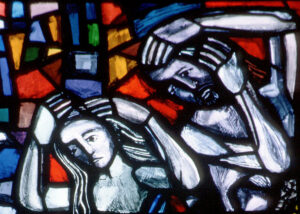
Gen. 2:9 Out of the ground the Lord God made to grow every tree that is pleasant to the sight and good for food, the tree of life also in the midst of the garden, and the tree of the knowledge of good and evil.
Gen. 3:1 Now the serpent was more crafty than any other wild animal that the Lord God had made. He said to the woman, “Did God say, ‘You shall not eat from any tree in the garden’?”
Gen. 3:2 The woman said to the serpent, “We may eat of the fruit of the trees in the garden;
Gen. 3:3 but God said, ‘You shall not eat of the fruit of the tree that is in the middle of the garden, nor shall you touch it, or you shall die.’”
Gen. 3:4 But the serpent said to the woman, “You will not die;
Gen. 3:5 for God knows that when you eat of it your eyes will be opened, and you will be like God, knowing good and evil.”
Gen. 3:6 So when the woman saw that the tree was good for food, and that it was a delight to the eyes, and that the tree was to be desired to make one wise, she took of its fruit and ate; and she also gave some to her husband, who was with her, and he ate.
Gen. 3:7 Then the eyes of both were opened, and they knew that they were naked; and they sewed fig leaves together and made loincloths for themselves.
Initial observations
Before taking on this reading, cast an eye over the chart on the second page. Lent this year offers the traditional sequence of Gospels as well as a large narrative arc in the Old Testament readings. Lent, Holy Week and the Easter Triduum are enriched by substantial biblical catechesis and the spine of this catechesis is the great narrative of the Hebrew Bible, taking us from Adam to the exile in Babylon. In Lent, the clear link with the Gospel is suspended. Nevertheless, on each Sunday we find themes shared across all three readings.
Kind of writing
Technically, this is an etiological tale, that is, a story which accounts for why things are the way they are.
Origin of the reading
The reading comes from the book of Genesis; more precisely, it comes from the so-called Prehistory, from creation to the tower of Babel (a very different sequence beings with the call of Abram in chapter 12). In terms of sources, our text belongs to the Yahwist source of the Pentateuch (using YHWH for God). The Yahwist always writes engagingly and very naturally, being totally unafraid to portray God in a touchingly human way.
Related passages
There are other creation stories in the Bible and not just the two familiar from Genesis. The Jewish tradition is never afraid to look at the same reality from widely differing perspectives. Here is an approximate list: Genesis 1:1-2:4a (the Priestly account; see also Psalm 104); Psalms 65:6-7; 74:12-17; 89:9-14; Job 9:5-14; 26:5-15; 38-39; Ezek 28:11-19 and many references in Second Isaiah (40-55).
Brief commentary
Verse 3:7 In a very plastic way, God shapes the human (= ’adam) from the soil (= ’adamah). This image of the creator as a potter was widespread in the Ancient Near East. In this account, humans are of lowlier origin than in 1:26-28, being moulded from the soil; and yet, there is greater intimacy with the creator in the Yahwist account. Cf. Remember that you fashioned me like clay; and will you turn me to dust again? (Job 10:9)
Verse 8 Eden is found a few times in the Bible: Gen 2:8, 10, 15; 3:23–24; 4:16;Isa 51:3; Ezek 28:13; 31:9, 16, 18; 36:35; Joel 2:3. The garden of YHWH is mentioned twice: Gen 13:10; Isa 51:3. The Greek translates garden as paradeisos (a Persian loan word indicating a pleasure park), whence our word paradise. The original Hebrew — simply a garden in Eden — has no particular connotation of pleasure.
Verse 9 Note that there are different kinds of trees in Eden. The tree of life is mentioned first and then ignored. The tree of knowledge becomes immediately more significant. “Good and evil” may be a merism, a figure of speech in which opposing realities denote the totality of something as such. Hence, the tree of knowledge of everything.
Verse 3:1 Crafty (= ‘arum) is a play of words on naked (= ‘arumim) in the preceding verse: And the man and his wife were both naked (Gen 2:25). As for the snake, cf. On that day the Lord with his cruel and great and strong sword will punish Leviathan the fleeing serpent, Leviathan the twisting serpent, and he will kill the dragon that is in the sea. (Isa 27:1)
Verse 2 Responding, the woman unfolds the ground rules for living in Eden.
Verse 3 Notice that Eve expands the original prohibition to include even touching the tree. There is a Talmudic dictum: whoever adds to a commandment subtracts from it!
Verse 4 The serpent contradicts God and, in a way, correctly, for Adam and Eve do not die immediately upon eating the fruit but only later.
Verse 5 The serpent ‘explains’ that God acted out of jealousy, thus impugning God’s motives. Note the contrast with Genesis 1: there, humans are God-like as a gift, but here they aspire to being God-like, as a sinful ambition. Eve’s ‘progress’ to sin is a climax: from the physical (eating), through the aesthetic (the eyes) to the intellectual (knowledge).
Verse 6 Delight is quite strong in Hebrew, indicating desire, appetite and sometimes even lust. “To make one wise”: early translations have “to look at”; perhaps both meanings are intended. Seeing and knowing are often linked in the Bible. Very quickly, the deed is done: Eve succumbs and Adam sins.
Verse 7 As the serpent correctly predicted, their eyes were indeed opened. Shame captures the consequent ambiguity of the achievement.
Pointers for prayer
- Each of us comes from the hands of God, who shapes us as a potter shapes the clay. We are in his hands.
- Can I see myself in the story, as my life has unfolded and evolved?
Prayer
God, we are the clay, you are the potter. You put before us life and death: help us by your grace to choose life again and again. Amen.
The Liturgy
Themes across the readings
Genesis as a “story of origins” is really the life of every human being, as we each move from innocence to knowledge and transgression, as we grow from being along to seeking companionship, as we learn to leave behind the security of childhood to accepting work, hardship, responsibilities and even death itself. Biblically, the story is really about us.
The second reading also reflects on origins but—and this is vital to Paul’s argument—from the perspective of faith in Christ. In Romans 5-8, Paul is outlining all the wonderful gifts which unite us in Christ: salvation, faith, baptism, the Holy Spirit, unshakeable love in Christ and so forth. On the way, he names our need for such great gifts: it is the human condition (going back symbolically to Adam in Romans 5) and it is the existential reality of each one (as we see in Romans 7). But all in the light of God’s victory in Christ. Paul moves from the cure, so to speak, to the disease, from Christ back to Adam. Only in the light of grace is our need truly apparent. That is why Romans 5 begins on such a positive note; in fact all of Romans 5-8 is found in nuce in the first five verses.
Finally, in the account of the temptations, Jesus himself illustrates the human condition of inclination to distorted options and the imposed freedom of having no choice but to choose. Naturally, we are only at the beginning of the ministry; the true battle over evil is at the end of that ministry, on the cross and in the resurrection.
The responsorial Psalm
Taking up the theme of sin, Psalm 51 (50) is the classic prayer of penance in the Bible. As often in the lectionary, the response helps identify our reaction to the first reading: Have mercy on us, O Lord, for we have sinned.
Sunday introductions
First reading
Genesis 2:7-9; 3:1-7
This “story of origins” is really the story of every human being and it is we who are portrayed in this story.
Second reading
Romans 5:12-19
If you listen carefully, you will notice that this is a very positive reading, contrasting our human condition before Christ with our state of grace, given so freely and so graciously.
Gospel
Matthew 4:1-11
The temptation story is not really about moral choices but about life-choices. As we read in Hebrews: Because he himself was tested by what he suffered, he is able to help those who are being tested. (Hebrews 2:18)
Weekday introductions
Monday 23 0February
St Polycarp, bishop and martyr
Leviticus 19:1-2,11-18
The Old Testament has a very high moral vision—expressed quite concretely and practically in this reading. Even though the text is very old, the teaching still speaks today. The examples given illustrate how we may be compassionate and just or, in a word, holy.
Matthew 25:31-46
Our Gospel is really more a tableau than a parable. Very simply, our choices have consequences.
Tuesday 24 February
Isaiah 55:10-11
The readings of Lent do indeed challenge, but they also encourage. Today we hear of God’s effective word, carrying out what it says. One way to listen might be to ask: has this been true for me in my life? Have I found the word of God an effective in my hearing and living?
Matthew 6:7-15
We often tend to separate worship and life. The prophets of old often pointed this out and Jesus does so again in the context of the Lord’s Prayer. Simps put, prayer from the heart, leads to forgiveness from the heart. The can be no separation.
Wednesday 25 February
Jonah 3:1-10
The ironic book of Jonah is serious about conversion as we see from the reaction not only of the humans, but even the beasts, herds and flocks!
Luke 11:29-32
There is more to the Gospel than a reference back to Jonah. Are we such a generation, unmoved and complacent?
Thursday 26 February
Esther 4:12, 14-16, 23-25
In today’s Gospel, Jesus teaches and encourages prayer of petition. Accordingly, in the first reading, Queen Esther makes a very moving and heart-felt prayer of petition.
Matthew 7:7-12
Jesus’ teaching on prayer can still take us by surprise — it all seems to simple. There is, however, really only one petition: may your kingdom come.
Friday 27 February
St Gregory of Narek abbot, doctor of the Church
Ezekiel 18:21-28
We can all change and repentance is a possibility always on the table. This is God’s desire for us — and our slightly threatening reading is finally positive.
Matthew 5:20-26
Following the best Jewish tradition, Jesus teaches that sin comes from the heart, from within. It is our attitudes which count, in every sense. The risk of any formal worship is to think that when we’ve done that, we’re done. No way, as Jesus illustrates in the appended parable.
Saturday 28 February
Deuteronomy 26:16-19
Against the background of the covenant, Moses outlines our side of the bargain. Notice that we are to keep his commands with our heart. The Gospel takes that a step deeper.
Matthew 5:43-48
Jesus demands of us a deeper and more costly love, taking us well beyond the conventional and even the natural.